

An astonishing discovery from the James Webb Space Telescope may rewrite our understanding of the Universe’s early years.
A galaxy named JADES-GS-z13-1, seen just 330 million years after the Big Bang, has been confirmed to emit a strong Lyman-α signal — something thought to be impossible at that time due to the surrounding cosmic “fog.” This challenges existing theories about when the first stars and galaxies reionized the Universe, suggesting it may have happened earlier or more unevenly than previously believed. The signal could hint at the presence of the Universe’s first stars or even a powerful black hole. Whatever the source, this galaxy is turning into a cosmic time capsule that could unlock major mysteries.
Peering Back to the Cosmic Dawn
One of the main scientific goals of the James Webb Space Telescope is to look farther back in time than ever before — into the early Universe, when the first galaxies were forming after the Big Bang. This effort has already led to the discovery of some of the most distant galaxies ever observed, thanks to surveys like the JWST Advanced Deep Extragalactic Survey (JADES). Because Webb is highly sensitive to infrared light, it allows astronomers to explore when and how these early galaxies formed, as well as their impact during a period known as cosmic dawn—the era when the first light from stars and galaxies began to transform the Universe.
Recently, scientists studying one of these early galaxies made a surprising discovery that challenges current theories about the Universe’s infancy.
The galaxy, named JADES-GS-z13-1, was spotted in images captured by Webb’s Near-Infrared Camera (NIRCam) and is estimated to be from just 330 million years after the Big Bang. Researchers estimated its distance by measuring its redshift — a way of determining how far a galaxy is based on how much its light has been stretched by the expansion of the Universe.

Credit: NASA, ESA, CSA, Brant Robertson (UC Santa Cruz), Ben Johnson (CfA), Sandro Tacchella (Cambridge), Phill Cargile (CfA), Joris Witstok (Cambridge, University of Copenhagen), P. Jakobsen (University of Copenhagen), Alyssa Pagan (STScI), Mahdi Zamani (ESA/Webb), JADES Collaboration
Confirming the Galaxy’s Redshift
The initial redshift estimate from NIRCam imaging was 12.9. To confirm this extraordinary distance, an international team — led by Joris Witstok of the University of Cambridge, the Cosmic Dawn Center, and the University of Copenhagen — conducted follow-up observations using Webb’s Near-Infrared Spectrograph (NIRSpec).
In the resulting spectrum (see image below), the redshift was confirmed to be 13.0. This equates to a galaxy seen just 330 million years after the Big Bang, a small fraction of the Universe’s present age of 13.8 billion years old. But an unexpected feature stood out as well: one specific, distinctly bright wavelength of light, identified as the Lyman-α emission radiated by hydrogen atoms.[1] This emission was far stronger than astronomers thought possible at this early stage in the Universe’s development.
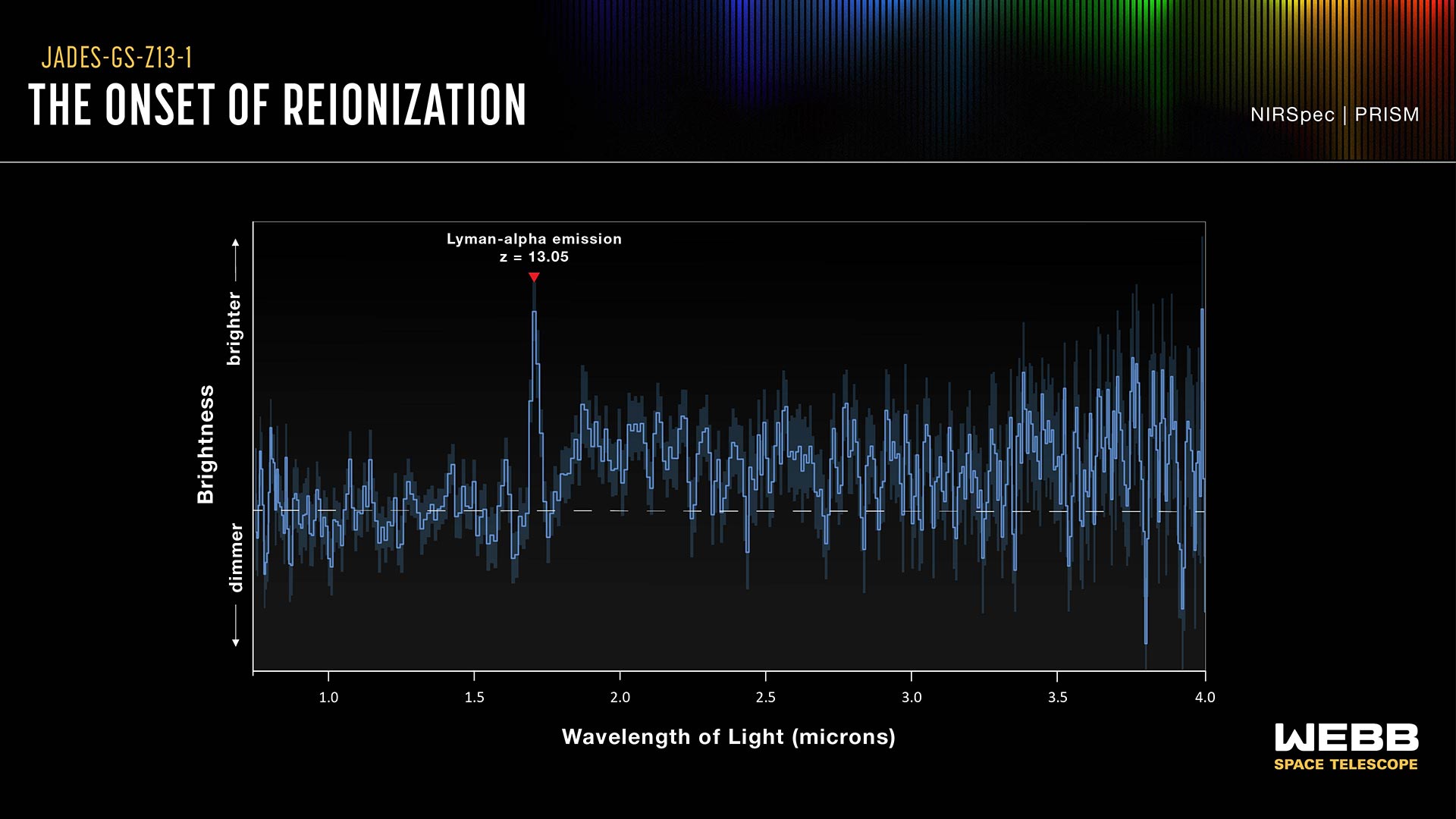
Credit: NASA, ESA, CSA, S. Carniani (Scuola Normale Superiore), P. Jakobsen (University of Copenhagen), Joseph Olmsted (STScI)
A Fog-Lifted Universe Too Soon?
“The early Universe was bathed in a thick fog of neutral hydrogen,” explained Roberto Maiolino, a team member from the University of Cambridge and University College London. “Most of this haze was lifted in a process called reionization, which was completed about one billion years after the Big Bang. GS-z13-1 is seen when the Universe was only 330 million years old, yet it shows a surprisingly clear, telltale signature of Lyman-α emission that can only be seen once the surrounding fog has fully lifted. This result was totally unexpected by theories of early galaxy formation and has caught astronomers by surprise.”

Challenging Theories of Reionization
Before and during the epoch of reionization,[2] the immense amounts of neutral hydrogen fog surrounding galaxies blocked any energetic ultraviolet light they emitted, much like the filtering effect of colored glass. Until enough stars had formed and were able to ionize the hydrogen gas, no such light — including Lyman-α emission — could escape from these fledgling galaxies to reach Earth. The confirmation of Lyman-α radiation from this galaxy, therefore, has great implications for our understanding of the early Universe.
Team member Kevin Hainline of the University of Arizona in the United States, says “We really shouldn’t have found a galaxy like this, given our understanding of the way the Universe has evolved. We could think of the early Universe as shrouded with a thick fog that would make it exceedingly difficult to find even powerful lighthouses peeking through, yet here we see the beam of light from this galaxy piercing the veil. This fascinating emission line has huge ramifications for how and when the Universe reionized.”
The source of the Lyman-α radiation from this galaxy is not yet known, but it is may include the first light from the earliest generation of stars to form in the Universe. Witstok elaborates: “The large bubble of ionised hydrogen surrounding this galaxy might have been created by a peculiar population of stars — much more massive, hotter and more luminous than stars formed at later epochs, and possibly representative of the first generation of stars”. A powerful active galactic nucleus (AGN),[3] driven by one of the first supermassive black holes, is another possibility identified by the team.
Webb’s Unexpected Window Into the Past
The new results could not have been obtained without the incredible near-infrared sensitivity of Webb, necessary not only to find such distant galaxies but also to examine their spectra in fine detail.
Former NIRSpec Project Scientist, Peter Jakobsen of the Cosmic Dawn Center and the University of Copenhagen in Denmark, recalls: “Following in the footsteps of the Hubble Space Telescope, it was clear Webb would be capable of finding ever more distant galaxies. As demonstrated by the case of GS-z13-1, however, it was always going to be a surprise what it might reveal about the nature of the nascent stars and black holes that are formed at the brink of cosmic time.”
The team plans further follow-up observations of GS-z13-1, aiming to obtain more information about the nature of this galaxy and the origin of its strong Lyman-α radiation. Whatever the galaxy is concealing, it is certain to illuminate a new frontier in cosmology.
This new research was published in Nature.
Explore Further:
- Webb Telescope Detects “Impossible” Light From the Dawn of Time
- Webb Spots Ancient Galaxy Breaking Through the Universe’s Primordial Fog
Notes
- The name comes from the fact that a hydrogen atom emits a characteristic wavelength of light, known as “Lyman-alpha” radiation, that is produced when its electron drops from the second-lowest to the lowest orbit around the nucleus (energy level).
- The epoch of reionization was a very early stage in the Universe’s history that took place after recombination (the first stage following the Big Bang). During recombination, the Universe cooled enough that electrons and protons began to combine to form neutral hydrogen atoms. Reionization began when denser clouds of gas started to form, creating stars and eventually entire galaxies. They produced large amounts of ultraviolet photons, which gradually reionized the hydrogen gas. As neutral hydrogen gas is opaque to energetic ultraviolet light, we can only see galaxies during this epoch at longer wavelengths until they create a “bubble” of ionized gas around them, so that their ultraviolet light can escape through it and reach us.
- An active galactic nucleus is a region of extremely strong radiation at the center of a galaxy. It is fuelled by an accretion disc, made of material orbiting and falling into a central supermassive black hole. The material crashes together as it spins around the black hole, heating to such extreme temperatures that it radiates highly energetic ultraviolet light and even X-rays, rivaling the brightness of the whole galaxy surrounding it.
Reference: “Witnessing the onset of reionization through Lyman-α emission at redshift 13” by Joris Witstok, Peter Jakobsen, Roberto Maiolino, Jakob M. Helton, Benjamin D. Johnson, Brant E. Robertson, Sandro Tacchella, Alex J. Cameron, Renske Smit, Andrew J. Bunker, Aayush Saxena, Fengwu Sun, Stacey Alberts, Santiago Arribas, William M. Baker, Rachana Bhatawdekar, Kristan Boyett, Phillip A. Cargile, Stefano Carniani, Stéphane Charlot, Jacopo Chevallard, Mirko Curti, Emma Curtis-Lake, Francesco D’Eugenio, Daniel J. Eisenstein, Kevin N. Hainline, Gareth C. Jones, Nimisha Kumari, Michael V. Maseda, Pablo G. Pérez-González, Pierluigi Rinaldi, Jan Scholtz, Hannah Übler, Christina C. Williams, Christopher N. A. Willmer, Chris Willott and Yongda Zhu, 26 March 2025, Nature.
DOI: 10.1038/s41586-025-08779-5
The data for this result were captured as part of JADES under JWST programmes #1180 (PI: D. J. Eisenstein), #1210, #1286 and #1287 (PI: N. Luetzgendorf), and the JADES Origin Field programme #3215 (PIs: Eisenstein and R. Maiolino).
The James Webb Space Telescope is the largest and most powerful space observatory ever launched. It is an international collaboration between NASA, the European Space Agency (ESA), and the Canadian Space Agency (CSA). ESA played a key role by providing the Ariane 5 launch vehicle and overseeing mission-specific launch adaptations, as well as procuring launch services through Arianespace. ESA also contributed critical onboard science instruments, including the versatile NIRSpec spectrograph and half of the mid-infrared instrument MIRI, developed by the MIRI European Consortium in collaboration with NASA’s Jet Propulsion Laboratory and the University of Arizona. Webb is designed to explore the Universe’s earliest galaxies, stars, and planetary systems with unprecedented clarity.
Never miss a breakthrough: Join the SciTechDaily newsletter.
Follow us on Google and Google News.
7 Comments
Why is the reference to the “Big bang theory” always spoken of as fact. Doesn’t the name show that it is just a theory. Until someone proves it as fact please be certain to point out it is “only” a theory.
Bingo.
The word “theory” is used differently in science than in everyday language.
Theory in science is an idea that has had several confirming evidences in nature.
Just below a scientific theory in terms of rigor is a “hypothesis”. A hypothesis is an idea that is well defined, and (very importantly) an idea that can be tested with actual experiments. This is what is known as “falsifiability” – a hypothesis that cannot be falsified by testing is not a valid scientific hypothesis. How is the hypothesis tested? Well, the hypothesis must make predictions that follow logically from the hypothesis, and then scientists can go and try to verify whether or not those evidences are actually present in nature.
The way science works is that a scientist first comes up with a hypothesis. Then that scientist also works out the predictions of the hypothesis. After that multiple scientists perform experiments to verify the predictions. A hypothesis that has survived multiple such attempts is called a theory.
Now, you may say, what is a fact in science? Scientists are skeptical fellows, and they always are trying to test the hypothesis or theory. Any time an experiment fails, the whole hypothesis / theory must be discarded.
Typically, though, not all of the theory need to be thrown away. Newton’s laws of motion survived many experiments. Until someone tried to use Newton’s laws on very small objects and on objects moving very close to the speed of light. In those cases, Newton’s laws fail – but those laws still work for everyday objects. New theories (Quantum and General Relativity) had to be invented for those extreme cases where Newton’s laws failed. In the meantime, Newton’s laws are perfectly good for use in constructing building and flying planes.
Why is Big Bang Theory (BBT) a theory? Because it made many predictions, and evidence from nature confirm those predictions. One such prediction is the Cosmic Microwave Background Radiation (CMBR).Another is the relative abundance of elements in the universe.
Any replacement of BBT must explain CMBR and relative abundances.
It is highly likely that parts of BBT that make those predictions are true – that part is that our current inverse is born of a fiery initial explosion.
And then let’s talk about “facts.” The typical source of arguments such as yours are the Christian apologists. They talk about the fact that god created the Universe. But what is the evidence for it? Such “facts” depend on faith – which is belief in the absence of evidence. If you had evidence, everyone would be forced to believe and there would be no need for faith.
I wonder what all these NASA guys will do when God eventually comes and they really find out that He exists.Hope they will believe before it’s too late.k.n.
What will you do, if you find out that God exists, but it isn’t the Christian God, but instead it is Allah? Brush up your excuse when Allah asks for why you guys unleashed the Crusades on his chosen people.
You can always be afraid of the unknown. There is no end to that fear. It is a terrible way to conduct life.
Too late for what exactly?