
Close Menu
    Facebook X (Twitter) Instagram
    SciTechDaily
    • Biology
    • Chemistry
    • Earth
    • Health
    • Physics
    • Science
    • Space
    • Technology
    Facebook X (Twitter) Pinterest YouTube RSS
    SciTechDaily
    Home»Space»No Zoom: How Hubble’s Fixed Focus Captures the Vast Universe
    Space

    No Zoom: How Hubble’s Fixed Focus Captures the Vast Universe

    By ESA/HubbleMarch 25, 20242 Comments3 Mins Read
    Facebook Twitter Pinterest Telegram LinkedIn WhatsApp Email Reddit
    Share
    Facebook Twitter LinkedIn Pinterest Telegram Email Reddit
    Globular Cluster NGC 1651
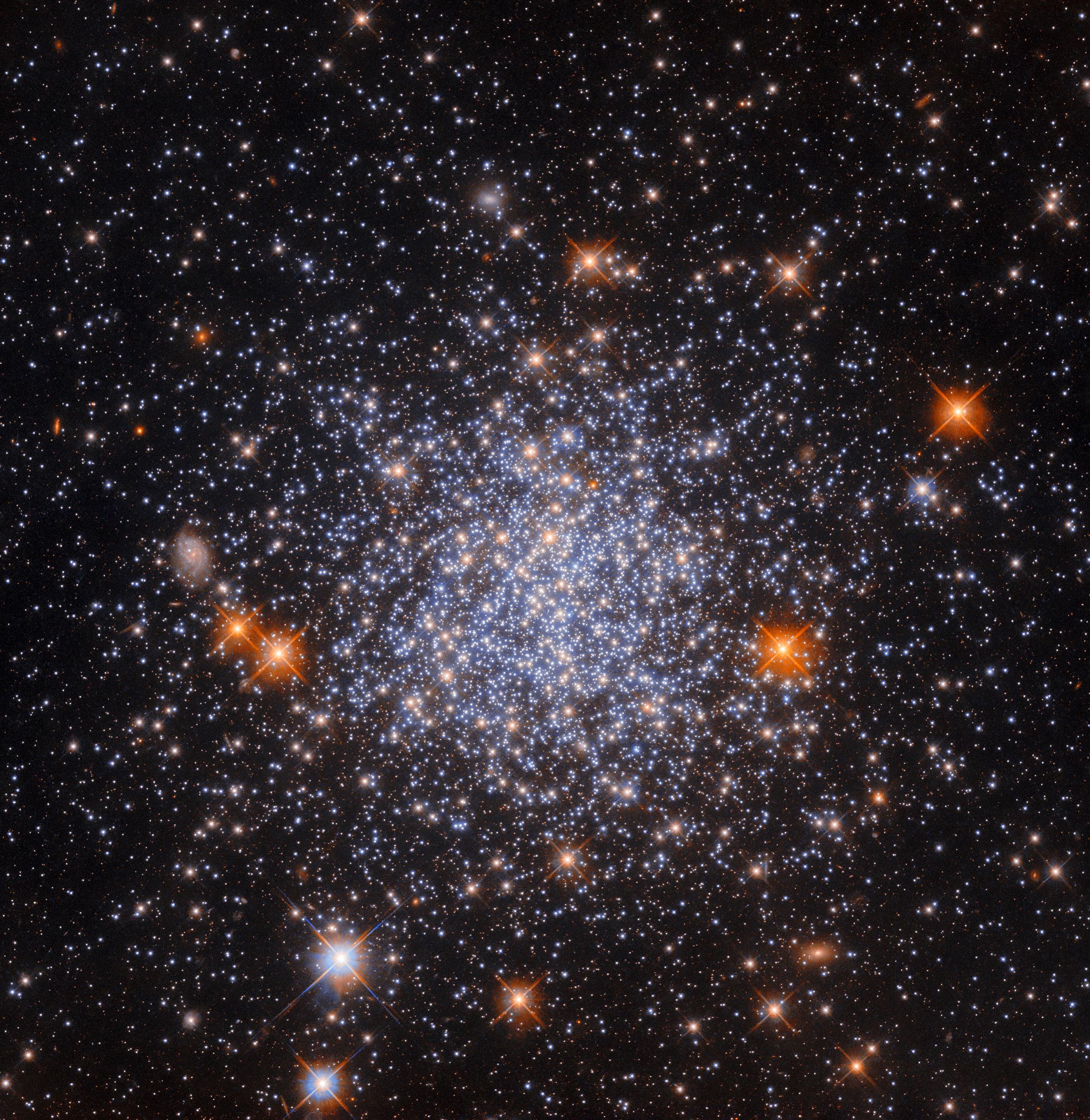
    This image of NGC 1651, a globular cluster in the Large Magellanic Cloud, exemplifies how celestial objects of varying sizes appear in Hubble’s images due to its fixed field of view and the object’s distance from Earth Credit: ESA/Hubble & NASA, L. Girardi, F. Niederhofer

    Hubble captures varied cosmic scales, from the close globular cluster NGC 1651 to distant galaxies, using its fixed observational scope and mosaicing when necessary.

    This Hubble Space Telescope image shows a globular cluster known as NGC 1651. Like the object in another recent Picture of the Week, it is located about 162,000 light-years away in the largest and brightest of the Milky Way’s satellite galaxies, the Large Magellanic Cloud (LMC).

    A notable feature of this image is that the globular cluster almost fills the entire image, even though globular clusters are only about 10 to 300 light-years in diameter (NGC 1651 has a diameter of roughly 120 light-years). In contrast, there are numerous Hubble Pictures of the Week that feature entire galaxies — which can be tens or hundreds of millions of light-years in diameter — that also more or less fill the whole image.

    Telescope Field of View Explained

    A common misconception is that Hubble and other large telescopes manage to observe wildly differently sized celestial objects by zooming in on them, as one would with a specialized camera here on Earth. However, whilst small telescopes might have the option to zoom in and out to a certain extent, large telescopes do not. Each telescope’s instrument has a fixed ‘field of view’ (the size of the region of sky that it can observe in a single observation).

    For example, the ultraviolet/visible light channel of Hubble’s Wide Field Camera 3 (WFC3), the channel and instrument that were used to collect the data used in this image, has a field of view roughly one-twelfth the diameter of the Moon as seen from Earth. Whenever WFC3 makes an observation, that is the size of the region of sky that it can observe.

    Capturing Cosmic Scale

    The reason that Hubble can observe objects of such wildly different sizes is two-fold. Firstly, the distance to an object will determine how big it appears to be from Earth, so entire galaxies that are relatively far away might take up the same amount of space in the sky as a globular cluster like NGC 1651 which is relatively close by.

    In fact, there’s a distant spiral galaxy lurking in this image, directly left of the cluster — though undoubtedly much larger than this star cluster, it appears small enough here to blend in with foreground stars! Secondly, multiple images spanning different parts of the sky can be mosaiced together to create single images of objects that are too big for Hubble’s field of view.

    This is a very complex task and is not typically done for Pictures of the Week, but it has been done for some of Hubble’s most iconic images.

    Never miss a breakthrough: Join the SciTechDaily newsletter.
    Follow us on Google and Google News.

    Astronomy European Space Agency Hubble Space Telescope
    Share. Facebook Twitter Pinterest LinkedIn Email Reddit

    Related Articles

    A Diamond Necklace of Cosmic Proportions

    Hubble Snaps a Stunning Close-Up of a Magnificent Spiral Galaxy

    Extraordinary Hubble Image: Light Bends From the Beyond

    Hubble Space Telescope Sees Volcanic Activity Reforming the Atmosphere on a Rocky Exoplanet

    Hubble Spies a Luminous Heart With Dark Tendrils

    Spectacular Return to the Veil Nebula

    Hubble Spots a Peculiar Sight: Unusual Spiral Galaxy With a Heavy Arm

    A Flash of Life: Hubble Spies an Unusual Planetary Nebula

    Through the Cosmic Clouds: Hubble Spots a Beautiful Stellar Nursery

    2 Comments

    1. Farrukh Naseer on March 25, 2024 10:35 am

      Universe can not be judged/covered neither by Hubble nor James Web Space Telescope…..

      Reply
    2. Farrukh Naseer on March 25, 2024 10:37 am

      Efforts of Hubble and JWST may be admired indeed….

      Reply
    Leave A Reply Cancel Reply

    • Facebook
    • Twitter
    • Pinterest
    • YouTube

    Don't Miss a Discovery

    Subscribe for the Latest in Science & Tech!

    Trending News

    Scientists May Have Discovered How To Heal Damaged Kidneys

    Interstellar Visitor 3I/ATLAS Is Bursting With an Unexpected Chemical

    Scientists Just Found All 5 Genetic “Letters” of DNA and RNA on an Asteroid

    The 4,000-Year-Old City That Defied History’s Rules on Wealth and Power

    The World’s Biggest Population Fear Has Flipped – and It Could Change Everything

    This “Fake” Pill Improved Memory and Physical Performance in Just 3 Weeks

    Scientists Say Frequent Ejaculation May Improve Sperm Quality and Fertility

    Scientists Have Found “The Heaven Sword” After Years of Looking

    Follow SciTechDaily
    • Facebook
    • Twitter
    • YouTube
    • Pinterest
    • Newsletter
    • RSS
    SciTech News
    • Biology News
    • Chemistry News
    • Earth News
    • Health News
    • Physics News
    • Science News
    • Space News
    • Technology News
    Recent Posts
    • A Giant Scorpion the Size of a Coffee Table Is Forcing Scientists To Rethink Evolution
    • Science Debunks a Common Belief About Pets and Stress
    • The Surprising Reason Sugary Gum Helped Lower Blood Pressure
    • Hidden Virus May Have Infected 9.4 Million People – Scientists Say We’ve Missed Most Cases
    • NASA’s Lucy Uncovers Ancient Water Clues on a Weirdly Wobbling Asteroid
    Copyright © 1998 - 2026 SciTechDaily. All Rights Reserved.
    • Science News
    • About
    • Contact
    • Editorial Board
    • Privacy Policy
    • Terms of Use

    Type above and press Enter to search. Press Esc to cancel.