
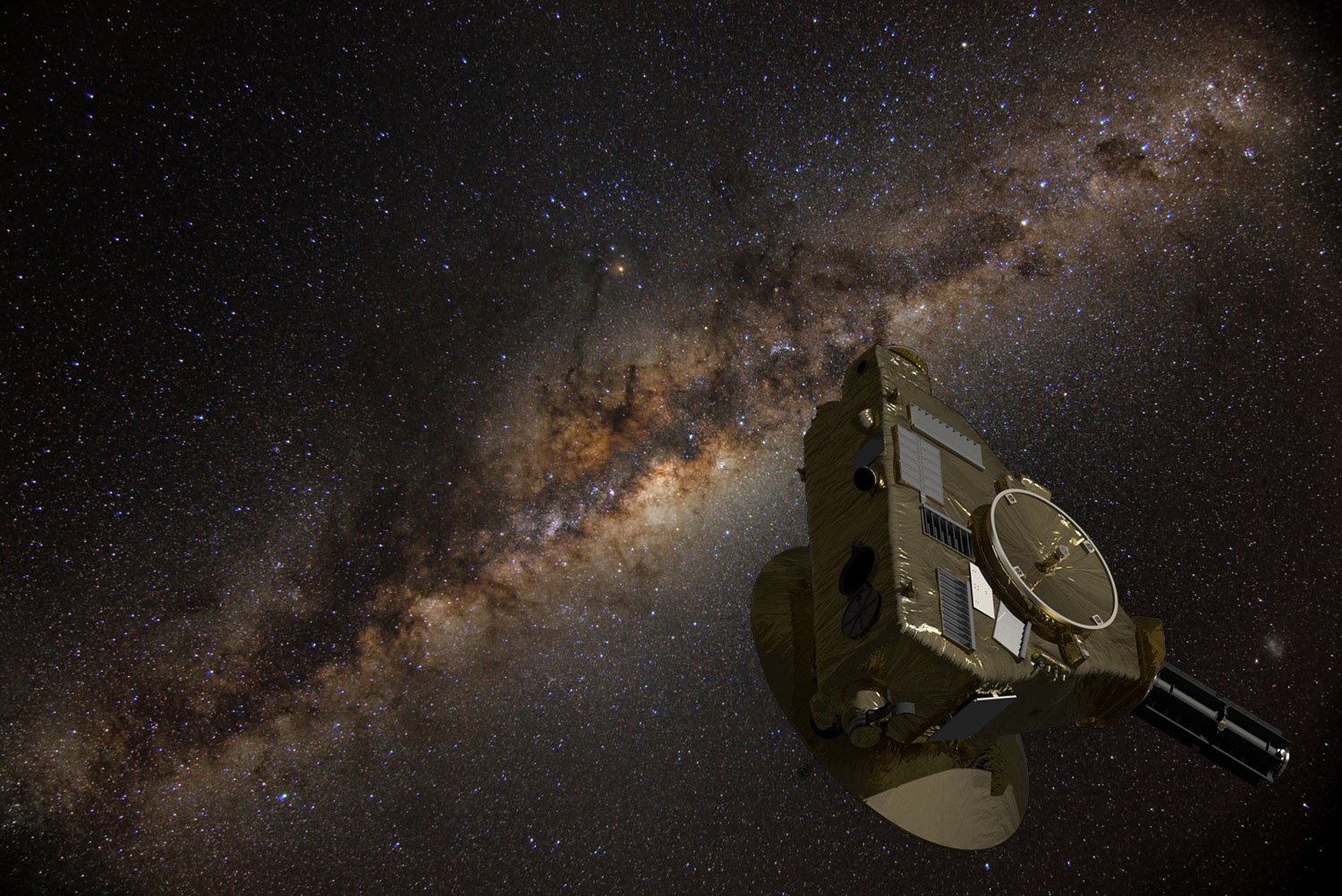
NASA’s New Horizons spacecraft has provided groundbreaking data from near the edge of the solar system, revealing the cosmic optical background—the faint glow left by billions of galaxies since the Big Bang.
This study, which meticulously subtracts interference from cosmic dust and other sources, confirms the lingering light aligns with theoretical expectations of galaxy formation, enhancing our understanding of cosmic evolution without ruling out potential anomalies.
Unveiling the Cosmic Glow
Scientists have traveled to the edges of the solar system, virtually, at least, to capture the most accurate measurements to date of the faint glow that permeates the universe—a phenomenon known as the cosmic optical background.
The new study draws on observations from NASA’s New Horizons spacecraft, which whizzed past Pluto in 2015 and is now nearly 5.5 billion miles from Earth. The research, published on August 28 in The Astrophysical Journal, seeks to answer a deceptively simple question, said co-author Michael Shull, an astrophysicist at CU Boulder.
“Is the sky really dark?” said Shull, professor emeritus in the Department of Astrophysical and Planetary Sciences.
The Cosmic Quest for Clarity
Space may look black to human eyes, but scientists believe that it’s not completely dark. Since the dawn of the cosmos, trillions of galaxies containing countless stars have formed and died, leaving behind an imperceptibly faint light. Think of it as the night light in space.
Shull and the team, led by Marc Postman at the Space Telescope Science Institute in Baltimore, calculated just how bright that glow is. Their findings suggest that the cosmic optical background is roughly 100 billion times fainter than the sunlight that reaches Earth’s surface—far too faint for humans to see with the naked eye.
The results could help scientists shine a light on the history of the universe since the Big Bang.
“We’re kind of like cosmic accountants, adding up every source of light we can account for in the universe,” Shull said.

Challenges of Cosmic Observations
It’s a type of number crunching that has captured the imagination of scientists for nearly 50 years, he added.
Shull explained that, after decades of research, astrophysicists think they have a pretty good idea of how the cosmos evolved. The first galaxies formed during an epoch known as the Cosmic Dawn several hundred million years after the Big Bang. The starlight from galaxies in the distant universe reached its brightest point about 10 billion years ago and has been dimming ever since.
Precise measurements of the cosmic optical background could help scientists confirm whether this picture of the cosmos makes sense—or if there are mysterious, as-of-yet-undiscovered objects casting light into space.
Taking those kinds of measurements, however, isn’t easy, especially not from Earth.
Earth’s neighborhood is teeming with tiny grains of dust and other debris. Sunlight glints off this mess, washing out any signals that might be coming from the cosmic optical background.
“A metaphor I use is if you want to see the stars, you need to get out of Denver,” Shull said. “You have to go way out, right to the northeast corner of Colorado where all you have ahead of you are South Dakota and Nebraska.”
New Horizons has given scientists a once-in-a-lifetime opportunity to do something similar in space.
Unprecedented Insights from the Edge
The mission has uniquely Colorado origins. Alan Stern, who studied as a graduate student at CU Boulder under Shull and former Senior Research Associate Jack Brandt, leads the New Horizons mission. He’s currently based at the Southwest Research Institute in Boulder, Colorado. The spacecraft also carries the Student Dust Counter, an instrument designed and built by students at the Laboratory for Atmospheric and Space Physics (LASP) at CU Boulder.
Over the course of several weeks in summer 2023, the researchers pointed New Horizons’ Long Range Reconnaissance Imager (LORRI) at about two dozen patches of sky.
The Limits of Current Technology
Even at the edge of the solar system, the team still had a lot of extra light to contend with. The Milky Way Galaxy, for example, sits within a halo that, like our solar system, gathers dust.
“You can’t get away from dust,” Shull said. “It’s everywhere.”
He and his colleagues estimated how much light that halo could generate, then subtracted it from what they were viewing with LORRI. After getting rid of additional sources of light, the team was left with the cosmic optical background.
In scientific terms, that background amounts to about 11 nanowatts per square meter per steradian. (A steradian is a patch of sky with a width about 130 times the diameter of the moon).
Shull said that this value lines up well with how many galaxies scientists believe should have formed since the Big Bang. Put differently, there don’t seem to be any strange objects, such as exotic kinds of particles, out there in space producing a lot of light. But the researchers can’t rule out such anomalies completely.
Future Perspectives in Cosmic Exploration
The team’s measurements are likely to be the best estimates of the universe’s glow for a long time. New Horizons is using its remaining fuel supplies to pursue other scientific priorities, and no other missions are currently heading toward those cold and dark corners of space.
“If they put a camera on a future mission, and we all wait a couple of decades for it to get out there, we could see a more exact measurement,” Shull said.
For more on this research, see Exploring the Dark Universe: Breakthroughs From NASA’s New Horizons Deep Space Probe.
Reference: “New Synoptic Observations of the Cosmic Optical Background with New Horizons” by Marc Postman, Tod R. Lauer, Joel W. Parker, John R. Spencer, Harold A. Weaver, J. Michael Shull, S. Alan Stern, Pontus Brandt, Steven J. Conard, G. Randall Gladstone, Carey M. Lisse, Simon B. Porter, Kelsi N. Singer and Anne. J. Verbiscer, 28 August 2024, The Astrophysical Journal.
DOI: 10.3847/1538-4357/ad5ffc
Other co-authors of the new study include SWRI’s Alan Stern and Tod Lauer at the U.S. National Science Foundation National Optical Infrared Astronomy Research Laboratory. Researchers from the Johns Hopkins University Applied Physics Laboratory, University of Texas at San Antonio and University of Virginia also participated.
Never miss a breakthrough: Join the SciTechDaily newsletter.
Follow us on Google and Google News.