
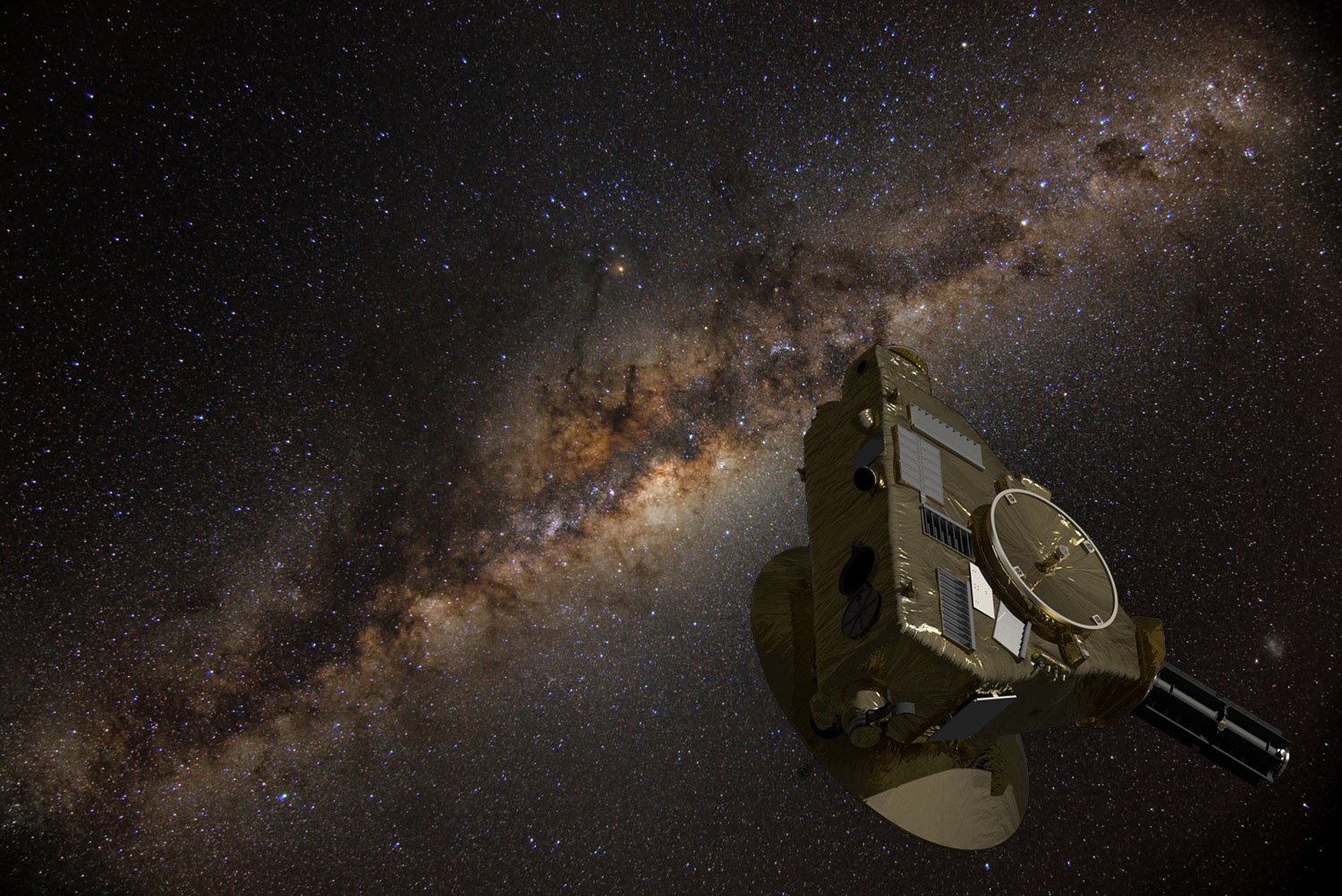
Deep space probe measures all the background light in the universe.
How dark is dark? This is not a Dr. Seuss riddle but a serious question astronomers have been probing for years. Their big opportunity came with the New Horizons spacecraft that is now far beyond the planets at more than 5.4 billion miles from Earth. It’s far enough to be free of light contamination from the glow of background dust in our solar system. This means the spacecraft was able to measure the darkness of the seemingly pitch-black deep space.
Astronomers found a residual glow coming from myriad background galaxies filling the universe. The good news is that there is no other source of the background light to befuddle astronomers. New Horizons accomplished a full inventory of visible light. Launched in January 2006, New Horizons flew by the dwarf planet Pluto in July 2015, before passing by a Kuiper Belt object, Arrokoth, in January 2019.
New Horizons Measurements Shed New Light on the Darkness of the Universe
Just how dark is deep space? Astronomers may have finally answered this long-standing question by tapping into the capabilities and distant position of NASA’s New Horizons spacecraft, by making the most precise, direct measurements ever of the total amount of light the universe generates.
More than 18 years after launch and nine years after its historic exploration of Pluto, New Horizons is more than 5.4 billion miles (7.3 billion kilometers) from Earth, in a region of the solar system far enough from the Sun to offer the darkest skies available to any existing telescope – and to provide a unique vantage point from which to measure the overall brightness of the distant universe.
Cosmic Optical Background: A New Understanding
“If you hold up your hand in deep space, how much light does the universe shine on it?” asked Marc Postman, an astronomer at the Space Telescope Science Institute in Baltimore and lead author of a new paper detailing the research, which published on August 28 in The Astrophysical Journal.
“We now have a good idea of just how dark space really is. The results show that the great majority of visible light we receive from the universe was generated in galaxies. Importantly, we also found that there is no evidence for significant levels of light produced by sources not presently known to astronomers.”
Historical Insights and Modern Challenges
The findings solve a puzzle that has perplexed scientists since the 1960s, when astronomers Arno Penzias and Robert Wilson discovered that space is pervaded by strong microwave radiation, which had been predicted to be left over from the creation of the universe itself. This result led to their being awarded the Nobel Prize. Subsequently, astronomers also found evidence of backgrounds of X-rays, gamma rays and infrared radiation that also fill the sky.
Detecting the background of “ordinary” (or visible) light – more formally called the cosmic optical background, or COB – provided a way to add up all the light generated by galaxies over the lifetime of the universe before NASA’s Hubble Space Telescope and James Webb Space Telescope could see the faint background galaxies directly.
In the Hubble and James Webb telescope era, astronomers measure the COB to detect light that might come from sources other than these known galaxies. But measuring the total light output of the universe is extremely difficult from Earth or anywhere in the inner solar system.
“People have tried over and over to measure it directly, but in our part of the solar system, there’s just too much sunlight and reflected interplanetary dust that scatters the light around into a hazy fog that obscures the faint light from the distant universe,” said Tod Lauer, a New Horizons co-investigator, astronomer from the National Science Foundation NOIRLab in Tucson, Arizona, and a co-author of the new paper. “All attempts to measure the strength of the COB from the inner solar system suffer from large uncertainties.”
The Role of New Horizons in Cosmic Observation
Enter New Horizons, billions of miles along its trek beyond the planets, now deep in the Kuiper Belt and headed toward interstellar space. Late last summer, from a distance 57 times farther from the Sun than Earth, New Horizons scanned the universe with its Long Range Reconnaissance Imager (LORRI), collecting two-dozen separate imaging fields.
LORRI itself was intentionally shielded from the Sun by the main body of the spacecraft – keeping even the dimmest sunlight from directly entering the sensitive camera – and the target fields were positioned away from the bright disk and core of the Milky Way and nearby bright stars.
Clarifying the Universe’s Luminescence
The New Horizons observers used other data, taken in the far-infrared by the European Space Agency’s Planck mission, of fields with a range in dust density to calibrate the level of those far-infrared emissions to the level of ordinary visible light. This allowed them to accurately predict and correct for the presence of dust-scattered Milky Way light in the COB images – a technique that was not available to them during a 2021 test COB observation run with New Horizons in which they underestimated the amount of dust-scattered light and overestimated excess light from the universe itself.
But this time around, after accounting for all known sources of light, such as background stars and light scattered by thin clouds of dust within the Milky Way galaxy, the researchers found the remaining level of visible light was entirely consistent with the intensity of light generated by all galaxies over the past 12.6 billion years.
Confirming Theories and Extending Missions
“The simplest interpretation is that the COB is completely due to galaxies,” Lauer said. “Looking outside the galaxies, we find darkness there and nothing more.”
“This newly published work is an important contribution to fundamental cosmology, and really something that could only be done with a far-away spacecraft like New Horizons,” said New Horizons Principal Investigator Alan Stern, of the Southwest Research Institute in Boulder, Colorado. “And it shows that our current extended mission is making important scientific contributions far beyond the original intent of this planetary mission designed to make the first close spacecraft explorations of Pluto and Kuiper Belt objects.”
Beyond Pluto: New Horizons’ Ongoing Journey
Launched in January 2006, New Horizons made the historic reconnaissance of Pluto and its moons in July 2015, before giving humankind its first close-up look at a planetary building block and Kuiper Belt object, Arrokoth, in January 2019. New Horizons is now in its second extended mission, imaging distant Kuiper Belt objects, characterizing the outer heliosphere of the Sun, and making important astrophysical observations from its unmatched vantage point in the farthest regions of the solar system.
Reference: “New Synoptic Observations of the Cosmic Optical Background with New Horizons” by Marc Postman, Tod R. Lauer, Joel W. Parker, John R. Spencer, Harold A. Weaver, J. Michael Shull, S. Alan Stern, Pontus Brandt, Steven J. Conard, G. Randall Gladstone, Carey M. Lisse, Simon B. Porter, Kelsi N. Singer and Anne. J. Verbiscer, 28 August 2024, The Astrophysical Journal.
DOI: 10.3847/1538-4357/ad5ffc
The Johns Hopkins Applied Physics Laboratory (APL) in Laurel, Maryland, built and operates the New Horizons spacecraft and manages the mission for NASA’s Science Mission Directorate. Southwest Research Institute, based in San Antonio and Boulder, Colorado, directs the mission via Principal Investigator Alan Stern and leads the science team, payload operations and encounter science planning. New Horizons is part of NASA’s New Frontiers program, managed by NASA’s Marshall Space Flight Center in Huntsville, Alabama.
Never miss a breakthrough: Join the SciTechDaily newsletter.
Follow us on Google and Google News.