
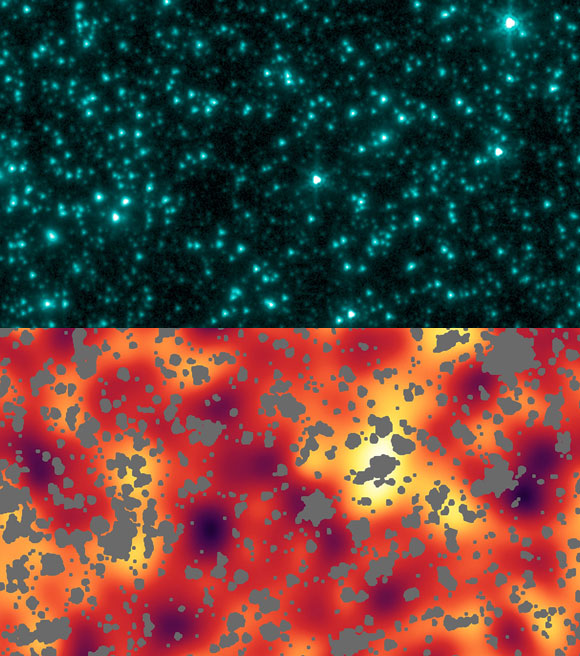
A newly published study from NASA’s Goddard Space Flight Center suggests a possible link between primordial black holes and dark matter.
Dark matter is a mysterious substance composing most of the material universe, now widely thought to be some form of massive exotic particle. An intriguing alternative view is that dark matter is made of black holes formed during the first second of our universe’s existence, known as primordial black holes. Now a scientist at NASA’s Goddard Space Flight Center in Greenbelt, Maryland, suggests that this interpretation aligns with our knowledge of cosmic infrared and X-ray background glows and may explain the unexpectedly high masses of merging black holes detected last year.
“This study is an effort to bring together a broad set of ideas and observations to test how well they fit, and the fit is surprisingly good,” said Alexander Kashlinsky, an astrophysicist at NASA Goddard. “If this is correct, then all galaxies, including our own, are embedded within a vast sphere of black holes each about 30 times the sun’s mass.”
In 2005, Kashlinsky led a team of astronomers using NASA’s Spitzer Space Telescope to explore the background glow of infrared light in one part of the sky. The researchers reported excessive patchiness in the glow and concluded it was likely caused by the aggregate light of the first sources to illuminate the universe more than 13 billion years ago. Follow-up studies confirmed that this cosmic infrared background (CIB) showed similar unexpected structure in other parts of the sky.
Primordial black holes, if they exist, could be similar to the merging black holes detected by the LIGO team in 2014. This computer simulation shows in slow motion what this merger would have looked like up close. The ring around the black holes, called an Einstein ring, arises from all the stars in a small region directly behind the holes whose light is distorted by gravitational lensing. The gravitational waves detected by LIGO are not shown in this video, although their effects can be seen in the Einstein ring. Gravitational waves traveling out behind the black holes disturb stellar images comprising the Einstein ring, causing them to slosh around in the ring even long after the merger is complete. Gravitational waves traveling in other directions cause weaker, shorter-lived sloshing everywhere outside the Einstein ring. If played back in real time, the movie would last about a third of a second.
In 2013, another study compared how the cosmic X-ray background (CXB) detected by NASA’s Chandra X-ray Observatory compared to the CIB in the same area of the sky. The first stars emitted mainly optical and ultraviolet light, which today is stretched into the infrared by the expansion of space, so they should not contribute significantly to the CXB.
Yet the irregular glow of low-energy X-rays in the CXB matched the patchiness of the CIB quite well. The only object we know of that can be sufficiently luminous across this wide energy range is a black hole. The research team concluded that primordial black holes must have been abundant among the earliest stars, making up at least about one out of every five of the sources contributing to the CIB.
The nature of dark matter remains one of the most important unresolved issues in astrophysics. Scientists currently favor theoretical models that explain dark matter as an exotic massive particle, but so far searches have failed to turn up evidence these hypothetical particles actually exist. NASA is currently investigating this issue as part of its Alpha Magnetic Spectrometer and Fermi Gamma-ray Space Telescope missions.
“These studies are providing increasingly sensitive results, slowly shrinking the box of parameters where dark matter particles can hide,” Kashlinsky said. “The failure to find them has led to renewed interest in studying how well primordial black holes — black holes formed in the universe’s first fraction of a second — could work as dark matter.”
Physicists have outlined several ways in which the hot, rapidly expanding universe could produce primordial black holes in the first thousandths of a second after the Big Bang. The older the universe is when these mechanisms take hold, the larger the black holes can be. And because the window for creating them lasts only a tiny fraction of the first second, scientists expect primordial black holes would exhibit a narrow range of masses.
On September 14, gravitational waves produced by a pair of merging black holes 1.3 billion light-years away were captured by the Laser Interferometer Gravitational-Wave Observatory (LIGO) facilities in Hanford, Washington, and Livingston, Louisiana. This event marked the first-ever detection of gravitational waves as well as the first direct detection of black holes. The signal provided LIGO scientists with information about the masses of the individual black holes, which were 29 and 36 times the sun’s mass, plus or minus about four solar masses. These values were both unexpectedly large and surprisingly similar.
“Depending on the mechanism at work, primordial black holes could have properties very similar to what LIGO detected,” Kashlinsky explained. “If we assume this is the case, that LIGO caught a merger of black holes formed in the early universe, we can look at the consequences this has on our understanding of how the cosmos ultimately evolved.”
In his new paper, published May 24 in The Astrophysical Journal Letters, Kashlinsky analyzes what might have happened if dark matter consisted of a population of black holes similar to those detected by LIGO. The black holes distort the distribution of mass in the early universe, adding a small fluctuation that has consequences hundreds of millions of years later, when the first stars begin to form.
For much of the universe’s first 500 million years, normal matter remained too hot to coalesce into the first stars. Dark matter was unaffected by the high temperature because, whatever its nature, it primarily interacts through gravity. Aggregating by mutual attraction, dark matter first collapsed into clumps called minihaloes, which provided a gravitational seed enabling normal matter to accumulate. Hot gas collapsed toward the minihaloes, resulting in pockets of gas dense enough to further collapse on their own into the first stars. Kashlinsky shows that if black holes play the part of dark matter, this process occurs more rapidly and easily produces the lumpiness of the CIB detected in Spitzer data even if only a small fraction of minihaloes manage to produce stars.
As cosmic gas fell into the minihaloes, their constituent black holes would naturally capture some of it too. Matter falling toward a black hole heats up and ultimately produces X-rays. Together, infrared light from the first stars and X-rays from gas falling into dark matter black holes can account for the observed agreement between the patchiness of the CIB and the CXB.
Occasionally, some primordial black holes will pass close enough to be gravitationally captured into binary systems. The black holes in each of these binaries will, over eons, emit gravitational radiation, lose orbital energy, and spiral inward, ultimately merging into a larger black hole like the event LIGO observed.
“Future LIGO observing runs will tell us much more about the universe’s population of black holes, and it won’t be long before we’ll know if the scenario I outline is either supported or ruled out,” Kashlinsky said.
Kashlinsky leads science team centered at Goddard that is participating in the European Space Agency’s Euclid mission, which is currently scheduled to launch in 2020. The project, named LIBRAE, will enable the observatory to probe source populations in the CIB with high precision and determine what portion was produced by black holes.
Reference: “LIGO gravitational wave detection, primordial black holes and the near-IR cosmic infrared background anisotropies” by A. Kashlinsky, 24 May 2016, The Astrophysical Journal Letters.
DOI: 10.3847/2041-8205/823/2/L25
arXiv:1605.04023
Never miss a breakthrough: Join the SciTechDaily newsletter.
Follow us on Google and Google News.
11 Comments
What does Kashlinsky mean by “If we assume…that LIGO caught a merger of black holes formed in the early universe”? The merger was of “a pair of merging black holes 1.3 billion light-years away.”
Oh well, no accounting for logic….
Light year is a unit of distance, not of time. You can have objects of any age at a distance of 1.3 billion light years
I thought black holes had already been eliminated as a dark-matter contender?
Black holes were one of the first ideas considered, then discarded, based on observations. Do we just throw out all the previous observations showing dark matter cannot be black holes?
The right thing to say is that we have no clue about the nature of dark matter.
And, yes, black holes were discarded as a contender once – this article doesn’t make it clear why that decision is worth revisiting.
Black holes are the result of rotating charged bodies. The centers of gravity is the geometric venter of rotating mass. If the rotating masses are chatged, the rotating masses create currents and these circular currents create a magnetic B-field perpendicular to the plane and in the center. The center B-field is the strongest and can cause electric jets.
If electrons enter the galaxy, the electron flow will cause the charged bodies/suns will rotate FASTER, LIKE A MOTOR. the electron flow creates a force
F= eVxB = vxP/r
P=mV=eBr=euI
V=(e/m)uI= 176G 1.25u Im/s = 220km/s at current I =1 amp.
The faster rotation is not due to gravity or “Dark matter”, it is due to Electromagnetism and so-called Dark Energy”, cP, the vector energy!
The Law of Gravity is described by Quaternion Space, not General Relativity. Quaternions quantities consist of a scalar and 3 vectors.
Gravitational Energy W = [c,V][0,P] = [-cp,cP] = [-mGM/r, cP]
This is the Quaternion Gravity Energy, Newton’s Energy is the scalar energy and cP=cmV is the vector energy. cP answers to the Dark Energy/Matter.
Great!
If you really think about it, it makes total sense. Dark Matter is the residual crap that comes from the Black Hole eating object matter and energy. Though you will probably never be able to prove this due to not being able to see what comes out the otherside.
Attention all planets of the Solar Federation!
Attention all planets of the Solar Federation!
Attention all planets of the Solar Federation!
We have assumed control!
We have assumed control!
We have assumed control!
Horse feathers.Conjecture and entire dark matter disscussion ignores the reality that missing mass in all the universe is inside of black holes. This is a discussion of ghosts as though they will be proven someday
Hah!!!
Think about it w/o superior intellect.
We see massive gravitational in fluency of black holes, stop. We say that dark matter is transparent and exerts no force, yet explains the mass shortage. Ah hah!!
Hello Sir! Massive objects need not always be opaque. You look at the masses of nucleons. Only Up and Down quarks are material but they account for only 10% of the known mass of them. Rest of the mass is hidden in the bosonic transparent nuclear forces called strong forces which is capable of creating more quarks than which it reveals. Again look at the weak electromagnetic forces called W+,W- and Z Bosons which are completely transparent but in radioactive decay they emit alpha particles (Helium Nuclei), Beta particles (electrons) which are all material in nature born out of these hidden bosons and the rest mostly emits again as the powerful Gamma rays. Mass and energy are the two sides of the same coin but the energy side is 96% of the Universe and yet they are transparent but pulls enormous gravitational force on your galaxies which are strewn apart at the speed of light. You don’t call it as very weak gravitational force but some unknown dark force enormous enough to sweep the material objects. So much so the Black Holes are exerting enormous force on the surroundings . We assume them to be collapsed galaxies and stars where only real physical appearance of objects of stars are diminished but the enormous 96% force unseen is enveloping it. Hence to relate black holes primordial to hitherto unknown dark matter is plausible, where the dark matter seems to be the origin of all the matter in the Universe and 96% energy hidden in them.Thanking You.