
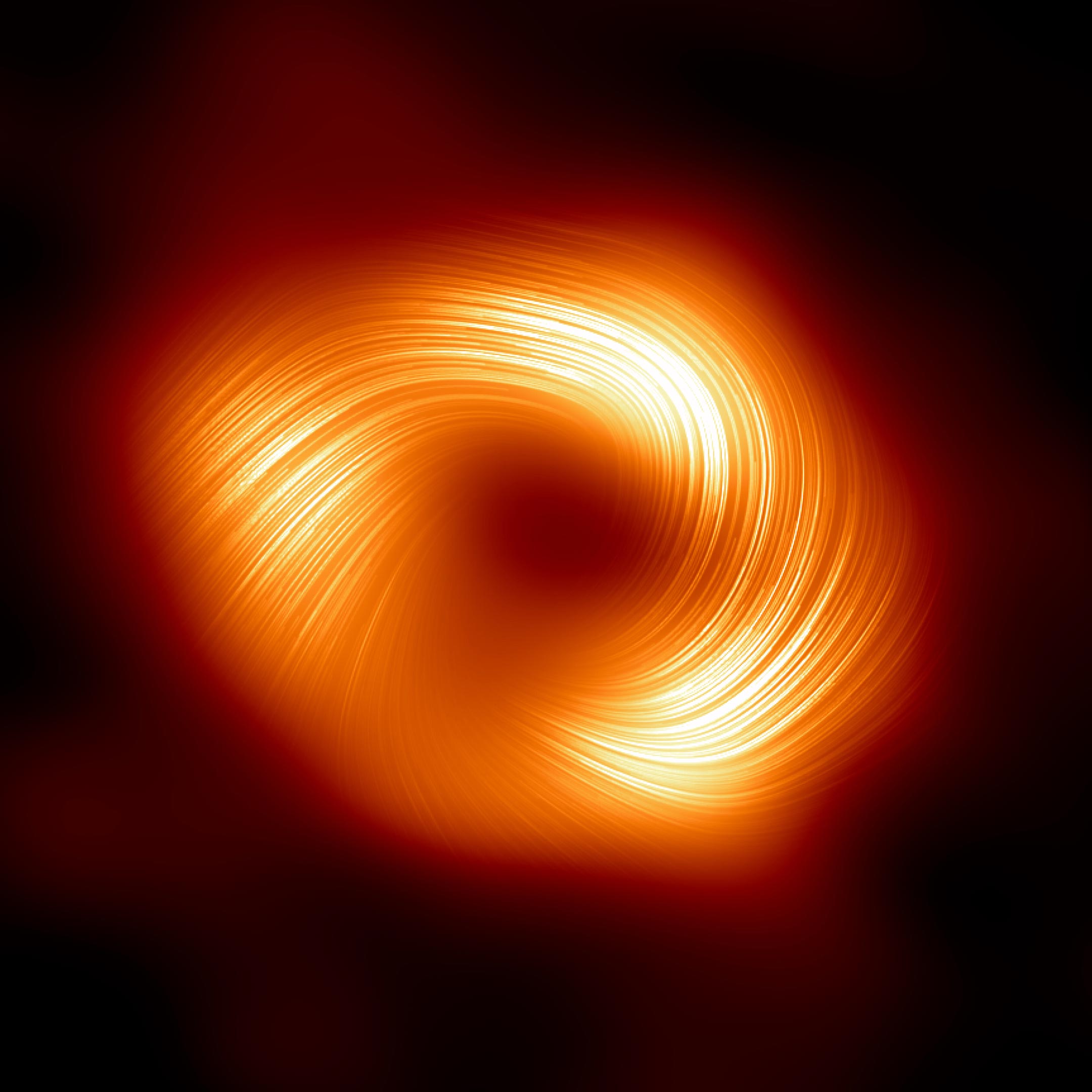
Radiation from dark matter in the early universe may have kept hydrogen gas hot enough to condense into black holes.
- Supermassive black holes typically take billions of years to form. But the James Webb Space Telescope is finding them not that long after the Big Bang — before they should have had time to form.
- UCLA astrophysicists have discovered that if dark matter decays, the photons it emits keep the hydrogen gas hot enough for gravity to gather it into giant clouds and eventually condense it into a supermassive black hole.
- In addition to explaining the existence of very early supermassive black holes, the finding lends support for the existence of a kind of dark matter capable of decaying into particles such as photons.
Formation of Supermassive Black Holes
It takes a long time for supermassive black holes, like the one at the center of our Milky Way galaxy, to form. Typically, the birth of a black hole requires a giant star with the mass of at least 50 of our suns to burn out – a process that can take a billion years – and its core to collapse in on itself.
Even so, at only about 10 solar masses, the resulting black hole is a far cry from the 4 million-solar-masses black hole, Sagittarius A*, found in our Milky Way galaxy, or the billion-solar-mass supermassive black holes found in other galaxies. Such gigantic black holes can form from smaller black holes by accretion of gas and stars, and by mergers with other black holes, which take billions of years.
Mysteries Unveiled by the James Webb Space Telescope
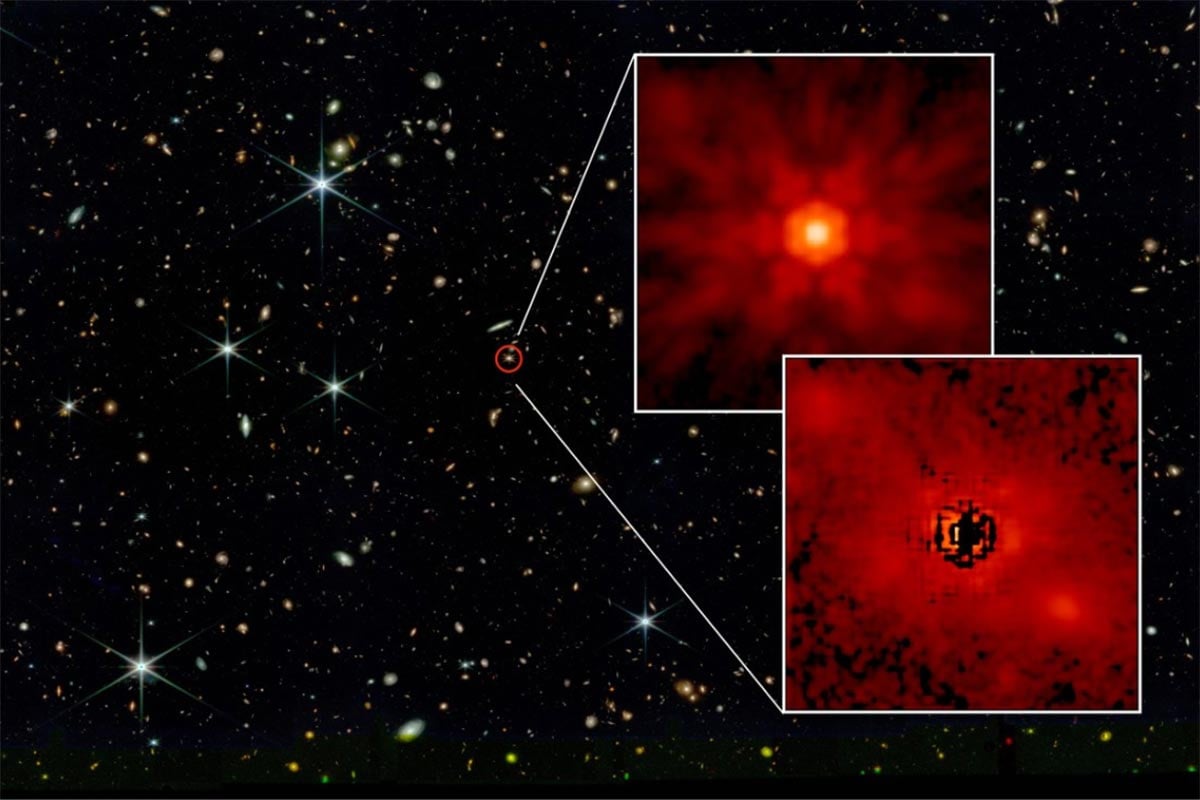
Why, then, is the James Webb Space Telescope discovering supermassive black holes near the beginning of time itself, eons before they should have been able to form? Astrophysicists from the University of California, Los Angeles (UCLA) have an answer as mysterious as the black holes themselves: Dark matter kept hydrogen from cooling long enough for gravity to condense it into clouds big and dense enough to turn into black holes instead of stars. The finding was published on August 27 in the journal Physical Review Letters.
“How surprising it has been to find a supermassive black hole with a billion solar mass when the universe itself is only half a billion years old,” said senior author Alexander Kusenko, a professor of physics and astronomy at UCLA. “It’s like finding a modern car among dinosaur bones and wondering who built that car in the prehistoric times.”
The Challenge of Gas Cooling in Space
Some astrophysicists have posited that a large cloud of gas could collapse to make a supermassive black hole directly, bypassing the long history of stellar burning, accretion and mergers. But there’s a catch: Gravity will, indeed, pull a large cloud of gas together, but not into one large cloud. Instead, it gathers sections of the gas into little halos that float near each other but don’t form a black hole.
The reason is because the gas cloud cools too quickly. As long as the gas is hot, its pressure can counter gravity. However, if the gas cools, pressure decreases, and gravity can prevail in many small regions, which collapse into dense objects before gravity has a chance to pull the entire cloud into a single black hole.
“How quickly the gas cools has a lot to do with the amount of molecular hydrogen,” said first author and doctoral student Yifan Lu. “Hydrogen atoms bonded together in a molecule dissipate energy when they encounter a loose hydrogen atom. The hydrogen molecules become cooling agents as they absorb thermal energy and radiate it away. Hydrogen clouds in the early universe had too much molecular hydrogen, and the gas cooled quickly and formed small halos instead of large clouds.”
Lu and postdoctoral researcher Zachary Picker wrote code to calculate all possible processes of this scenario and discovered that additional radiation can heat the gas and dissociate the hydrogen molecules, altering how the gas cools.
“If you add radiation in a certain energy range, it destroys molecular hydrogen and creates conditions that prevent fragmentation of large clouds,” Lu said.
Role of Dark Matter in Black Hole Formation
But where does the radiation come from?
Only a very tiny portion of matter in the universe is the kind that makes up our bodies, our planet, the stars, and everything else we can observe. The vast majority of matter, detected by its gravitational effects on stellar objects and by the bending of light rays from distant sources, is made of some new particles, which scientists have not yet identified.
The forms and properties of dark matter are therefore a mystery that remains to be solved. While we don’t know what dark matter is, particle theorists have long speculated that it could contain unstable particles that can decay into photons, the particles of light. Including such dark matter in the simulations provided the radiation needed for the gas to remain in a large cloud while it is collapsing into a black hole.
Dark matter could be made of particles that slowly decay, or it could be made of more than one particle species: some stable and some that decay at early times. In either case, the product of decay could be radiation in the form of photons, which break up molecular hydrogen and prevent hydrogen clouds from cooling too quickly. Even very mild decay of dark matter yielded enough radiation to prevent cooling, forming large clouds and, eventually, supermassive black holes.
“This could be the solution to why supermassive black holes are found very early on,” Picker said. “If you’re optimistic, you could also read this as positive evidence for one kind of dark matter. If these supermassive black holes formed by the collapse of a gas cloud, maybe the additional radiation required would have to come from the unknown physics of the dark sector.”
Reference: “Direct Collapse Supermassive Black Holes from Relic Particle Decay” by Yifan Lu, Zachary S. C. Picker and Alexander Kusenko, 27 August 2024, Physical Review Letters.
DOI: 10.1103/PhysRevLett.133.091001
Never miss a breakthrough: Join the SciTechDaily newsletter.
Follow us on Google and Google News.
11 Comments
If dark matter explains everything else… just what explains dark matter?
Dark matter doesn’t explain even as much as normal matter (no chemistry).
What explains normal matter?
Mathematics is the main environment for modeling problems in other areas. Observations and experiments, theory, and modeling reinforce each other and together lead to our understanding of natural phenomena.
Space has physical properties of zero viscosity and absolute incompressibility. Zero viscosity and absolute incompressibility are physical characteristics of ideal fluids. The space with ideal fluid physical characteristics forms vortices via topological phase transitions, which is not difficult to understand mathematically. Once the topological vortex is formed, it occupies space and maintains its presence in time. This is the transition from chaos to order via two bidirectional coupled continuous chaotic systems.
From cosmic accretion disks to particle spins, topological vortex fractal structures are ubiquitous. Symmetry of topological vortex can be used to explore celestial bodies and particles behavior under spatial, temporal, and quantum reversals, involving gravitation, discrete and continuous changes. It underpins the consistency of natural laws and experiment reproducibility.
Physical theories such as quantum field theory cannot be put on mathematical axiomatic ground, they need physics to complement the quantification.
For the rest, I simply modify my response to the similar comment you made on another SciTechDaily article yesterday:
Modeling has nothing to do with the existence and nature of dark matter, which is a well tested fact and – as part of the dark energy-dark matter (LCDM) cosmology a well tested theory.
Your speculations on space are demonstrably wrong, space is gravitationally stiff but not incompressible or we would not observe gravitational waves. And we don’t see “topological vortex fractal structures” existing in nature, just in your unsupportable comments.
It can be certain that the things you don’t see in nature far exceed what you can see.
Please think deeply:
1. Didn’t you see that it must be a scientific reason?
2. Is not feeling it or not hearing it also a scientific reason?
3. If humans lack sensation, perception, and hearing, or perish, would the universe cease to exist?
Your declarations and actions are using facts to illustrate that Physical Review and their so-called academic publications are destroying science.
Low dimensional spacetime matter is the substructure of high-dimensional spacetime matter. Topological vortices and their antivortices have identical spatiotemporal structures. The synchronous effect of countless topological vortex fractal structures makes spatiotemporal motion more complex. Symmetry is mainly manifested between topological vortices and their antivortices, rather than between the high-dimensional spacetime objects formed by their interactions. In theory, it is difficult for two molecules, two atoms, or even any observable high-dimensional spacetime objects to be absolutely identical or symmetrical.
To deny the scientificity of low dimensional spacetime matter is essentially to deny the value of mathematics and its geometric shapes to science.
You are truly a proud pupil of Physical Review. Physical Review should be proud to have follower like you.
I had seen you have been waving the Peer Review -that is one of the ugliest fig leaf in the history of science. Please witness the exemplary collaboration between theoretical physicists and experimentalists (https://scitechdaily.com/microscope-spacecrafts-most-precise-test-of-key-component-of-the-theory-of-general-relativity/#comment-854286).
“Typically, the birth of a black hole requires a giant star with the mass of at least 50 of our suns to burn out – a process that can take a billion years – and its core to collapse in on itself.”
“Typically”–doesn’t a star of that mass burn for much less time than that?
You are right. That statement needs an explanation.
Good catch! You are both right.
It is not something the theoretical collapse paper describes, and it can be explained by the press release accidentally put “billions” instead of “millions” there. Several search hits confirm that a 50 solar mass star has an estimated lifetime of less than a million years. (There is even a fairly anonymous star lifetime calculator, if you can trust it – but it agrees with educational material.)
The model mash together several problems into one, but it isn’t predicting more than a heavy seed formation channel. Competing models explain so much more with more conventional physics.
1. The last parsec problem of supermassive black hole mergers involving gas cooling can be solved by more conventional self interacting dark matter.
“The astronomers behind the study found that when they switched out collisionless dark matter for self-interacting dark matter in their models, the final parsec problem wasn’t a problem anymore. Supermassive black holes are thought to merge as the last stage in the merger of two galaxies. As the supermassive black holes enter the core of the resulting single galaxy, they encounter greater densities of dark matter. The black holes interact with the dark matter through gravity — just as they do with gas and stars when they are farther apart — which siphons energy from the momentum of the black hole into the dark matter particles. With collisionless dark matter, the dark matter particles pick up this extra energy and then simply leave. But with self-interacting dark matter, the extra energy added to the particles just goes into more interactions.
This allows the dark matter to act as a reservoir that can absorb the kinetic energy of the black holes as they come closer together. With this extra reservoir available, the supermassive black holes quickly close the final parsec and meet in their final gravitational embrace.”
https://www.astronomy.com/science/how-merging-black-holes-could-reveal-the-nature-of-dark-matter/
2. The early black hole population can easily form from heavy seed formation channels of conventional early globular clusters, as soon as the last parsec problem is solved.
“Other heavy seed formation channels include collisions of stars in young star clusters and hierarchical BH mergers within a star cluster. Such dynamical pathways to heavy seeds can generate a spectrum of seed masses. In the second halo model considered in this paper, the authors find seed BHs up to 10,000 solar masses, generated through such dynamical channels. The formation of these seeds is 100,000 times more likely than heavy seeds produced via direct collapse and are therefore more likely to explain the overall MBH population.”
https://astrobites.org/2024/06/14/massive-bh-se/
3. The accretion rates of the most prodigious early “red dot” galaxies are naturally explained in the first complete model of supermassive black hole accretion disks (also explaining magnetic field aggregation in them), as soon as the heavy seed formation channel mechanism is solved.
“We show that accretion rates up to ∼10−100 M_⊙ yr^−1 can be sustained into the accretion disk at ≪10^3 R_schw, with gravitational torques between stars and gas dominating on sub-kpc scales until star formation is shut down on sub-pc scales by a combination of optical depth to cooling and strong magnetic fields. There is an intermediate-scale, flux-frozen disk which is gravitoturbulent and stabilized by magnetic pressure sustaining strong turbulence and inflow with persistent spiral modes.”
https://astro.theoj.org/article/94757-forge-d-in-fire-resolving-the-end-of-star-formation-and-structure-of-agn-accretion-disks-from-cosmological-initial-conditions
Your knowledge of physics is indeed profound. I had seen you have been waving the Peer Review -that is one of the ugliest fig leaf in the history of science. Please witness the exemplary collaboration between theoretical physicists and experimentalists (https://scitechdaily.com/microscope-spacecrafts-most-precise-test-of-key-component-of-the-theory-of-general-relativity/#comment-854286).