

A study linked electrolyte abnormalities in individuals with eating disorders to a higher risk of death and serious health issues. Researchers recommend electrolyte testing to improve patient outcomes.
A recent study published in The Lancet Psychiatry revealed that 32% of people with eating disorders had abnormal electrolyte levels, which were linked to an increased risk of death from all causes.
The study, led by researchers at ICES and The Ottawa Hospital, found that electrolyte abnormalities were also linked to the development of other serious health conditions, including chronic kidney disease, bone fracture, bowel obstruction, and acute kidney injury.
This is one of the first large, population-based studies to identify an important risk factor for mortality and poor health outcomes in individuals suffering from eating disorders. Electrolytes, such as potassium and sodium, can affect how the body functions. It’s common to find that people with eating disorders have electrolyte abnormalities due to symptoms such as purging, the use of laxatives, and dehydration.
“These findings might inform explicit mention of electrolyte abnormalities in the criteria we use to assess the severity of eating disorders,” says lead author Dr. Marco Solmi, Medical Director of the Regional Eating Disorder Program at The Ottawa Hospital, and Director of research at the University of Ottawa’s Psychiatry Department.
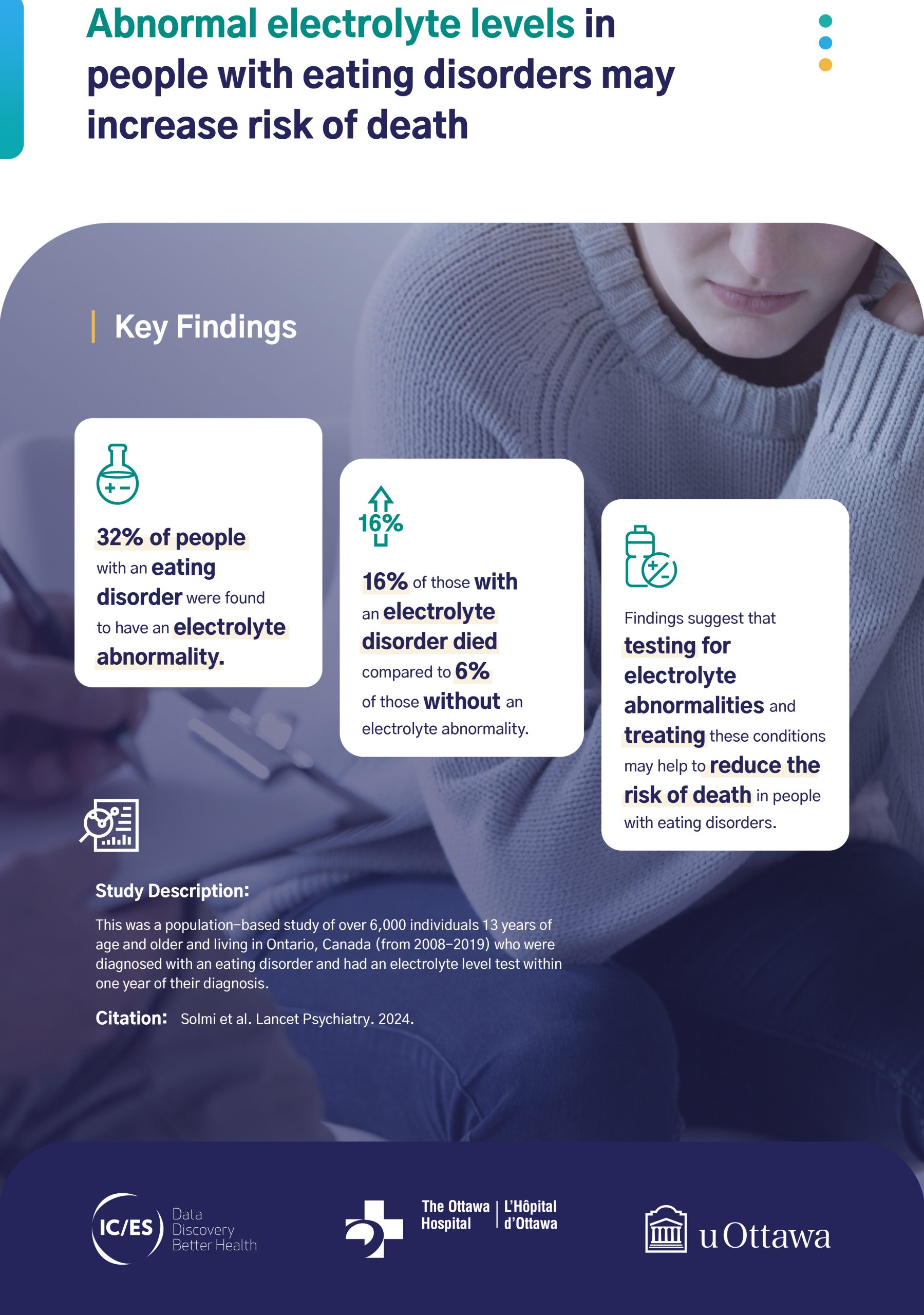
The researchers included over 6,000 individuals 13 years of age and older who were diagnosed with an eating disorder and had an electrolyte level test within one year of their diagnosis, as recorded on a hospitalization or emergency department record in the province of Ontario, Canada.
Health outcomes and mortality
Analyzing health records between 2008 and 2019, the researchers found that:
- Most people included in the study were diagnosed with an eating disorder not otherwise specified—disordered eating that falls outside the criteria for anorexia, bulimia, and binge eating (59%) — followed by anorexia nervosa (22%) and bulimia nervosa (15%).
- The mean age was 27 years, and 89% were female.
- 1,987 individuals (32%) had an electrolyte abnormality, and many had co-occurring health conditions.
- Among those with an electrolyte disorder, 16% died compared to 6% in those without an electrolyte abnormality.
- Electrolyte abnormalities were also associated with a higher risk of hospitalization and other serious health conditions, but not with a risk of infection or heart disease event.
“These findings underscore the importance of testing for electrolyte levels in people suffering from eating disorders, and then acting on those results to potentially reduce the risk of death or other severe outcomes,” says co-lead author Dr. Nicholas Fabiano, a psychiatry resident at The Ottawa Hospital and the University of Ottawa.
There is also a role for patient education and awareness. “Eating disorders are conditions that patients may often deny the existence of, or patients fail to appreciate the implications to their health. This study now shows that eating disorders which are severe enough to cause electrolyte disturbances have major ramifications in regard to long-term patient health outcomes,” says senior author Dr. Gregory Hundemer, an adjunct scientist at ICES, nephrologist and Lorna Jocelyn Wood Chair for Kidney Research at The Ottawa Hospital, and assistant professor at the University of Ottawa.
Finally, the researchers suggest that the findings can help to redefine how clinicians score the severity of eating disorders, which is currently based on a patient’s body mass index and the frequency of behaviors like binge episodes. Electrolyte abnormalities may be found in patients who do not fit more typical eating disorder presentations and could ultimately help improve care for these patients and reduce their risk of death or other negative outcomes.
Reference: “Adverse outcomes and mortality in individuals with eating disorder-related electrolyte abnormalities in Ontario, Canada: a population-based cohort study” by Marco Solmi, Nicholas Fabiano, Anna E Clarke, Stephen G Fung, Peter Tanuseputro, Greg Knoll, Daniel T Myran, Ann Bugeja, Manish M Sood and Gregory L Hundemer, 17 September 2024, The Lancet Psychiatry.
DOI: 10.1016/S2215-0366(24)00244-X
Never miss a breakthrough: Join the SciTechDaily newsletter.
Follow us on Google and Google News.
1 Comment
Wow, Ottawa Hospital and University of Ottawa, eating disorders correlating to electrolyte imbalance. It’s almost as if the patients have a disordered eating of electrolytes? Maybe next they should check food, if It’s Got Electrolytes, especially considering neither the article nor the study mentioned food. If they’re just trying to look busy, maybe next check blood sugar levels or for malnutrition.