
Close Menu
    Facebook X (Twitter) Instagram
    SciTechDaily
    • Biology
    • Chemistry
    • Earth
    • Health
    • Physics
    • Science
    • Space
    • Technology
    Facebook X (Twitter) Pinterest YouTube RSS
    SciTechDaily
    Home»Space»NASA’s Hubble Telescope Captures Close-up Portrait of Jupiter
    Space

    NASA’s Hubble Telescope Captures Close-up Portrait of Jupiter

    By Ann Jenkins / Ray Villard, Space Telescope Science InstituteApril 6, 2017No Comments4 Mins Read
    Facebook Twitter Pinterest Telegram LinkedIn WhatsApp Email Reddit
    Share
    Facebook Twitter LinkedIn Pinterest Telegram Email Reddit
    NASA's Hubble Gets a Close-up View of Jupiter
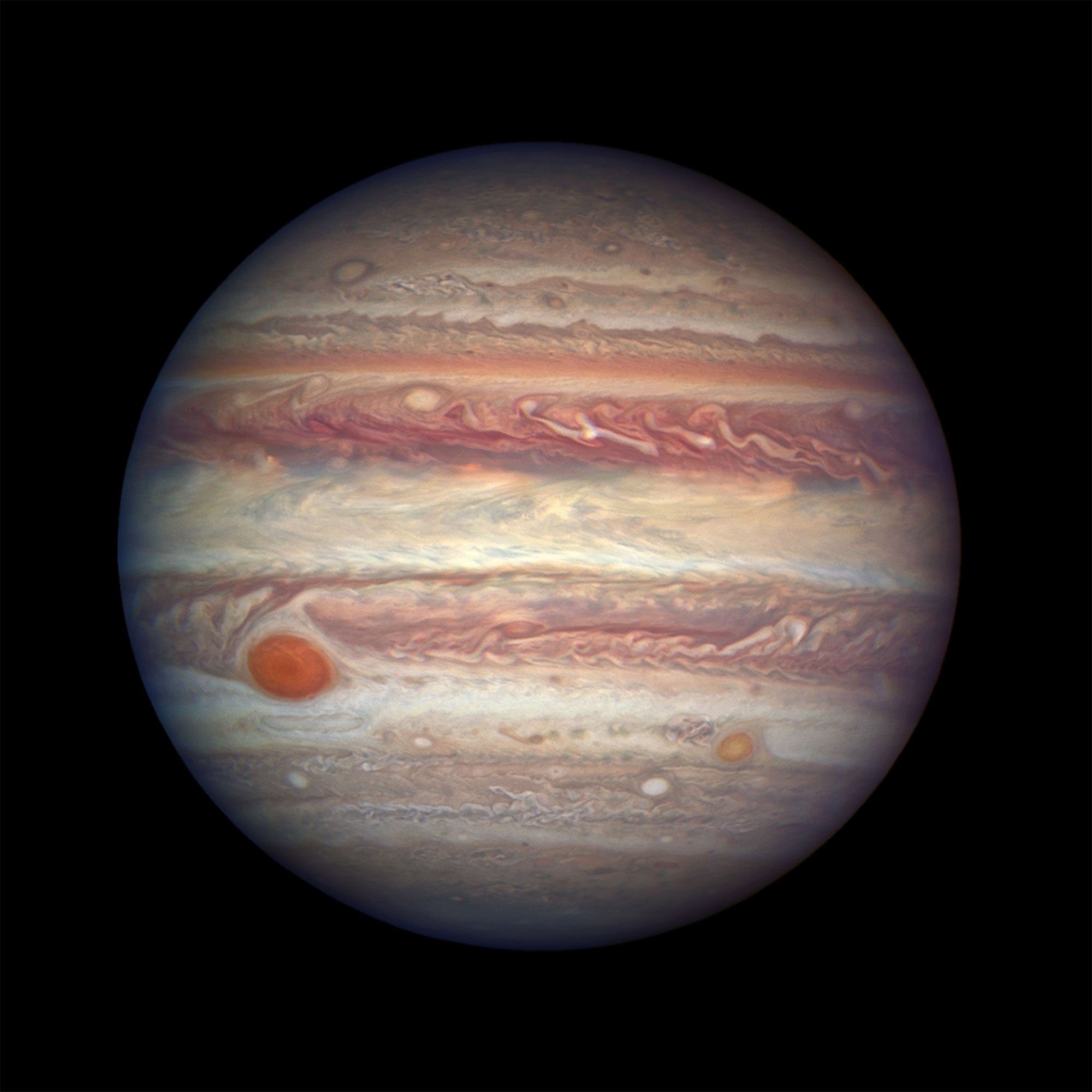
    Named after the Roman king of the gods, the immense planet Jupiter is undoubtedly king of the solar system. Containing more mass than all the other planets combined, Jupiter’s immense gravitational field deflects wayward comets that otherwise might slam into Earth, wreaking havoc. This stunning Hubble photo of Jupiter was taken when it was comparatively close to Earth, at a distance of 415 million miles. Hubble reveals the intricate, detailed beauty of Jupiter’s clouds as arranged into bands of different latitudes, known as tropical regions. These bands are produced by air flowing in different directions at various latitudes. Lighter colored areas, called zones, are high-pressure where the atmosphere rises. Darker low-pressure regions where air falls are called belts. The planet’s trademark, the Great Red Spot, is a long-lived storm roughly the diameter of Earth. Much smaller storms appear as white or brown-colored ovals. Such storms can last as little as a few hours or stretch on for centuries.

    As Jupiter made its nearest approach to Earth in a year, a distance of 415 million miles (668 million kilometers) away, Hubble took advantage and captured stunning images of the planet and its atmosphere.

    NASA’s Hubble Space Telescope viewed Jupiter as it made its nearest approach to Earth in a year, revealing the solar system’s largest planet in all of its up-close glory. Hubble captured spectacular views of the colorful, roiling atmosphere, the legendary Great Red Spot, and it smaller companion at farther southern latitudes dubbed “Red Spot Jr.”

    The giant planet is now at “opposition,” positioned directly opposite the sun from the Earth. This means that the sun, Earth and Jupiter line up, with Earth sitting between the sun and the gas giant. Opposition also marks Jupiter’s closest point to us, and the planet appears brighter in the night sky than at any other time in the year.

    This positioning allowed a team led by Amy Simon of NASA’s Goddard Space Flight Center in Greenbelt, Maryland to observe Jupiter using Hubble’s Wide Field Camera 3. Hubble photographed exquisite details in Jupiter’s atmosphere, as small as about 80 miles (129 kilometers) across.


    The Hubble Space Telescope observed Jupiter on April 3rd, 2017 – just days before Jupiter is in opposition on April 7th. This new image of Jupiter is part of Hubble’s Outer Planets Atmospheres Legacy program, which is one of many ways Hubble provides science on the Jupiter system.

    With its immense and powerful storms and hundreds of smaller vortices, the atmosphere of Jupiter is divided into several distinct, colorful bands, parallel to the equator. These bands, with alternating wind motions, are created by differences in the thickness and height of the ammonia ice clouds; the lighter bands rise higher and have thicker clouds than the darker bands. The bands are separated by winds that can reach speeds of up to 400 miles (644 kilometers) per hour.
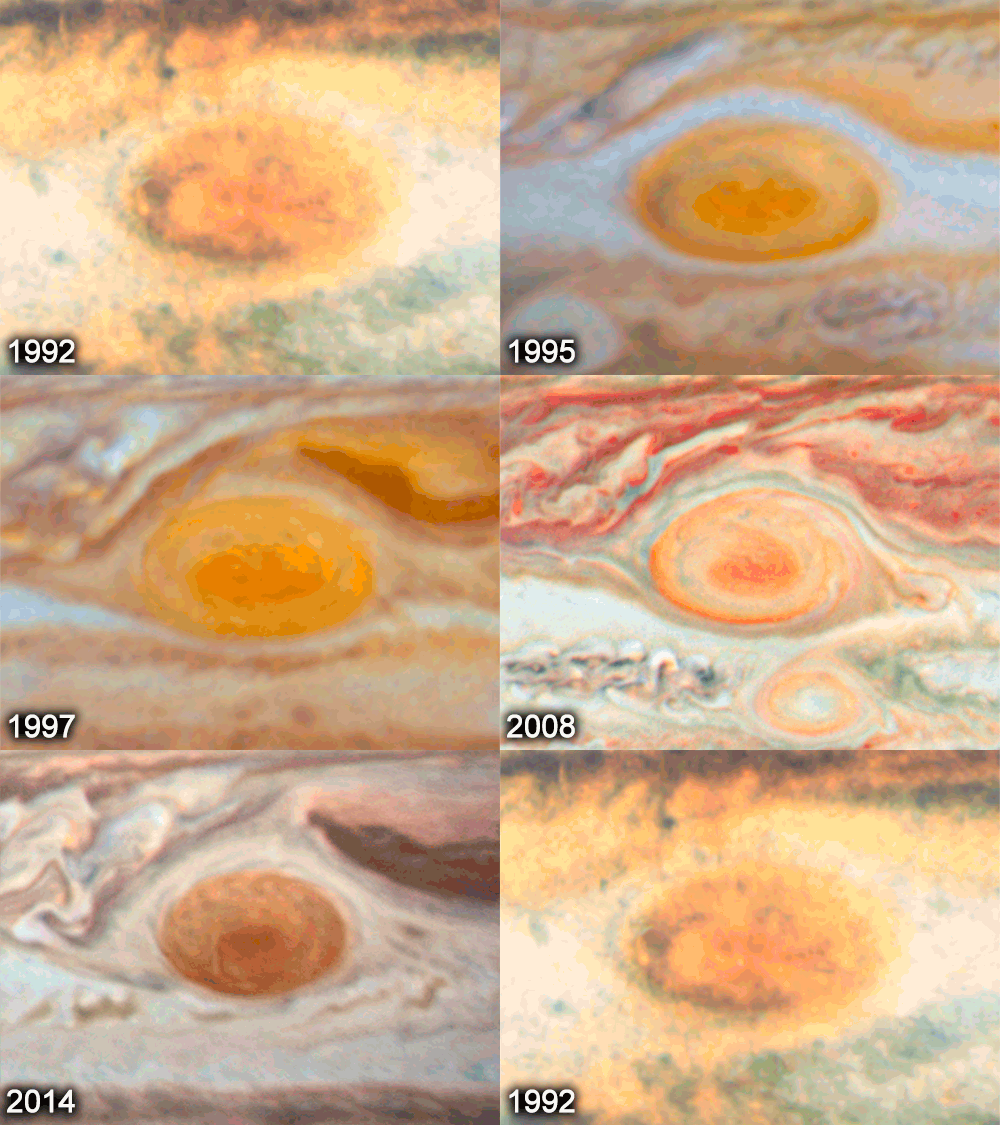
     Hubble Observations of Jupiter's Great Red Spot
    Animation showing Hubble observations of Jupiter’s Great Red Spot, 1992 through 2017.

    Jupiter is best known for the Great Red Spot, an anticyclone that has raged for at least 150 years. This famous storm is larger than Earth. However, the Great Red Spot is slowly shrinking — a trend seen since the late 1800s. The reason for this phenomenon is still unknown. Hubble will continue to observe Jupiter in hopes of solving this mysterious riddle.

    The images are part of the Outer Planets Atmospheres Legacy program or OPAL. This program provides yearly Hubble global views of the outer planets to look for changes in their storms, winds, and clouds. It began in 2014 with Uranus, and has been studying Jupiter and Neptune since 2015. In 2018, it will begin viewing Saturn.

    The team timed the Hubble observation to coincide with when NASA’s space probe Juno would be near its closest point to Jupiter, so that scientists could get concurrent observations.

    Never miss a breakthrough: Join the SciTechDaily newsletter.
    Follow us on Google and Google News.

    Astronomy Hubble Space Telescope Jupiter Planetary Science Popular
    Share. Facebook Twitter Pinterest LinkedIn Email Reddit

    Related Articles

    Hubble Telescope Views Vivid Auroras in Jupiter’s Atmosphere

    Radio Signals from Jupiter Could Aid in the Search for Extraterrestrial Life on Its Moons

    Jupiter’s Great Red Spot Has Shrunk to Its Smallest Known Size

    Hubble Reveals Cloudy Weather on Exoplanet GJ1214b

    Hubble Detects Water Vapor Over Jupiter’s Moon Europa

    Hubble Finds Signatures of Water on Distant Exoplanets

    Hubble Data Reveals a New Neptune Moon

    Herschel Solves Mystery of Origin of Water in the Upper Atmosphere of Jupiter

    New Study Revives Doubted Exoplanet Fomalhaut b

    Leave A Reply Cancel Reply

    • Facebook
    • Twitter
    • Pinterest
    • YouTube

    Don't Miss a Discovery

    Subscribe for the Latest in Science & Tech!

    Trending News

    Breakthrough Bowel Cancer Trial Leaves Patients Cancer-Free for Nearly 3 Years

    Natural Compound Shows Powerful Potential Against Rheumatoid Arthritis

    100,000-Year-Old Neanderthal Fossils in Poland Reveal Unexpected Genetic Connections

    Simple “Gut Reset” May Prevent Weight Gain After Ozempic or Wegovy

    2.8 Days to Disaster: Scientists Warn Low Earth Orbit Could Suddenly Collapse

    Common Food Compound Shows Surprising Power Against Superbugs

    5 Simple Ways To Remember More and Forget Less

    The Atomic Gap That Could Cost the Semiconductor Industry Billions

    Follow SciTechDaily
    • Facebook
    • Twitter
    • YouTube
    • Pinterest
    • Newsletter
    • RSS
    SciTech News
    • Biology News
    • Chemistry News
    • Earth News
    • Health News
    • Physics News
    • Science News
    • Space News
    • Technology News
    Recent Posts
    • After 37 Years, the World’s Longest-Running Soil Warming Experiment Uncovers a Startling Climate Secret
    • NASA Satellite Captures First-Ever High-Res View of Massive Pacific Tsunami
    • ADHD Isn’t Just a Deficit: Study Reveals Powerful Hidden Strengths
    • Scientists Uncover “Astonishing” Hidden Property of Light
    • Scientists Discover Stem Cells That Could Regrow Teeth and Bone
    Copyright © 1998 - 2026 SciTechDaily. All Rights Reserved.
    • Science News
    • About
    • Contact
    • Editorial Board
    • Privacy Policy
    • Terms of Use

    Type above and press Enter to search. Press Esc to cancel.