
Close Menu
    Facebook X (Twitter) Instagram
    SciTechDaily
    • Biology
    • Chemistry
    • Earth
    • Health
    • Physics
    • Science
    • Space
    • Technology
    Facebook X (Twitter) Pinterest YouTube RSS
    SciTechDaily
    Home»Health»Could We Be Fighting Alzheimer’s Wrong? New Research Suggests a Different Approach
    Health

    Could We Be Fighting Alzheimer’s Wrong? New Research Suggests a Different Approach

    By Universitat Autonoma de BarcelonaFebruary 14, 20255 Comments3 Mins Read
    Facebook Twitter Pinterest Telegram LinkedIn WhatsApp Email Reddit
    Share
    Facebook Twitter LinkedIn Pinterest Telegram Email Reddit
    Alzheimers Dementia Brain Disease Concept
    Researchers at INc-UAB found that tau and beta-amyloid affect different brain circuits in Alzheimer’s, with tau impairing memory and beta-amyloid causing emotional disturbances. A new transgenic mouse model replicating both pathologies suggests that dual-targeted therapies may be more effective than existing treatments.

    Using a new animal model of Alzheimer’s disease, the study highlights a potential breakthrough in treatment strategies. Unlike current therapies that primarily target a single toxic protein linked to the disease, this research explores a more comprehensive approach.

    A research team from the Institut de Neurociències at the Universitat Autònoma de Barcelona (INc-UAB) has identified how the two primary hallmarks of Alzheimer’s disease—tau protein and beta-amyloid—affect brain circuits in distinct yet complementary ways, particularly those involved in memory and emotions. The study, conducted in collaboration with the Centro de Investigación Biomédica en Red Enfermedades Neurodegenerativas (CIBERNED) and the Universidad Pablo de Olavide (UPO), provides new insights into the mechanisms underlying the disease.

    Published in Molecular Psychiatry, the research shows that tau accumulation in the hippocampus primarily contributes to memory deficits, while beta-amyloid buildup in the amygdala leads to emotional disturbances such as anxiety and fear—both of which are early symptoms of Alzheimer’s. Furthermore, the presence of both pathologies together exacerbates brain inflammation and dysfunction, amplifying their overall impact on cognitive and emotional health.

    The Research Team From the INc UAB That Conducted the Study
    The research team from the INc-UAB that conducted the study. From left to right: Ángel Deprada, Arnaldo Parra-Damas, Paula Sotillo, Carles Saura y Maria Dolores Capilla-López. Credit: UAB

    For decades, research into Alzheimer’s disease has been shaped by two theories: one suggesting that the disease originates from tau buildup inside neurons, and another pointing to beta-amyloid accumulation as the primary trigger. These perspectives have largely dictated current therapeutic approaches, with treatments aiming to prevent the buildup of either tau or beta-amyloid in hopes of slowing disease progression.

    However, the research team led by researchers Carles Saura and Arnaldo Parra-Damas, from the UAB Department of Biochemistry and Molecular Biology and the INc-UAB, argues that a dual-targeted therapeutic strategy may be necessary to effectively combat this disease.

    A New Transgenic Mouse Model

    This breakthrough was made possible by the development of a novel transgenic mouse model that replicates both tau and beta-amyloid pathologies. “Although both proteins accumulate in the brains of Alzheimer’s patients, most animal models used for studying the disease typically focus on only one of these factors,” explains researcher Maria Dolores Capilla, lead author of the study.
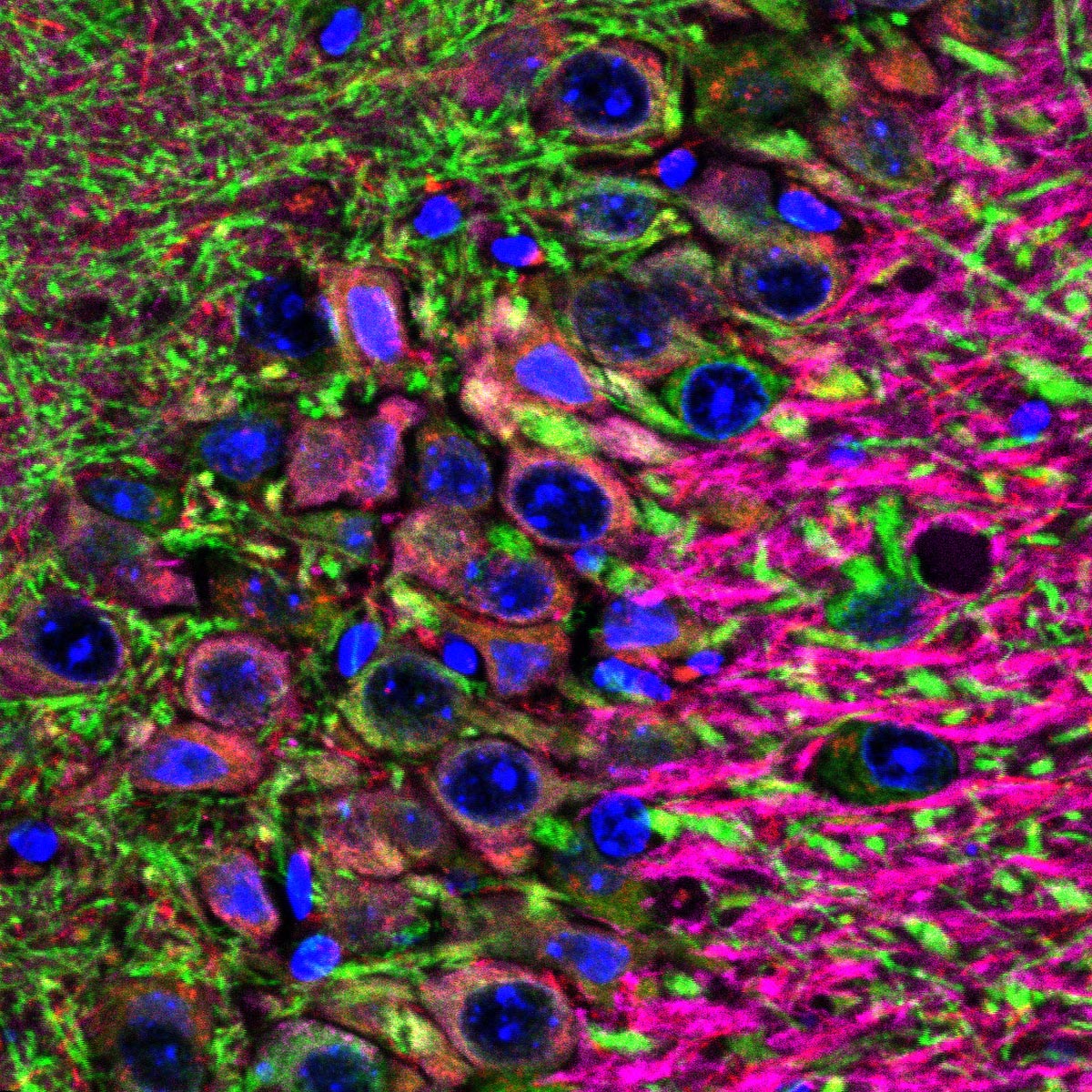
    Neurons of the Hippocampus
    Image of neurons of the hippocampus that regulates memory are affected by Alzheimer’s disease pathology in the mouse model generated in the study. Credit: UAB

    “In our research, we generated a transgenic mouse model exhibiting both tau and beta-amyloid accumulation, allowing us to analyze their individual and combined effects,” adds the INc-UAB researcher.

    These findings could reshape current treatment strategies, which often target only one of these toxic proteins.

    “Existing therapies have not achieved clear clinical benefits. Our study suggests that a therapeutic approach addressing multiple disease mechanisms—such as phosphorylated tau and beta-amyloid—could be more effective,” concludes Carles Saura.

    While further research is needed to confirm its applicability to humans, this study represents a significant step toward new investigative pathways for Alzheimer’s treatment, the research team concludes.

    Reference: “Synaptic vulnerability to amyloid-β and tau pathologies differentially disrupts emotional and memory neural circuits” by Maria Dolores Capilla-López, Angel Deprada, Yuniesky Andrade-Talavera, Irene Martínez-Gallego, Heriberto Coatl-Cuaya, Paula Sotillo, José Rodríguez-Alvarez, Antonio Rodríguez-Moreno, Arnaldo Parra-Damas and Carlos A. Saura, 30 January 2025, Molecular Psychiatry.
    DOI: 10.1038/s41380-025-02901-9

    Never miss a breakthrough: Join the SciTechDaily newsletter.
    Follow us on Google and Google News.

    Alzheimer's Disease Amygdala Brain Hippocampus Neuroscience Popular Universitat Autonoma de Barcelona
    Share. Facebook Twitter Pinterest LinkedIn Email Reddit

    Related Articles

    The Hidden Belly Fat That Quietly Ages Your Brain

    Scientists Find a Way to Help the Brain Clear Alzheimer’s Plaques Naturally

    Tiny Brain Tubes Discovered by Johns Hopkins Could Explain Alzheimer’s

    Breakthrough Vitamin K Compounds May Reverse Alzheimer’s Damage

    This Common Sleep Aid May Also Protect Your Brain From Alzheimer’s

    According to Harvard Scientists, This Missing Nutrient May Be the Key to Stopping Alzheimer’s

    Some Brains Stay Sharp Thanks to a Plaque Eating Immune Cell That Fights Alzheimer’s

    Scientists Discover the Brain’s “Reset Button” That Separates Your Memories

    This Tau Brain Scan Could Predict Alzheimer’s Early

    5 Comments

    1. What's my name again on February 14, 2025 9:33 am

      They’re prob jus forgetful… lol

      Reply
    2. Boba on February 15, 2025 9:11 am

      I didn’t know we were fighting Alzheimer’s at all, let alone “wrong”.

      Reply
    3. Babs on February 18, 2025 10:16 am

      Well there is tons of research but a research study by a Dr whose husband had Alzheimers years ago did a 20 year study with autopsies. She found no clear connection between amyloid tangles and the disease . As a former VA nurse can tell you our government paid millions of dollars for Aricept that did nothing for the patients for many many years and may still be buying it.

      Reply
      • Nope on February 18, 2025 2:16 pm

        Old and out-dated theories. Alzheimer’s is due to insulin resistance and the resulting metabolic issues.

        Reply
        • Jeanette Clarkson on February 20, 2025 4:01 am

          Our current administration in the U.S. is more dedicated to cutting research and lining their pockets than to discover new ways to help people. Luckily other countries still care.

          Reply
    Leave A Reply Cancel Reply

    • Facebook
    • Twitter
    • Pinterest
    • YouTube

    Don't Miss a Discovery

    Subscribe for the Latest in Science & Tech!

    Trending News

    First-of-Its-Kind Discovery: Homer’s Iliad Found Embedded in a 1,600-Year-Old Egyptian Mummy

    Beyond Inflammation: Scientists Uncover New Cause of Persistent Rheumatoid Arthritis

    A Simple Molecule Could Unlock Safer, Easier Weight Loss

    Scientists Just Built a Quantum Battery That Charges Almost Instantly

    Researchers Unveil Groundbreaking Sustainable Solution to Vitamin B12 Deficiency

    Millions of People Have Osteopenia Without Realizing It – Here’s What You Need To Know

    Researchers Discover Boosting a Single Protein Helps the Brain Fight Alzheimer’s

    World-First Study Reveals Human Hearts Can Regenerate After a Heart Attack

    Follow SciTechDaily
    • Facebook
    • Twitter
    • YouTube
    • Pinterest
    • Newsletter
    • RSS
    SciTech News
    • Biology News
    • Chemistry News
    • Earth News
    • Health News
    • Physics News
    • Science News
    • Space News
    • Technology News
    Recent Posts
    • Unusually Warm Water Detected Creeping Toward Antarctica – and Scientists Are Alarmed
    • Scientists Uncover Hidden Property of Light That Twists Matter Sideways
    • Artemis II Just Proved NASA Is Closer Than Ever to Returning to the Moon
    • NASA Powers Down Voyager 1 Instrument As It Fights To Survive Deep Space
    • Physicists Propose Strange Experiment Where Time Goes Quantum
    Copyright © 1998 - 2026 SciTechDaily. All Rights Reserved.
    • Science News
    • About
    • Contact
    • Editorial Board
    • Privacy Policy
    • Terms of Use

    Type above and press Enter to search. Press Esc to cancel.