

The brain’s immune cells removed plaques and helped restore a healthier environment in the brains of immunized patients.
For over 30 years, scientists have focused on treating Alzheimer’s disease by removing amyloid beta plaques, sticky, toxic protein clusters that build up in the brain. But a new study from Northwestern Medicine offers a promising new approach: boosting the brain’s own immune cells to clear these plaques more effectively.
This shift could transform how Alzheimer’s is treated, moving the focus from external plaque removal to activating the brain’s natural defenses.
Past efforts to develop a vaccine failed when the immune response led to harmful brain swelling. Even today’s FDA-approved antibody therapies are controversial. They offer limited benefits, come with side effects, and are often expensive.
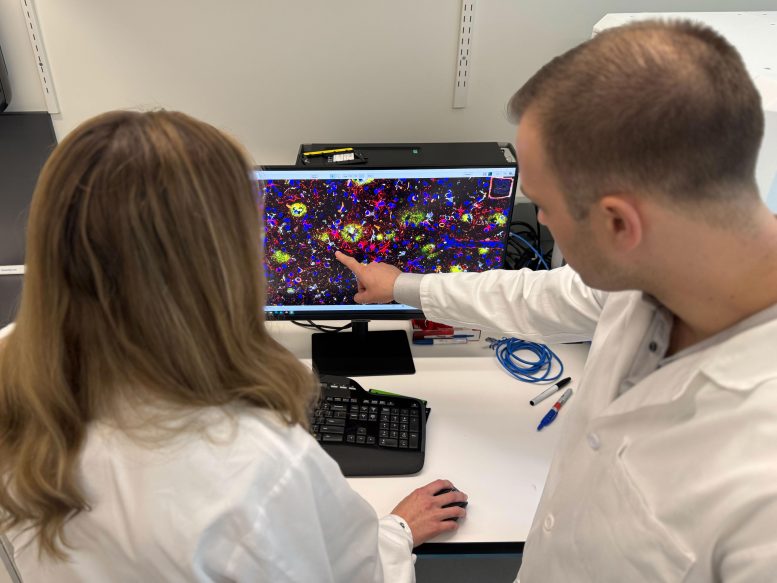
“Although these drugs are improving, they still don’t cure Alzheimer’s,” said David Gate, assistant professor of neurology at Northwestern University Feinberg School of Medicine and director of the Abrams Research Center on Neurogenomics. “They work by stimulating the brain’s immune cells to clear amyloid beta. Our findings suggest ways to make these drugs even more effective.”
The paper was recently published in Nature Medicine.
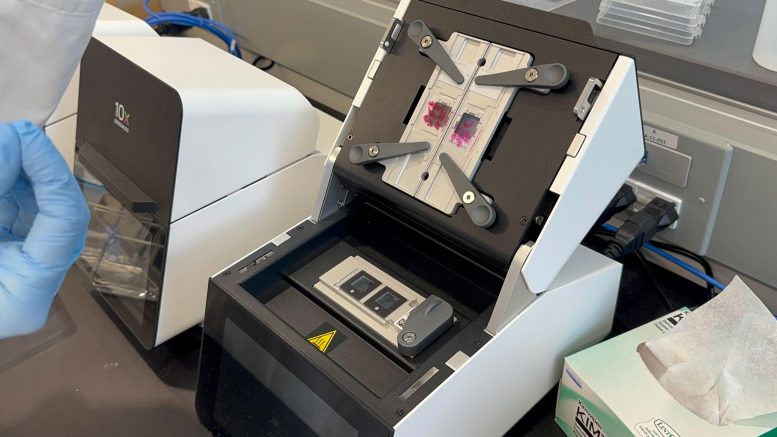
The study is the first to use a cutting-edge technique called spatial transcriptomics on human clinical-trial brains with Alzheimer’s disease. The technique allows scientists to pinpoint the specific spatial location of gene activity inside a tissue sample.
By analyzing donated brain tissue from deceased people with Alzheimer’s disease who received amyloid-beta immunization and comparing it to those who did not, the scientists found that when these treatments work, the brain’s immune cells (called microglia) don’t just clear plaques — they also help restore a healthier brain environment.
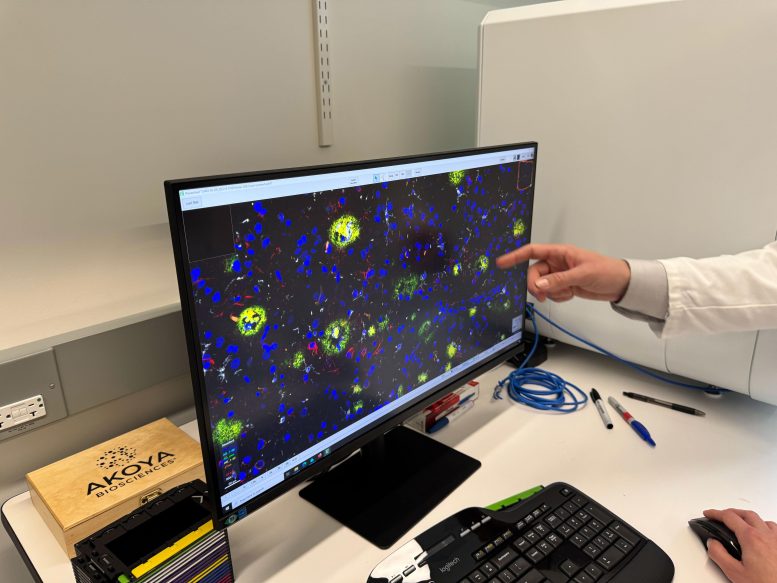
But not all microglia are created equal. Some are quite effective at removing plaques, while others struggle, the study found. Also, microglia in treated brains adopt distinct states depending on the brain region and type of immunization. Lastly, certain genes, like TREM2 and APOE, are more active in microglia in response to treatment, helping these cells remove amyloid beta plaques, according to the findings.
“A long-standing question in the field of Alzheimer’s therapeutics is if we coax these immune cells into removing the amyloid, are they just always going to be in that amyloid-removal mode?” Gate said. “The answer we found is no, they can remove the amyloid and then go back to being good and appear to actually help the brain heal.”
Stopping Alzheimer’s ‘dominoes’ from falling
The amyloid cascade hypothesis, the prevailing theory of Alzheimer’s disease development, can be compared to a row of dominoes.
If amyloid plaques can be cleared from the brain before they trigger the formation of tau pathology — the key driver of cognitive decline in Alzheimer’s patients — the cascade is halted before it can begin, preventing further damage.
“The idea is that in people who already have Alzheimer’s disease, yes, you can maybe remove amyloid, but if the tau spread has been set in motion, you are fighting an uphill battle,” Gate said. “But maybe, if you treat people so early that they don’t yet have tau pathology, you can stop the domino effect from happening. Our study is the first to identify the mechanisms in microglia, the brain’s immune cells, that help limit the spread of amyloid in certain brain regions following treatment with amyloid-targeting drugs.
“If we can define the mechanisms that are associated with clearance of the pathology, and we can find the genetic makeup of immune cells that are associated with people that are really responding well to the drug, then maybe one day we can circumvent the whole drug process and just target these specific cells,” Gate said.
Currently, there isn’t a way to target these immune cells, Gate said, but methods of targeting cells in the brain are improving year over year.

How the study was conducted
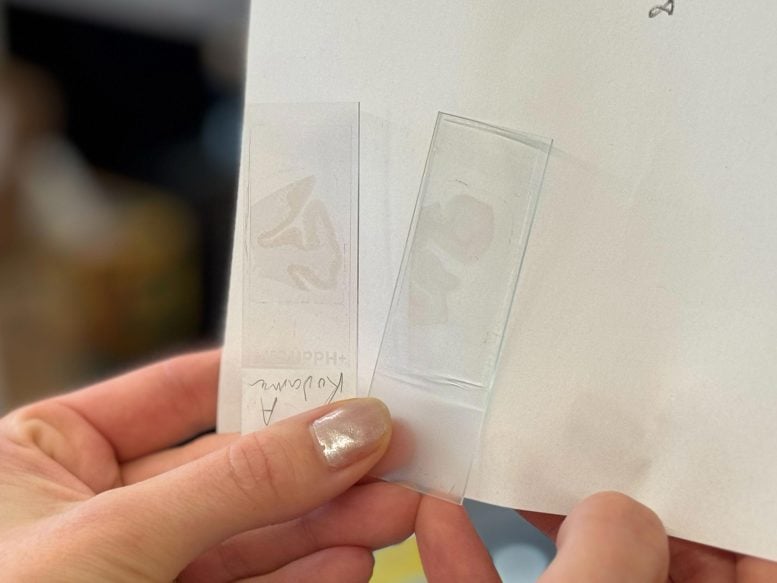
The study included six control brains that had no neurologic disease; six brains with Alzheimer’s disease that had not been treated with any immunization drug; and 13 brains that had been vaccinated with amyloid beta. Of those 13, seven had high levels of amyloid-plaque clearance in the brain while the other six had limited amounts of clearance.

The scientists then compared the immune cells in the brains between those two groups.
“Our study is highly novel because we had the rare opportunity to analyze one of the largest post-mortem brain cohorts of Alzheimer’s patients treated with amyloid-targeting drugs — similar to those now approved by the FDA for Alzheimer’s disease,” said lead author Lynn van Olst.

“This allowed us to investigate the brain mechanisms that determine why some individuals respond well to these treatments and successfully clear toxic amyloid-beta, while others do not. We found that brain immune cells play a crucial role in this process and identified the molecular genetic factors that drive these differences.”
Reference: “Microglial mechanisms drive amyloid-β clearance in immunized patients with Alzheimer’s disease” by Lynn van Olst, Brooke Simonton, Alex J. Edwards, Anne V. Forsyth, Jake Boles, Pouya Jamshidi, Thomas Watson, Nate Shepard, Talia Krainc, Benney MR Argue, Ziyang Zhang, Joshua Kuruvilla, Lily Camp, Mengwei Li, Hang Xu, Jeanette L. Norman, Joshua Cahan, Robert Vassar, Jinmiao Chen, Rudolph J. Castellani, James AR Nicoll, Delphine Boche and David Gate, 6 March 2025, Nature Medicine.
DOI: 10.1038/s41591-025-03574-1
Funding for the study was provided by the National Institutes of Health National Institutes of Aging R01 grant AG078713, BrightFocus Foundation A2023003S, Alzheimer’s Association 23AARG-1026607, Alzheimer Nederland Impulssubsidie grant WE.06-2023-03 and Alzheimer Nederland Early Career grant WE.03-2023-08.
Never miss a breakthrough: Join the SciTechDaily newsletter.
Follow us on Google and Google News.
1 Comment
Plague was debunked as a cause of Alzheimers so once again, science fraud.