
Close Menu
    Facebook X (Twitter) Instagram
    SciTechDaily
    • Biology
    • Chemistry
    • Earth
    • Health
    • Physics
    • Science
    • Space
    • Technology
    Facebook X (Twitter) Pinterest YouTube RSS
    SciTechDaily
    Home»Space»Characteristics of the Remarkable Jet in Quasar 4C+19.44
    Space

    Characteristics of the Remarkable Jet in Quasar 4C+19.44

    By Harvard-Smithsonian Center For AstrophysicsOctober 13, 2017No Comments3 Mins Read
    Facebook Twitter Pinterest Telegram LinkedIn WhatsApp Email Reddit
    Share
    Facebook Twitter LinkedIn Pinterest Telegram Email Reddit
    Multi-Band Study of the Remarkable Jet in Quasar 4C+19.44
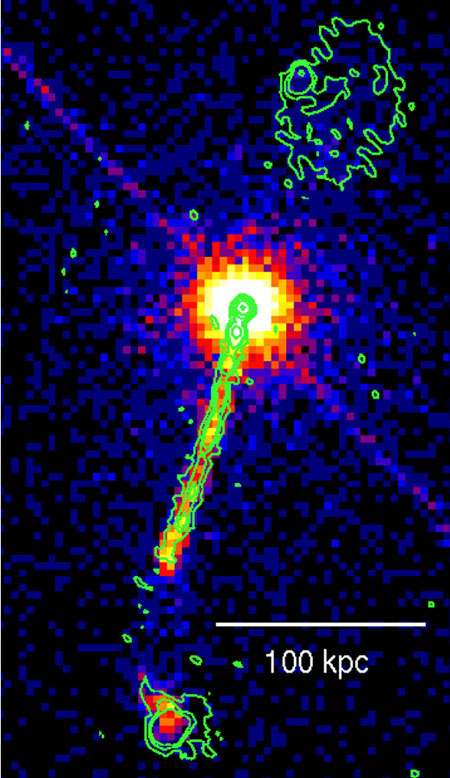
    A Chandra X-ray image of the quasar 3C19.44. The overlayed contours show the radio emission (the dimension 100kpc corresponds to 329,000 light-years; the extremely bright core produces a line of bright pixels as an artifact). NASA/Chandra VLA and Harris et al.

    Using a combination of multiwavelength observations, astronomers measure the characteristics of the Remarkable Jet in Quasar 4C+19.44.

    Quasars are galaxies with massive black holes at their cores. So much energy is being radiated from near the nucleus of a quasar that it is much brighter than the rest of the entire galaxy. Much of that radiation is at radio wavelengths, produced by electrons ejected from the core at speeds very close to that of light, often in narrow, bipolar jets that are hundreds of thousands of light-years long. The fast-moving charged particles can also scatter photons of light, kicking them up in energy into the X-ray range. Even after more than two decades of study, however, there is still no clear conclusion as to the physical mechanism actually responsible for the X-ray emission. In more powerful quasars, it does appear that this scattering process dominates. In lower-power jets, however, the emission characteristics suggest that the X-ray emission is dominated by magnetic field effects, not scattering.

    The lead author of a new paper on the remarkable jet in the quasar 4C+19.44 is CfA astronomer Dan Harris, who very sadly passed away in December, 2015, after a long and productive career. His CfA teammates on this project, Dan Schwartz with Nicholas Lee and Aneta Siemiginowska, worked to finish the research together with an international team of colleagues. The scientists undertook a detailed, high spatial resolution study of the straight, three hundred thousand light-years long jet in this quasar using multiwavelength data from the Chandra (X-ray), Spitzer (infrared), and Hubble (optical) space observatories as well as from the Very Large Array (radio).

    The combination of multiwavelength observations with high spatial resolution enabled the team to measure the characteristics of the emission systematically in ten distinct knots along the jets. They find that both the magnetic field strength and the particle velocities are (remarkably) quite constant all along the length of this jet, at least when presuming the scattering process dominates. But the scientists are not able to exclude magnetic effects as producing some of the X-ray emission. They do conclude, however, that for the magnetic process to be active, any electrons contributing to it must belong to a separate population that is distinct from the electrons that dominate the scattering.

    Reference: “A Multi-band Study of the Remarkable Jet in Quasar 4C+19.44” by D. E. Harris1, N. P. Lee, D. A. Schwartz, A. Siemiginowska, F. Massaro, M. Birkinshaw, D. M. Worrall, C. C. Cheung, J. M. Gelbord, Svetlana G. Jorstad, Alan P. Marscher, H. Land1, H. Marshall, E. S. Perlman, L. Stawarz1, Y. Uchiyama and C. M. Urry, 8 September 2017, The Astrophysical Journal.
    DOI: 10.3847/1538-4357/aa845c
    PDF

    Never miss a breakthrough: Join the SciTechDaily newsletter.
    Follow us on Google and Google News.

    Astronomy Cosmology Harvard-Smithsonian Center for Astrophysics Quasars
    Share. Facebook Twitter Pinterest LinkedIn Email Reddit

    Related Articles

    Astronomers Just Reconstructed a Galaxy’s 12-Billion-Year History

    Was the James Webb Telescope Broken? The Real Culprit Was a Monster Black Hole

    Webb’s Mysterious “Little Red Dots” May Be the Cradle of the First Black Holes

    Mysterious Radio Signals Reveal What’s Hiding Between Galaxies

    Cosmic Mystery Solved: Astronomers Have Discovered the Universe’s “Missing” Matter

    Invisible Storm Lights Up Galaxy Cluster With Record-Breaking Radio Glow

    Scientists Use Quasars To Probe Dark Energy & Measure Its Role in the Evolution of the Universe

    Astronomers Record Detailed Measurements of the Inner Region of a Quasar Nucleus

    Calculations Show the Ideal Time to Study the Cosmos

    Leave A Reply Cancel Reply

    • Facebook
    • Twitter
    • Pinterest
    • YouTube

    Don't Miss a Discovery

    Subscribe for the Latest in Science & Tech!

    Trending News

    Magnetic Bacterium Extends Lifespan by 43% in Surprising Anti-Aging Study

    Archaeologists Discover Evidence of “Brands” 3,200 Years Before Modern Capitalism

    The Rare Vision Side Effect of Ozempic and Wegovy You Should Know About

    Hidden Deep Beneath Mars, Scientists Find Evidence of a Vast Magmatic System

    Your Gut Microbiome May Be Contagious, Scientists Discover

    Scientists Find a Troubling Effect of Sitting That Exercise Couldn’t Prevent

    125-Million-Year-Old Crocodile Fossil Reveals Astonishing New Secrets

    Scientists Discover an “Impossible” Way Muscle Filaments Can Grow

    Follow SciTechDaily
    • Facebook
    • Twitter
    • YouTube
    • Pinterest
    • Newsletter
    • RSS
    SciTech News
    • Biology News
    • Chemistry News
    • Earth News
    • Health News
    • Physics News
    • Science News
    • Space News
    • Technology News
    Recent Posts
    • Scientists Discover a “Loose Cannon” Virus Enzyme That Rewires Nearly Every Protein in a Bacterial Cell
    • Scientists Tracked Galápagos Sea Turtles for Years – What They Found Was Unexpected
    • Scientists Discover a “New” Frog That Was Hiding in Plain Sight for 100 Years
    • Humanity’s Carbon Signature Is Now Embedded Deep in the Ocean
    • Scientists Find TNT Leaking From a 100-Year-Old Submarine Wreck
    Copyright © 1998 - 2026 SciTechDaily. All Rights Reserved.
    • Science News
    • About
    • Contact
    • Editorial Board
    • Privacy Policy
    • Terms of Use

    Type above and press Enter to search. Press Esc to cancel.