
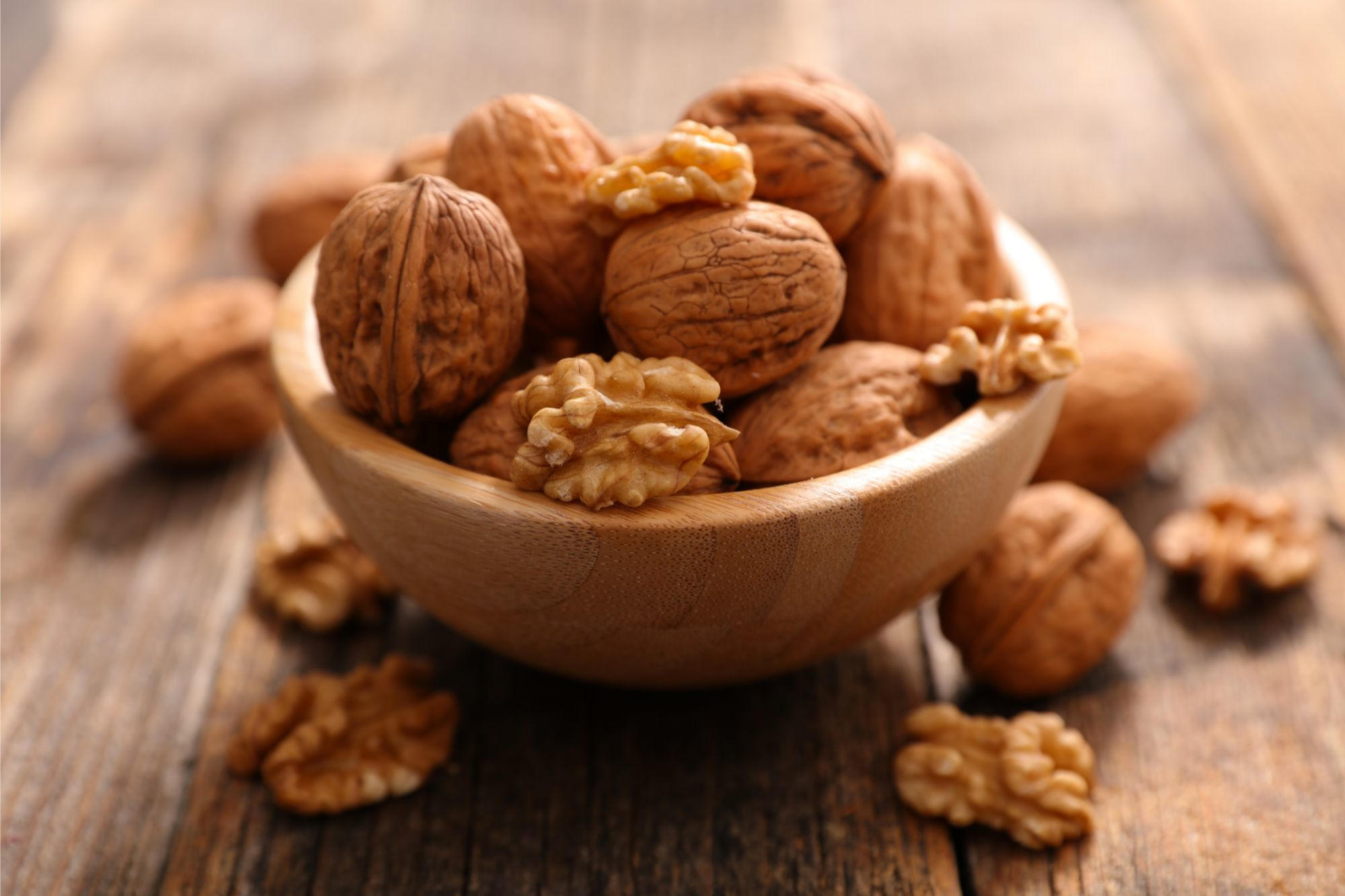
A UConn clinical trial confirms that eating walnuts promotes colonic health and may help prevent cancer.
New research highlights the health benefits of eating walnuts. A clinical trial conducted by the UConn School of Medicine, featured on the cover of the April issue of Cancer Prevention Research, found that walnuts help reduce systemic inflammation and lower the risk of colon cancer.
Why walnuts?
Ellagitannins, plant-derived polyphenol compounds found in walnuts, are metabolized exclusively by the gut microbiome into a variety of anti-inflammatory molecules known as urolithins. These urolithins exhibit strong anti-inflammatory effects and may also have cancer-inhibiting properties.
“Ellagitannins in the walnut are importantly providing the anti-inflammatory and anti-cancer properties that we’re seeing in patients in our clinical trial research, particularly the gut’s conversion of ellagitannins to a potent anti-inflammatory agent, urolithin A,” reports Daniel W. Rosenberg, Ph.D. and his multidisciplinary team of researchers at the UConn School of Medicine.
Dr. Rosenberg, who serves as the HealthNet Chair in Cancer Biology and as an Investigator in the Center for Molecular Oncology, has spent more than a decade studying the health effects of walnuts, with a particular focus on their anti-inflammatory properties.
The UConn research team’s clinical trial findings show that high levels of urolithin A formation by the gut microbiome from walnut consumption has a positive impact on reducing inflammatory markers across blood, urine, and fecal samples, and may even positively affect the immune cells within colon polyps.
Clinical Trial Design
For the clinical trial, patients between the ages of 40 to 65 years and at an elevated risk for colon cancer, were referred for the study from the Division of Gastroenterology at UConn Health, the University of Connecticut’s academic medical center. Each of the 39 enrolled study participants were screened by the clinical research team at UConn John Dempsey Hospital and asked to complete an NIH Food Frequency Questionnaire for analysis by Ock Chun Ph.D., a nutritional epidemiologist in the College of Agriculture, Health and Natural Resources at UConn Storrs.
Patients were asked to avoid all ellagitannin-containing foods and beverages for a week to set their urolithin levels at or close to zero before they began consuming ellagitannin-rich walnuts as part of their closely monitored diet. At the end of the three-week study, all participants received a high-definition colonoscopy performed by Drs. John Birk and Haleh Vaziri.
Among the key findings, the researchers found that elevated urolithin A levels in the urine of patients correlated with the serum levels of peptide YY, an interesting protein that has been associated with inhibition of colorectal cancer. Reduced levels of several inflammation markers present in the blood were also found, especially in obese patients that had the greatest capacity to form urolithins by their gut microbiome.
Rosenberg also used high-dimensional spatial imaging technology that allowed UConn researchers to develop a detailed view of the direct cellular interactions present inside colon polyps that were removed during colonoscopy at the end of the walnut study. This cutting-edge advanced imaging technology revealed that patients with high levels of urolithin A formation following walnut consumption was directly associated with reduced levels of several important proteins that are often present in polyps, showing for the first time how walnut ingestion may directly enhance colon health.
The research team also discovered that the protein vimentin, often associated with more advanced forms of colon cancer, was greatly reduced inside polyp tissues obtained from patients who had also formed the highest levels of urolithin A by their gut microbiome.
Building on Previous Research
These important new research findings build upon the earlier work of Dr. Masako Nakanishi, an assistant professor in the Rosenberg Lab, who showed in several earlier publications that walnuts had beneficial and anti-cancer effects in the colons of cancer-prone mice, key findings that prompted the current clinical trial.
“Urolithin A has a very positive influence on inflammation and maybe even cancer prevention,” says Rosenberg. “Our study proves that dietary supplementation with walnuts can boost the general population’s urolithin levels in those people with the right microbiome, while significantly reducing several inflammatory markers, especially in obese patients.”
Rosenberg concludes, “Our study provides strong rationale for dietary inclusion of walnut ellagitannins for cancer prevention. Nutrients from walnuts can contribute to reduced cancer risk. There are many potential benefits one can get from eating walnuts, with so little downside risk, that just grabbing a handful every day is really something that you can easily do for your long-term health benefit.”
Reference: “Systemic Inflammation and the Inflammatory Context of the Colonic Microenvironment Are Improved by Urolithin A” by Marmar R. Moussa, Nuoxi Fan, John Birk, Anthony A. Provatas, Pratik Mehta, Yuichiro Hatano, Ock K. Chun, Manije Darooghegi Mofrad, Ali Lotfi, Alexander Aksenov, Vinicius N. Motta, Maryam Zenali, Haleh Vaziri, James J. Grady, Masako Nakanishi and Daniel W. Rosenberg, 1 April 2025, Cancer Prevention Research.
DOI: 10.1158/1940-6207.CAPR-24-0383
This research is supported by generous awards from the American Institute for Cancer Research, the California Walnut Commission, and the National Cancer Institute.
Never miss a breakthrough: Join the SciTechDaily newsletter.
Follow us on Google and Google News.