
Close Menu
    Facebook X (Twitter) Instagram
    SciTechDaily
    • Biology
    • Chemistry
    • Earth
    • Health
    • Physics
    • Science
    • Space
    • Technology
    Facebook X (Twitter) Pinterest YouTube RSS
    SciTechDaily
    Home»Chemistry»Uranium Performs Reactions That No One Thought Were Possible
    Chemistry

    Uranium Performs Reactions That No One Thought Were Possible

    By University of ManchesterDecember 1, 20171 Comment2 Mins Read
    Facebook Twitter Pinterest Telegram LinkedIn WhatsApp Email Reddit
    Share
    Facebook Twitter LinkedIn Pinterest Telegram Email Reddit
    Chemistry Breakthrough Could Pave the Way for New Materials
    Research found uranium can perform reactions that previously no one thought possible, potentially revolutionizing chemical, polymer, drug, and plastic production, 

    New research from the University of Manchester reveals that uranium can perform reactions that previously no one thought possible, which could transform the way industry makes bulk chemicals, polymers, and the precursors to new drugs and plastics.

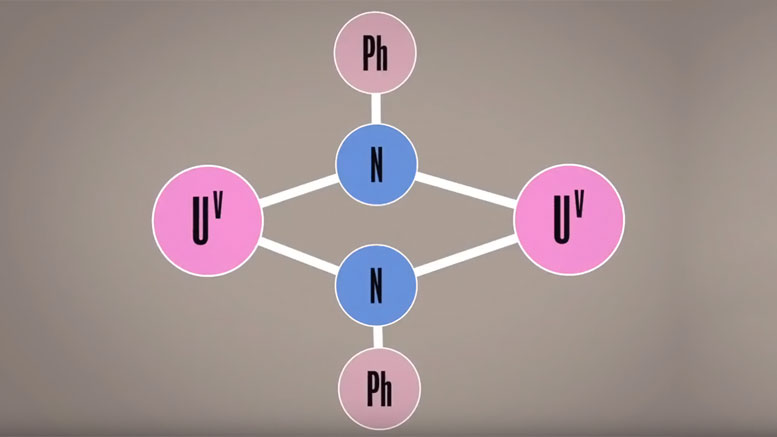
    Writing in the journal Nature Communications, the chemists have discovered that uranium can perform reactions that used to be the preserve of transition metals such as rhodium and palladium. And because uranium sits between different types of reactivity of lanthanides and transition metals it might be able to combine the best of both to give new ways of producing materials and chemicals.

    This discovery is also profiled in a new video which is part of a series produced by the School of Chemistry. Other videos show how chemists at Manchester have developed the world’s smallest fuel-powered motor and identified that Parkinson’s sufferers can have a unique smell identifying the disease — before any medical professional can see symptoms.

    The latest discovery means that industry might now be in a position to develop new compounds that can’t be made in any other way.

    What’s more, uranium is one of the elements we know the least about and while it is associated with nuclear weapons and nuclear power, the new discovery suggests other uses may be on the horizon.

    Steve Liddle, Professor and Head of Inorganic Chemistry, and author of the paper, said: “This discovery will lead to some monumental developments that could change the way we live. Development work like this really could pave the way for new medicines and also the creation of truly biodegradable hard plastic.”

    “It is comparable to the discovery of liquid crystal displays, which happened 20 years before everyone sat up and realized that they could be used in modern computer displays and TVs.”

    Reference: “Evidence for single metal two electron oxidative addition and reductive elimination at uranium” by Benedict M. Gardner, Christos E. Kefalidis, Erli Lu, Dipti Patel, Eric J. L. McInnes, Floriana Tuna, Ashley J. Wooles, Laurent Maron and Stephen T. Liddle, 1 December 2017, Nature Communications.
    DOI: 10.1038/s41467-017-01363-0

    Never miss a breakthrough: Join the SciTechDaily newsletter.
    Follow us on Google and Google News.

    Popular University of Manchester
    Share. Facebook Twitter Pinterest LinkedIn Email Reddit

    Related Articles

    New Catalyst Turns Stubborn Plant Waste Into Valuable Chemicals

    Visual Evidence That Atmospheric Particles Can Undergo Liquid–Liquid Phase Separations

    Olympicene, the Smallest Possible Five-Ringed Structure

    Working to Recycle Greenhouse Gases

    Gold Nanorods Shaped as Starfruit Deliver Impressive Results

    Unlocking Chemical Pathways to Synthesize Chemicals Found in Nature

    Chemists Work on Synthetic Cell Creation

    Criegee Biradicals May Cool Planet and Offset Global Warming

    Graphene Turned Magnetic by University of Manchester Researchers

    1 Comment

    1. n2o3 on December 5, 2017 4:45 am

      Thanks for the content, the untapped potential seems to be immense!:)

      Reply
    Leave A Reply Cancel Reply

    • Facebook
    • Twitter
    • Pinterest
    • YouTube

    Don't Miss a Discovery

    Subscribe for the Latest in Science & Tech!

    Trending News

    JWST Finds a “Star” 100 Billion Times Brighter Than Any Star Should Be

    Scientists Find a Hidden Biological Link Across Different Forms of Autism

    Astronomers Discover a Ghostly River of Stars That Could Reveal Dark Matter

    Why Is Colorectal Cancer Rising in People Under 50? New Clues Point to the Environment

    Quantum Fluctuations Break a Crystal’s Symmetry Rules

    Why Does an Irregular Heartbeat Strike 40 Years Early in Some People?

    Scientists Reveal How ADHD Could Fuel Creative Thinking

    Scientists Find Just 3 Minutes of Sprinting Can Transform Blood Chemistry

    Follow SciTechDaily
    • Facebook
    • Twitter
    • YouTube
    • Pinterest
    • Newsletter
    • RSS
    SciTech News
    • Biology News
    • Chemistry News
    • Earth News
    • Health News
    • Physics News
    • Science News
    • Space News
    • Technology News
    Recent Posts
    • Common Vape Flavor May Disrupt Early Human Development
    • Ultra-Processed Foods Linked to 30% Higher Prostate Cancer Risk
    • More Screen Time, Better Thinking? An 8-Year Study Finds a Surprising Link
    • A Vast Clean Energy Source May Be Hiding Beneath Australia’s Red Soil
    • Scientists Uncover Signs of an Ancient Climate “Tipping Point”
    Copyright © 1998 - 2026 SciTechDaily. All Rights Reserved.
    • Science News
    • About
    • Contact
    • Editorial Board
    • Privacy Policy
    • Terms of Use

    Type above and press Enter to search. Press Esc to cancel.