
Close Menu
    Facebook X (Twitter) Instagram
    SciTechDaily
    • Biology
    • Chemistry
    • Earth
    • Health
    • Physics
    • Science
    • Space
    • Technology
    Facebook X (Twitter) Pinterest YouTube RSS
    SciTechDaily
    Home»Health»More Exercise Isn’t Always Better: New Study Reveals the Surprising Secret to a Younger Brain
    Health

    More Exercise Isn’t Always Better: New Study Reveals the Surprising Secret to a Younger Brain

    By Health Data ScienceAugust 6, 20251 Comment3 Mins Read
    Facebook Twitter Pinterest Telegram LinkedIn WhatsApp Email Reddit
    Share
    Facebook Twitter LinkedIn Pinterest Telegram Email Reddit
    Brain Boost Mental Focus Clarity Concept Close
    A groundbreaking analysis of nearly 17,000 UK Biobank participants used wrist-worn accelerometers and advanced MRI-derived metrics to show that brain “age” doesn’t simply improve with more exercise. Credit: Stock

    Moderate exercise may slow brain aging, protecting cognition and brain structure, while too little or too much activity may have the opposite effect.

    A new scientific investigation using data from accelerometers and brain MRI scans suggests that engaging in moderate physical activity could help slow the aging process in the brain. The research, led by Associate Professor Chenjie Xu of the School of Public Health at Hangzhou Normal University, was conducted in collaboration with Tianjin University of Traditional Chinese Medicine and Tianjin Medical University. The findings have been published in the journal Health Data Science.

    The team examined information from 16,972 participants in the UK Biobank. To estimate each person’s “brain age,” they applied a LightGBM machine learning model to more than 1,400 image-based phenotypes. Their results revealed a U-shaped pattern between physical activity (PA) intensity and the brain age gap (BAG). In this pattern, both low and high levels of PA were associated with faster brain aging, while moderate activity appeared to offer the most benefit.
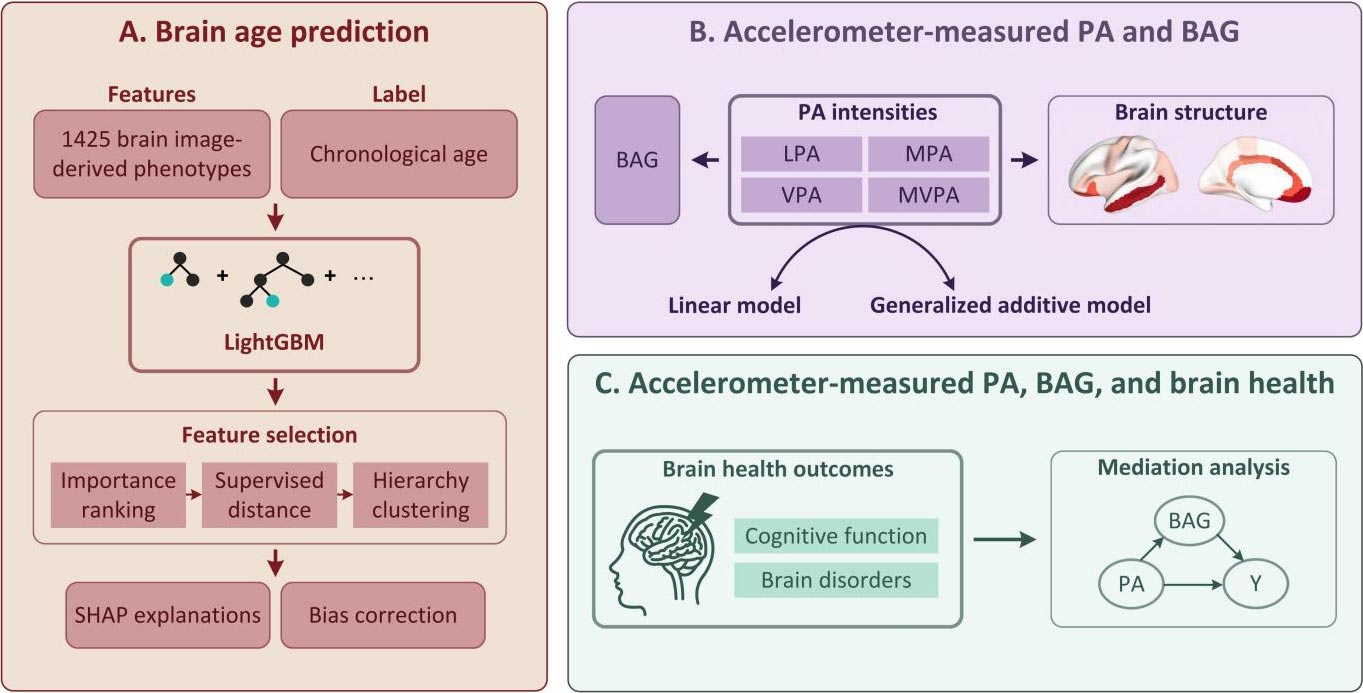
    Accelerometers Measured Physical Activity and Neuroimaging Driven Brain Age
    A ) A brain age prediction model is constructed by leveraging LightGBM algorithm training on 1425 image-derived phenotypes (IDPs) from T1-weighted brain MRI and chronological age. Features initially undergo tree-based feature importance ranking, where top 50 important features are picked out. Next, supervised distance between each feature is calculated then underwent hierarchy clustering to identify redundant feature groups. After removing redundancy, we visually interpret the final selected subset of features using SHAP technique. To deal with bias, predicted brain age was corrected by linear method. B) We first investigate correlations between objectively measured PA and BAG using both nonlinear and linear models. Next, to gain insight into PA and brain structures, we investigate correlations between PA and 1425 IDPs using both nonlinear and linear models. C) To verify whether PA and brain health was mediated by BAG, we conducted mediation analysis. Cognitive function and brain disorders were selected as brain health outcomes of interest. Credit: Chen Han., et al, School of Public Health, Hangzhou Normal University

    Addressing the shortcomings of prior research reliant on self-reported data, this study objectively measured 7-day PA using wrist-worn accelerometers to quantify light (LPA), moderate (MPA), vigorous (VPA), and moderate-to-vigorous (MVPA) activity. Results showed that moderate levels of MPA and VPA significantly reduced BAG (e.g., VPA: β = −0.27), suggesting a brain-protective effect.

    Brain Aging and Cognitive Outcomes

    Importantly, BAG was found to partially mediate the effects of PA on cognitive function (e.g., reaction time) and brain-related disorders (e.g., dementia, depression). Neuroanatomical analysis revealed that activity-related reductions in BAG were associated with lower white matter hyperintensities and preserved volume in the cingulate cortex, caudate nuclei, and putamen—regions critical for cerebrovascular integrity and cortico-striatal circuitry.

    “Our study not only confirms a nonlinear relationship between objectively measured PA and brain aging in a large population, but also provides actionable insight: more exercise isn’t always better—moderation is key,” said Xu.

    The team’s next step is to build a multi-scale aging framework incorporating sleep, sedentary behavior, neuroimaging, and omics data. Longitudinal studies will investigate how behavioral interventions reshape brain aging, while genome-wide and proteomic analyses aim to uncover the biological mechanisms underlying these effects.

    Reference: “Accelerometer-Measured Physical Activity and Neuroimaging-Driven Brain Age” by Han Chen, Zhi Cao, Jing Zhang, Dun Li, Yaogang Wang and Chenjie Xu, 2 May 2025, Health Data Science.
    DOI: 10.34133/hds.0257

    Never miss a breakthrough: Join the SciTechDaily newsletter.
    Follow us on Google and Google News.

    Aging Brain Exercise Neuroscience Popular Public Health
    Share. Facebook Twitter Pinterest LinkedIn Email Reddit

    Related Articles

    Aging Makes the Brain Leaky but Exercise Fights Back

    Reversing Aging: Exercise Rejuvenates Brain Cells

    Scientists Discover Fascinating Link Between Regular Exercise and Better Brain Health

    Scientists Reveal 3 Keys to Keeping Your Brain Healthy

    Exercise Alters Brain Chemistry To Protect Aging Synapses From Alzheimer’s and Dementia

    Researchers Have Discovered an Exercise “Sweet Spot” To Reverse Cognitive Decline

    Scientists Identify the Cause of Alzheimer’s Progression in the Brain – Very Different Than Previously Thought

    Amazon Indigenous People May Hold a Key to Slowing Down Aging

    Rapid Mental Rejuvenation: Experimental Drug Reverses Age-Related Cognitive Decline Within Days

    1 Comment

    1. Steve Nordquist on August 8, 2025 2:54 pm

      UK biobank thing with wacky brain heatmap study, maybe kinda literally.

      Reply
    Leave A Reply Cancel Reply

    • Facebook
    • Twitter
    • Pinterest
    • YouTube

    Don't Miss a Discovery

    Subscribe for the Latest in Science & Tech!

    Trending News

    Scientists Uncover Potential Brain Risks of Popular Fish Oil Supplements

    Scientists Discover a Surprising Way To Make Bread Healthier and More Nutritious

    After 60 Years, Scientists Uncover Unexpected Brain Effects of Popular Diabetes Drug Metformin

    New Research Uncovers Hidden Side Effects of Popular Weight-Loss Drugs

    Scientists Rethink Extreme Warming After Surprising Ocean Discovery

    Landmark Study Links Never Marrying to Significantly Higher Cancer Risk

    Researchers Discover Unknown Beetle Species Just Steps From Their Lab

    Largest-Ever Study Finds Medicinal Cannabis Ineffective for Anxiety, Depression, PTSD

    Follow SciTechDaily
    • Facebook
    • Twitter
    • YouTube
    • Pinterest
    • Newsletter
    • RSS
    SciTech News
    • Biology News
    • Chemistry News
    • Earth News
    • Health News
    • Physics News
    • Science News
    • Space News
    • Technology News
    Recent Posts
    • “Like Liquid Metal”: Scientists Create Strange Shape-Shifting Material
    • Early Warning Signals of Esophageal Cancer May Be Hiding in Plain Sight
    • Researchers Have Discovered a THC-Free Cannabis Compound That May Replace Opioids
    • Common Blood Pressure Drug Shows Surprising Power Against Deadly Antibiotic-Resistant Superbug
    • Students Build Dark Matter Detector and Set New Experimental Limits
    Copyright © 1998 - 2026 SciTechDaily. All Rights Reserved.
    • Science News
    • About
    • Contact
    • Editorial Board
    • Privacy Policy
    • Terms of Use

    Type above and press Enter to search. Press Esc to cancel.