
Close Menu
    Facebook X (Twitter) Instagram
    SciTechDaily
    • Biology
    • Chemistry
    • Earth
    • Health
    • Physics
    • Science
    • Space
    • Technology
    Facebook X (Twitter) Pinterest YouTube RSS
    SciTechDaily
    Home»Technology»Physicists Improve Optical Efficiency in Hexagonal Boron Nitride
    Technology

    Physicists Improve Optical Efficiency in Hexagonal Boron Nitride

    By Naval Research LaboratoryJanuary 4, 2018No Comments3 Mins Read
    Facebook Twitter Pinterest Telegram LinkedIn WhatsApp Email Reddit
    Share
    Facebook Twitter LinkedIn Pinterest Telegram Email Reddit
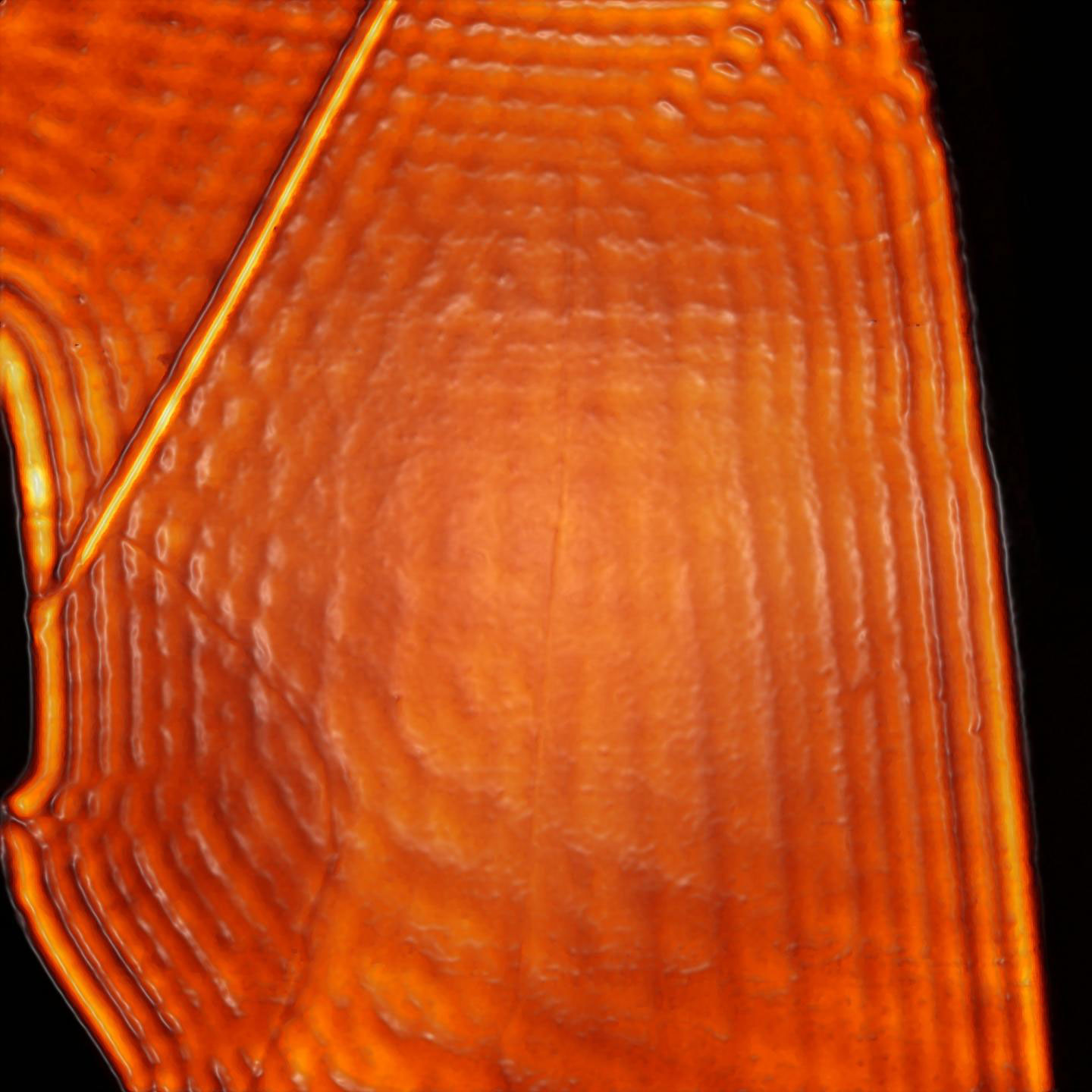
    NRL Improves Optical Efficiency in Hexagonal Boron Nitride
    Image shows directly measured polaritons propagating through a flake of Hexagonal boron nitride (hBN). This material has been identified as an ideal substrate for two-dimensional materials research while also recently being demonstrated as an exciting optical material for infrared nanophotonics. Credit: US Naval Research Laboratory

    A team of physicists, headed by the U.S. Naval Research Laboratory (NRL), have demonstrated the means to improve the optical loss characteristics and transmission efficiency of hexagonal boron nitride devices, enabling very small lasers and nanoscale optics.

    “The applications for this research are considerably broad,” said Dr. Alexander J. Giles, research physicist, NRL Electronics Science and Technology Division. “By confining light to very small dimensions, nanophotonic devices have direct applications for use in ultra-high resolution microscopes, solar energy harvesting, optical computing and targeted medical therapies.”

    Hexagonal boron nitride (hBN) forms an atomically thin lattice consisting of boron and nitrogen atoms. This material has recently been demonstrated as an exciting optical material for infrared nanophotonics and is considered an ‘ideal substrate’ for two-dimensional materials.

    While previous work demonstrated that natural hBN supports deeply sub-diffractional hyperbolic phonon polaritons desired for applications, such as, sub-diffractional optical imaging (so-called ‘hyperlensing’), energy conversion, chemical sensing, and quantum nanophotonics, limited transmission efficiencies continue to persist.

    “We have demonstrated that the inherent efficiency limitations of nanophotonics can be overcome through the careful engineering of isotopes in polar semiconductors and dielectric materials,” Giles said.

    Naturally occurring boron is comprised of two isotopes, boron-10, and boron-11, lending a 10 percent difference in atomic masses. This difference results in substantial losses due to phonon scattering, limiting the potential applications of this material. The research team at NRL has engineered greater than 99 percent isotopically pure samples of hBN, meaning they consist almost entirely of either boron-10 or boron-11 isotopes.

    This approach results in a dramatic reduction in optical losses, resulting in optical modes that travel up to three times farther and persist for up to three times longer than natural hBN. These long-lived vibrational modes not only enable immediate advances specific to hBN – near field optics and chemical sensing – but also provide a strategic approach for other materials systems to exploit and build upon.

    “Controlling and manipulating light at nanoscale, sub-diffractional dimensions is notoriously difficult and inefficient,” said Giles. “Our work represents a new path forward for the next generation of materials and devices.”

    Reference: “Ultralow-loss polaritons in isotopically pure boron nitride” by Alexander J. Giles, Siyuan Dai, Igor Vurgaftman, Timothy Hoffman, Song Liu, Lucas Lindsay, Chase T. Ellis, Nathanael Assefa, Ioannis Chatzakis, Thomas L. Reinecke, Joseph G. Tischler, Michael M. Fogler, J. H. Edgar, D. N. Basov and Joshua D. Caldwell, 11 December 2017, Nature Materials.
    DOI: 10.1038/nmat5047

    Never miss a breakthrough: Join the SciTechDaily newsletter.
    Follow us on Google and Google News.

    Materials Science Nanoscience Nanotechnology Photonics U.S. Naval Research Laboratory
    Share. Facebook Twitter Pinterest LinkedIn Email Reddit

    Related Articles

    Flexible Sensors May Lead to “Artificial Skin” That Senses Touch, Humidity and Temperature

    Improving Magnetic Memory by Controlling Spin Orientation

    Electrospinning Technique Yields Simultaneously Strong and Tough Nanofibers

    Scientists View Self-Assembling Gold Nanoparticles in Real Time

    Spray-on Mixture Combines Carbon Nanotubes With Ceramic

    Copper Sulfide Could Enable Faster Memory Chips and More Efficient Batteries

    Triangular Layers of Tungsten Disulfide May Have Applications in Optical Technology

    Nanodevice Can Focus Light into a Point Just a Few Billionths of a Meter Across

    The First All-optical Nanowire Switch

    Leave A Reply Cancel Reply

    • Facebook
    • Twitter
    • Pinterest
    • YouTube

    Don't Miss a Discovery

    Subscribe for the Latest in Science & Tech!

    Trending News

    Don’t Miss: A Brilliant Venus and Glowing Harvest Moon Light Up the Sky

    New Twist on the Einstein Problem Reveals Unexpected Physics

    JWST Captures Stunning Evidence of How Supermassive Black Holes Feed

    Early Exercise May Permanently Change How Much Energy the Body Uses To Move

    New Molecule Wipes Out Aggressive Lymphoma Tumors in Mice in Just 11 Days

    The Human Family Tree May Need a Major Rewrite

    Scientists Find a Surprising Cancer-Fighting Effect in Dark Sweet Cherries

    New AI Detects Hidden Warning Signs of Solar Eruptions Hours Before They Emerge

    Follow SciTechDaily
    • Facebook
    • Twitter
    • YouTube
    • Pinterest
    • Newsletter
    • RSS
    SciTech News
    • Biology News
    • Chemistry News
    • Earth News
    • Health News
    • Physics News
    • Science News
    • Space News
    • Technology News
    Recent Posts
    • Africa’s Giant Herbivores Were Disappearing Millions of Years Before Humans Could Hunt Them
    • This Utah Mountain Is Hiding Enough Ice To Fill 600 Olympic Pools
    • Vagus Nerve Stimulation Could Unlock the Brain’s Hidden Learning Potential
    • Your Mother’s Age May Leave a Biological Mark That Lasts for Generations
    • Women Who Ate More Antioxidants Had Strikingly Lower Rates of Cervical Cancer
    Copyright © 1998 - 2026 SciTechDaily. All Rights Reserved.
    • Science News
    • About
    • Contact
    • Editorial Board
    • Privacy Policy
    • Terms of Use

    Type above and press Enter to search. Press Esc to cancel.