
Close Menu
    Facebook X (Twitter) Instagram
    SciTechDaily
    • Biology
    • Chemistry
    • Earth
    • Health
    • Physics
    • Science
    • Space
    • Technology
    Facebook X (Twitter) Pinterest YouTube RSS
    SciTechDaily
    Home»Space»New Discovery Challenges Popular Theory About Dwarf Galaxies
    Space

    New Discovery Challenges Popular Theory About Dwarf Galaxies

    By Oliver Müller, Australian National UniversityFebruary 2, 2018No Comments3 Mins Read
    Facebook Twitter Pinterest Telegram LinkedIn WhatsApp Email Reddit
    Share
    Facebook Twitter LinkedIn Pinterest Telegram Email Reddit
    Satellite Galaxies Around Centaurus A Challenge Cold Dark Matter Cosmology
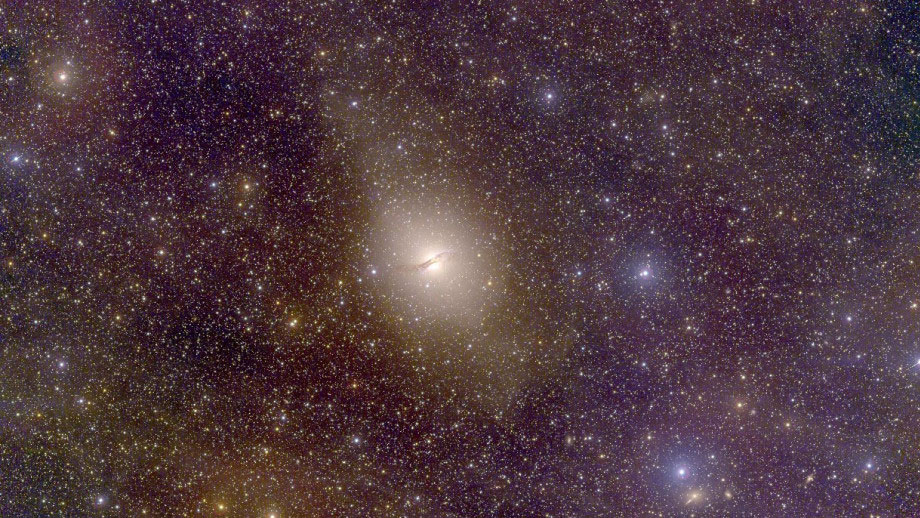
    This is an image of Centaurus A. Credit: ANU SkyMapper

    A new international study involving The Australian National University (ANU) has found a plane of dwarf galaxies orbiting around Centaurus A in a discovery that challenges a popular theory about how dwarf galaxies are spread around the Universe.

    Co-researcher Associate Professor Helmut Jerjen from ANU said astronomers had previously observed planes of dwarf galaxies whirling around our galaxy, the Milky Way, and the neighboring Andromeda.

    He said the latest finding challenged a long-held theory among cosmologists and theoreticians that there were thousands of dwarf galaxies in all directions around these large galaxies like bees swarming around a hive.

    “Cold dark matter theory made astronomers believe that the best-studied galaxies in the Universe – the Milky Way and Andromeda – are the odd ones out,” said Dr. Jerjen from the ANU Research School of Astronomy and Astrophysics. “It seems that our Milky Way and Andromeda are normal galaxies after all, and spinning pancake-like systems of satellite galaxies are more common than scientists expected.”

    Dr. Jerjen said dwarf galaxies were distributed in planes that were almost perpendicular to the disks of the Milky Way, Andromeda, and Centaurus A. “Even the best cosmological simulations struggle to explain the phenomenon of these small galaxies revolving in one direction around host galaxies,” he said.

    Dr. Jerjen conducted the study in collaboration with Dr. Oliver Müller from the University of Basel in Switzerland, Dr. Marcel Pawlowski from the University of California, Irvine, in the United States, and Dr. Federico Lelli from the European Southern Observatory in Germany.

    Dr. Müller said it was likely most large galaxies in the Universe have had a close encounter or merged with another galaxy at least once in their life. “Co-rotating dwarf galaxy systems could have formed during such interactions. In this scenario dwarf galaxies should be devoid of dark matter,” he said.

    The Milky Way and Andromeda are spiral galaxies, while Centaurus A has both elliptical and spiral features. Centaurus A is about 13 million light years away from Earth. The most well-known dwarf galaxies around the Milky Way are the Magellanic Clouds, which are visible to the naked eye from the southern hemisphere.

    “Scientists have identified close to 50 dwarf galaxy candidates around the Milky Way – most of them are aligned in a plane orbiting the center of the host galaxy,” Dr. Jerjen said. “Most of the dwarf galaxy candidates that my colleagues and I observed around Centaurus A are arranged this way, and it’s a similar case with at least half of them around Andromeda.”

    Dr. Jerjen said the latest research will have major implications for future cosmological work.

    Reference: “A whirling plane of satellite galaxies around Centaurus A challenges cold dark matter cosmology” by Joliver Müller, Marcel S. Pawlowski, Helmut Jerjen and Federico Lelli, 2 Feb 2018, Science.
    DOI: 10.1126/science.aao1858

    Never miss a breakthrough: Join the SciTechDaily newsletter.
    Follow us on Google and Google News.

    Astronomy Astrophysics Australian National University Centaurus A Cosmology Galaxy Evolution
    Share. Facebook Twitter Pinterest LinkedIn Email Reddit

    Related Articles

    James Webb’s Mysteriously Bright Galaxies May Finally Have an Explanation

    James Webb Discovers a Nearly Pristine Galaxy From the Dawn of the Universe

    Ancient Dusty Galaxies Discovered at the Edge of the Universe Rewrite Cosmic History

    New Research Shows Early Galaxies Grew Massive Through Collisions

    Simulations Shed Light on the Formation of Stars in the Earliest Galaxies

    Uniform Heavy Element Distribution Points to Early Cosmic ‘Seeding’

    Study Suggest Spiral Galaxies Are Larger Than Previously Thought

    New Planck Data Challenges Our Understanding of the Universe

    Discovery Solves Decades Old Discrepancies

    Leave A Reply Cancel Reply

    • Facebook
    • Twitter
    • Pinterest
    • YouTube

    Don't Miss a Discovery

    Subscribe for the Latest in Science & Tech!

    Trending News

    Stanford Scientists Discover 3 Hidden Brain Types in Children With ADHD and Anxiety

    What Is a Thought Made Of? Scientists Reveal Why Human Consciousness May Be Beyond the Reach of AI

    Scientists Discover Mysterious Toxic Chemicals Floating in the Air Above America

    Astronomers Discover a Chilling Preview of Our Solar System’s Future

    Scientists Discover Alarming Signs of Extinction Risk Deep Beneath the Ocean

    A Common Gut Antibody May Be the Key to Preventing Colon Cancer Before It Starts

    Scientists Discover a Disturbing Link Between Cannabis Use and Earlier Psychosis

    Scientists Discover Two Monster Black Holes at the Dawn of Time That Shouldn’t Exist

    Follow SciTechDaily
    • Facebook
    • Twitter
    • YouTube
    • Pinterest
    • Newsletter
    • RSS
    SciTech News
    • Biology News
    • Chemistry News
    • Earth News
    • Health News
    • Physics News
    • Science News
    • Space News
    • Technology News
    Recent Posts
    • An Overlooked Property of Light Could Open the Door to a New Era of Optical Computing
    • NASA Smashed Into an Asteroid. Now ESA’s Hera Spacecraft Is About to Reveal the Damage
    • Does the Sun Have a Secret Companion? A Controversial Theory Could Explain Earth’s Mass Extinctions
    • Scientists Develop New Nanomaterial That Could Help the Body Regrow Missing Bone
    • Alzheimer’s Breakthrough: Researchers Find New Clues to Cognitive Decline in Healthy Adults
    Copyright © 1998 - 2026 SciTechDaily. All Rights Reserved.
    • Science News
    • About
    • Contact
    • Editorial Board
    • Privacy Policy
    • Terms of Use

    Type above and press Enter to search. Press Esc to cancel.