
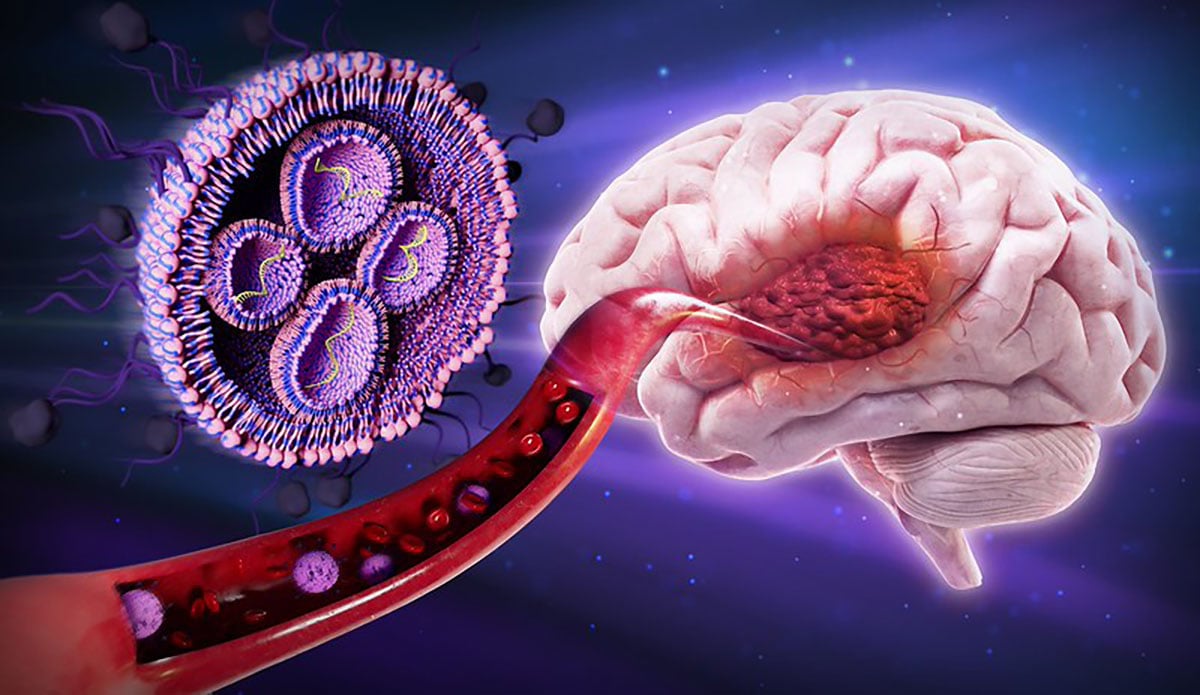
A sugar-coated nanoparticle treatment helped extend survival in mice with glioblastoma.
Glioblastoma is the deadliest form of brain cancer, with few effective treatment options and a five-year survival rate below 5%. One of the biggest obstacles is the brain’s own defense system: the blood-brain barrier, which blocks most drugs from reaching tumors. Even therapies that make it into the brain often struggle to accumulate in cancer cells while sparing healthy tissue.
Researchers at Oregon State University believe they may have found a way to overcome both challenges at once. Oleh Taratula, Olena Taratula, and Yoon Tae Goo of the OSU College of Pharmacy developed lipid nanoparticles—tiny fat-based carriers loaded with genetic material—and engineered them to slip through the blood-brain barrier and preferentially target glioblastoma cells.
In a study published in the Journal of Controlled Release, the team tested the approach in mice with glioblastoma. The sugar-coated nanoparticles successfully delivered a tumor-suppressing therapy across the blood-brain barrier, increasing median survival by 50% compared with untreated animals.
Sugar coating helps entry
The key sugar was mannose, which is closely related to glucose, the main fuel the body uses for energy. This similarity matters because cells lining blood vessels in the brain contain a transporter called GLUT1. Its usual job is to move glucose from the bloodstream into the central nervous system, but it can recognize mannose too.
That gave the researchers a possible entry route. The challenge was that glucose is already abundant in the blood, so the nanoparticles needed to compete for the same transporter. Oleh Taratula said the solution was to pack the nanoparticle surface densely with mannose.
“Blood contains relatively high concentrations of glucose, and that’s what the nanoparticles are competing against for GLUT1’s attention,” Oleh Taratula said. “For the nanoparticles to get it, they need a densely coated sugar surface, and that’s our central innovation. By chemically connecting mannose to cholesterol, a major structural component of the nanoparticles, we improved surface coverage sixfold.”
Tumor cells become targets
Once the nanoparticles crossed the blood-brain barrier, the next question was whether they would build up more in tumor tissue than in normal brain tissue. Glioblastoma helped create that opening because its cells rely heavily on metabolic pathways and express unusually high levels of GLUT1.
The cargo inside the nanoparticles was messenger RNA, a temporary set of cellular instructions. In this case, the mRNA directs cells to make PTEN, a tumor-suppressing protein that is often lost in glioblastoma. Restoring PTEN matters because it can help reestablish control over cell growth. To keep the mRNA protected during delivery, the researchers added a cationic cholesterol derivative that helped safeguard the encapsulated genetic material.
“Glioblastoma is metabolically reprogrammed and expresses GLUT1 at three times the levels of normal brain tissue, so the particles preferentially accumulate in tumor tissue after crossing the blood-brain barrier,” Olena Taratula said. “And restoring PTEN expression in tumor cells reinstates growth control. Across repeated dosing, tumor shrinkage occurred without any measurable organ toxicity.”
Glioblastoma remains difficult
The findings are preclinical, meaning they come from animal research rather than human trials. That distinction is important because many promising cancer therapies in mice do not ultimately work the same way in people. Still, the work targets two major barriers that have long limited glioblastoma treatment: reaching the brain and concentrating therapy inside the tumor.
In the United States, glioblastoma occurs at a rate of 3.19 cases per 100,000 people. It is more common in males than females, and the median age at diagnosis is 64. More than 95% of patients live less than five years after diagnosis, which is why new delivery strategies remain a major focus in brain cancer research.
Reference: “Single-ligand dual-targeting lipid nanoparticles for therapeutic mRNA delivery to glioblastoma across the blood-brain barrier” by Yoon Tae Goo, Vincent N. Cataldi, Vladislav Grigoriev, Neera Yadav, Tetiana Korzun, Chao Wang, Adam W.G. Alani, Olena R. Taratula and Oleh Taratula, 15 June 2026, Journal of Controlled Release.
DOI: 10.1016/j.jconrel.2026.115107
This research was supported by the National Cancer Institute of the National Institutes of Health (R01CA237569 and R37CA234006) and the Eunice Kennedy Shriver National Institute of Child Health and Human Development (R01HD101450 and R01HD112007). This research was also supported by Basic Science Research Program through the National Research Foundation of Korea (NRF), funded by the Ministry of Education (RS-2023-00241580).
Never miss a breakthrough: Join the SciTechDaily newsletter.
Follow us on Google and Google News.
1 Comment
why tree