
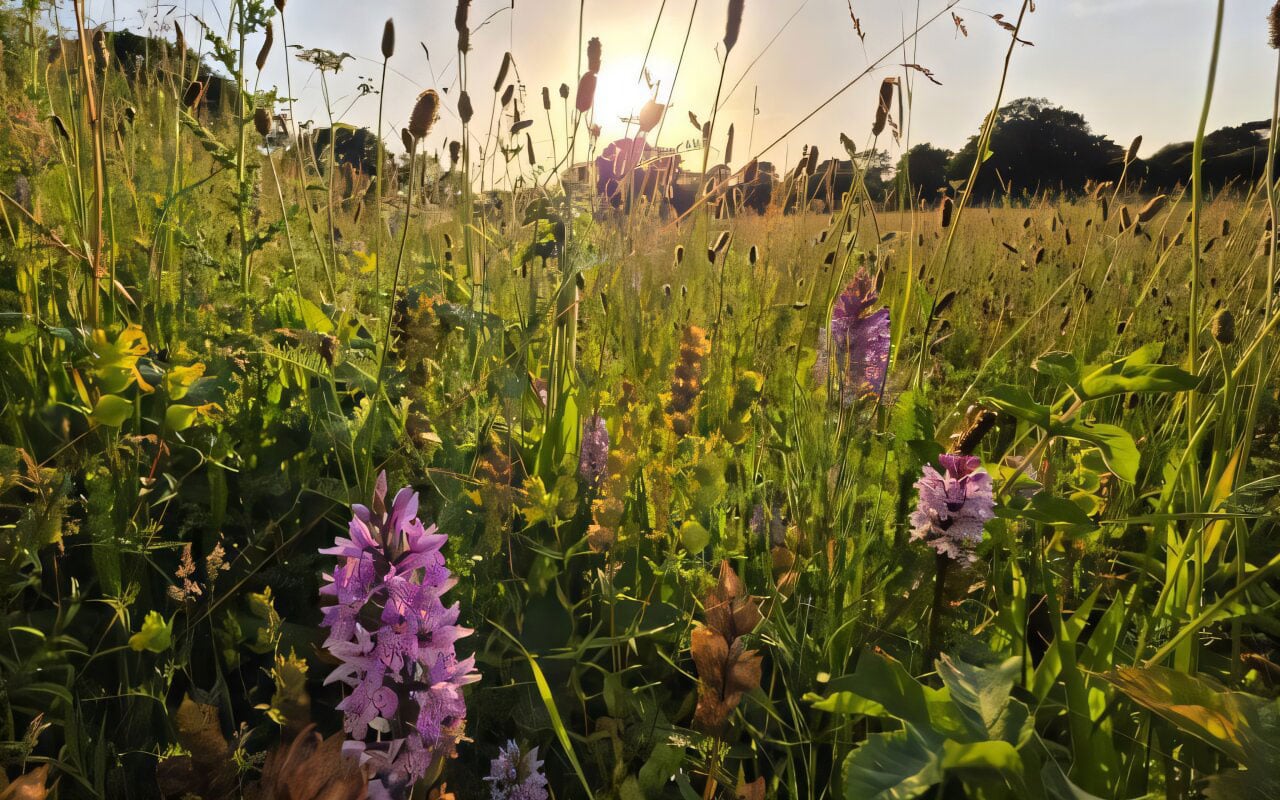
UCL researchers found that abandoned farmland can be transformed into grassland rich in wildflowers without expensive, labor-intensive seeding.
A former crop field in Norfolk was left without seed mixes, soil removal, or deep plowing. Once a year, its vegetation was cut for hay and removed. Over the next decade, wildflowers gradually returned, including species that had become rare in the surrounding landscape.
Researchers followed this transformation from 2011 through 2022 on a two-hectare field that had been abandoned in 2005. Their findings, published in Restoration Ecology, suggest that former farmland can develop rich plant diversity within 10 to 15 years through natural recovery supported only by traditional annual hay cutting.
That result challenges a common strategy in government-funded conservation programs, which often rely on commercially produced seed mixtures to establish new grasslands.
The question matters because wildflower meadows provide habitat for pollinating insects and other wildlife while supporting many uncommon plant species. More than 90% of these habitats have disappeared from the UK since the Second World War.
At the same time, governments across the UK and Europe are considering how to restore large areas of abandoned agricultural land. Allowing vegetation to recover naturally could offer a practical way to create species-rich grassland across broad areas without the cost and labor required by more intensive methods.
Natural recovery challenges seeding
Lead author Professor Carl Sayer (UCL Geography) said: “Our study shows that resisting seeding and allowing nature to lead may be worth trying a lot more in wildflower meadow restoration. Natural plant recovery better safeguards genetic diversity than seeding and ensures that local species thrive, making meadows less generic. As things stand, the UK needs nature recovery fast, at big scales. In the push to achieve this goal, our study poses the question: should we be employing patience over seed packets more often?”
Restoring grasslands can support pollinators, birds, and mammals while protecting threatened species. These habitats may also reduce pollution and make ecosystems better able to withstand the effects of climate change.
Many restoration projects attempt to accelerate the process by sowing commercial wildflower mixtures. Some also remove topsoil or use deep plowing, approaches that require additional labor and money.
Yet researchers have conducted relatively few long-term UK studies of what happens when former farmland is managed only by cutting and removing hay. The gap exists partly because natural recovery takes years to document and requires consistent monitoring throughout that period.
Long monitoring tests the idea
The researchers studied Sayer’s Meadow in Bodham, North Norfolk. The property belongs to the father of the lead researcher and fellow coauthor Derek Sayer, allowing the annual hay cutting to continue consistently and giving the researchers access to a detailed record of how the land had previously been used.
Every two to three years, Professor Sayer and his friend Pete Robinson surveyed the field to document which plants had appeared. They walked systematically across the meadow and recorded every species they encountered.
To measure changes more precisely, they also closely examined two dozen plots, each measuring 1 square meter, positioned along two transects. Returning to the same sampling areas allowed them to track whether plant diversity was increasing rather than relying only on general impressions of the meadow.
Plant diversity rises steadily
The surveys showed a consistent rise in the number of plant species between 2011 and 2022. After approximately 10 years, the meadow contained several locally rare plants, including southern marsh orchid, greater tussock sedge, yellow rattle, and common centaury.
Within the closely monitored plots, the average number of species nearly doubled. A typical plot contained about 10 species in 2011 and almost 20 by 2022.
The researchers also recorded the exact GPS position of every orchid and yellow rattle plant. These species served as indicators of improving meadow conditions, but the researchers eventually stopped mapping individual plants because their numbers had grown too large to count.
How some uncommon plants reached the field remains uncertain, especially because the nearest known populations were some distance away. The researchers suggested that deer may have carried seeds into the meadow.
Patience restores local species
Professor Sayer said: “The field belongs to my family, and after an oilseed rape crop in 2005 we stopped farming it as the land was difficult to drain. I really wanted a wildflower meadow, and all advice was to seed it, but I resisted the temptation, as I have always been interested in nature’s ability to recover itself.
“When the first orchids started appearing in our surveys, we were thrilled, and now the meadow is unbelievably diverse, with thousands of orchids that delight locals in the village. Our study shows what can be achieved by a traditional hay cutting approach combined with nature’s brilliant spontaneity. A visit to the meadow is like stepping back through time.”
Reference: “No need to seed: restoring species-rich grassland on former arable fields by natural regeneration” by Carl D. Sayer, Peter Robinson, Derek C. G. Sayer and Jan C. Axmacher, 29 June 2026, Restoration Ecology.
DOI: 10.1111/rec.70487
Never miss a breakthrough: Join the SciTechDaily newsletter.
Follow us on Google and Google News.