
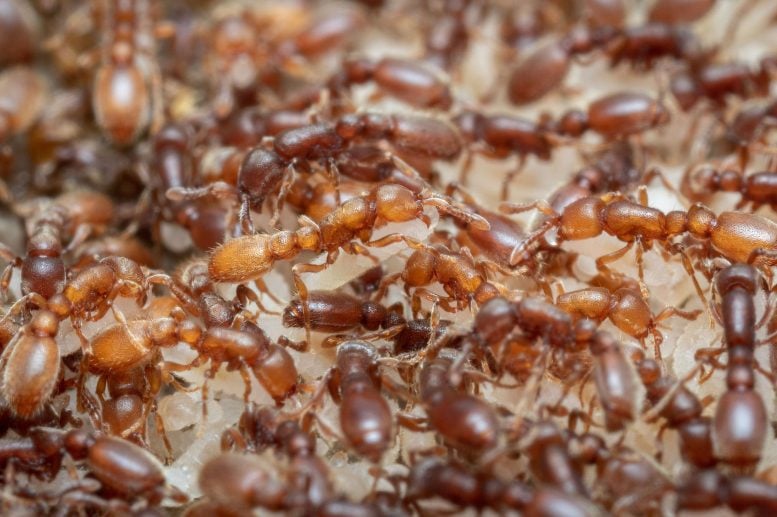
Parenting may have evolved by repurposing the brain’s ancient hunger circuits.
Long before parenting became widespread, many animals simply laid eggs and left their offspring to survive alone.
A new study published in Nature reveals how evolution may have turned that lack of care into nurturing behavior. By studying clonal raider ants, an insect known for tending its young, researchers found that evolution did not need to create entirely new brain circuits. Instead, it adapted ancient systems that regulate hunger to also trigger caregiving and other social behaviors.
“Our work is a prime example of how evolution seldom invents things from scratch,” says Daniel Kronauer, head of the Laboratory of Social Evolution and Behavior at Rockefeller. “Evolution takes what it has and works with that, sometimes in very surprising ways.”
Mammals nurse their young, birds tend nests, and ants care for larvae. Scientists still do not fully understand how such varied parenting behaviors emerged from ancestors that offered little or no care. One leading idea is that evolution modified existing biological systems rather than building new ones. Earlier mammal studies, for example, suggested that some neuropeptides involved in hunger may have been adapted to encourage parenting.
Ants Offer a Simpler Brain Model
Testing this theory has been challenging. Fruit flies and roundworms, two widely used laboratory animals in neuroscience, do not care for their offspring. Mice are attentive parents, and researchers have identified several neuropeptides involved in their caregiving behavior.
Kronauer’s team found that some neuromodulatory mechanisms are shared by mice and ants. The ant brain contains about 60,000 cells vs. 100 million in a mouse brain, making ants a potentially faster and simpler model for examining these mechanisms and their underlying circuits in greater detail.
Closeup of the high-throughput assay used in the study to quantify the interactions between larvae (orange) and adults (blue), and when they are in contact (magenta). Credit: Laboratory of Social Evolution and Behavior at The Rockefeller University
Tracking Caregiving Across an Ant’s Lifetime
The researchers first created a behavioral system that placed individual ants with individual larvae. This allowed them to automatically monitor hundreds of caregiving interactions. They then identified and produced many of the chemical signaling molecules found in ant brains and tested how each one affected caregiving.
Ant colonies organize work according to age. Young ants remain inside the nest and care for larvae, while older ants leave to search for food. The team wanted to determine how changes in brain chemistry control this transition.
Further experiments explored where the most promising molecules were produced, how their levels changed throughout an ant’s life, and how behavior responded when the researchers increased or reduced their activity. The scientists also compared well-fed and starved ants to learn whether caregiving signals were still connected to the ancient feeding circuits from which they may have evolved.
“We annotated the neuropeptidome of this ant, the complete set of neuropeptides,” says Kay. “There were 70 that we could identify. It took a lot of hard work, but now we have a set of molecules that we can investigate in numerous ways.”
Two Molecules Control Caregiving and Foraging
The results showed that the brain systems governing caregiving remain closely tied to ancient hunger circuits. Two signaling molecules acted in opposite ways depending on the ant’s internal condition. Neuropeptide F (NPF) encouraged caregiving, while Allatostatin A (AstA) prompted ants to leave the larvae and begin foraging. Young ants naturally had higher levels of NPF and lower levels of AstA in key brain regions. Older ants displayed the reverse pattern.
This matched the ants’ natural shift from nursing to foraging as they aged. Changing the activity of either molecule altered their behavior, demonstrating the strong influence of these neuropeptides.
As previous mammal research suggested, both molecules also responded to hunger. Starving ants increased NPF and reduced AstA, leading them to act more like caregivers. After feeding, the balance reversed, and the ants were more likely to abandon caregiving duties and forage.
“We learned that parental behaviors build on the neural circuitry for feeding, and that makes some sense,” Kronauer says. “Parental behavior is a lot about feeding, not just yourself, but your offspring.”
Ants Could Illuminate Parenting and Healthy Aging
The researchers now plan to map the neural circuits influenced by these neuropeptides as they produce caregiving behavior. Mammals appear to use some of the same molecules, so comparing these circuits across species could reveal how parenting evolved. The similarities may point to a shared biological strategy found across much of the animal kingdom.
“It amazes me that similar parenting behaviors have evolved so many times in so many distinct animal lineages,” says Kay. “Our paper suggests that the evolutionary routes to these sorts of behaviors are far more constrained than we may have naively imagined. That’s very exciting, because it may eventually lead to a blueprint of how these complex social behaviors evolve.”
Because ants naturally change from caregivers to foragers as they grow older, they may also provide a valuable model for studying how healthy aging alters the brain. The findings could eventually help researchers examine similar changes in humans.
“There’s a lot of research and funding invested in studying late-stage neurodegenerative diseases, but we actually know very little about how the brain changes throughout the normal healthspan of an individual,” says Kronauer. “In ant colonies, these dynamics are central to the organization of the society. Our discovery provides a striking demonstration that neuromodulators can produce age-dependent changes in behavioral proclivities in ants, and I suspect that that’s the case in other animals as well, including in humans.”
Reference: “Ancient feeding-related neuropeptides regulate alloparenting in ants” by Alexander Paul, Tomas Kay, Ivan Lacroix, Vikram Chandra, Asaf Gal, Patrick K. Piekarski, Stephany Valdés-Rodríguez, Amelia L. Ritger, Katelyn S. Lee, Kip D. Lacy and Daniel J. C. Kronauer, 8 July 2026, Nature.
DOI: 10.1038/s41586-026-10747-6
Never miss a breakthrough: Join the SciTechDaily newsletter.
Follow us on Google and Google News.