
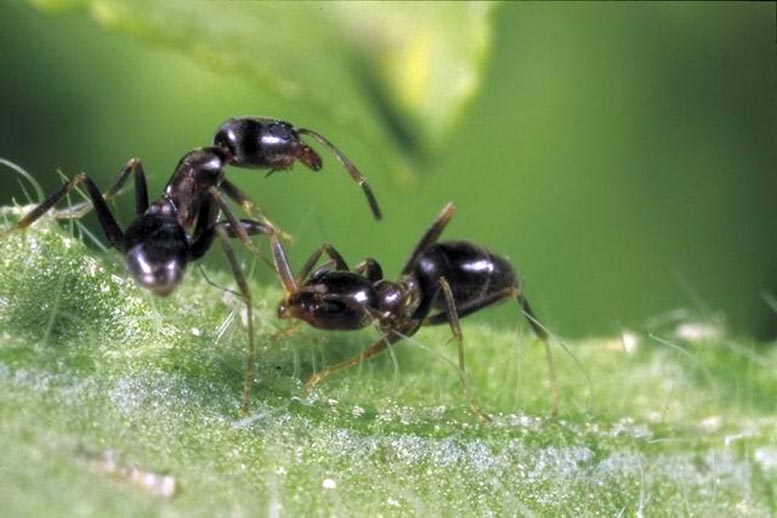
Sanitary care by social ants shapes disease outcome — study published in Ecology Letters.
Who wins in a competition is largely dependent on the opponent faced, yet the role of the environment in which the battle takes place should not be underestimated either. In sports, some skiers profit from icy over snowy grounds and some tennis players are weaker on sand than on grass. Similarly, within our bodies, the immune system sets the environment for the competition between multiple pathogens that infect us at the same time.
It is long known that an immune response can bias the competitive outcome of competing pathogens as it may affect one pathogen more than the other. Professor Sylvia Cremer and her team at the Institute of Science and Technology (IST Austria) could now provide first evidence that it is not only the immune system of the host individual which shapes the competitive outcome of coinfecting pathogens within the insect body, but that the social context can have a similar effect.
Survival of the fastest
Solitary species have to fight disease alone. In contrast, in groups of social species — including bees, ants or termites — nestmates often assist the infected individual by providing sanitary care, thereby creating an environment of “social immunity.” The Cremer group discovered that — besides the immune system of the individual host itself — the sanitary care provided by ants to their fungus-exposed colony members modulates the pathogen competition inside the host’s body, changing the success of pathogen outgrowth after infection.
Testing a number of different pathogen combinations, the Cremer’s team found that one fungal pathogen species that was very successful in winning the competition in individually-reared ants was much less successful when the ants were reared together with healthy colony members. The researchers discovered that this bias introduced by care-providing nestmates was not caused by selective grooming of one pathogen species over the other. Rather, the fungal spores showed different susceptibility to the ants’ grooming: spores that quickly enter their host’s body turned out less susceptible to grooming than spores that need more time penetrating the body surface. Due to this slower so called germination speed, the respective pathogen was exposed to the ants’ grooming for longer than the otherwise weaker competitor.
Professor Sylvia Cremer summarizes: “If one pathogen species takes longer to germinate, this leaves the ants more time and increases their chance to groom it off. Hence a fast germination reduces the time window for the ants to perform successful sanitary care and can shift the balance towards winning the competition against a slower-germinating pathogen species.”
Social care-giving beats self-cleaning
Pathogens of the genus Metarhizium infect insects by attaching to the body surface of their hosts as spores and start germinating. Germinated spores grow a plug-like structure that produces both pressure and lytic enzymes to break the host body surface. They then grow into the host, replicate, kill the host by toxins and grow out millions of novel spores that cause the next round of infections. Grooming helps ants to effectively prevent these infections.
First author and IST Austria postdoc Barbara Milutinovi explains: “The ants use their mouthparts to pluck off the infectious spores from the body surface of their nestmates. Such social allogrooming is much more efficient than selfgrooming, as some body parts are impossible to be reached by oneself — as we all know from our own experience when we try to scratch an itchy spot on our own back.” As the Cremer group found, in the presence of grooming nestmates, this social allogrooming can induce a shift in the pathogen community inside the host — and thus alter the disease outcome.
Reference: “Social immunity modulates competition between coinfecting pathogens” by Barbara Milutinović, Miriam Stock, Anna V. Grasse, Elisabeth Naderlinger, Christian Hilbe and Sylvia Cremer, 16 January 2020, Ecology Letters.
DOI: 10.1111/ele.13458
Never miss a breakthrough: Join the SciTechDaily newsletter.
Follow us on Google and Google News.
1 Comment
Really useful. I really enjoyed reading this post.