
Researchers developed knitted textiles that can function as switches and count steps.
A piece of knitted fabric can now do more than stretch and fold. By carefully controlling its yarns and stitch patterns, researchers have made textiles that snap between stable shapes, operate electrical switches, and even track a person’s steps.
Researchers at the Harvard John A. Paulson School of Engineering and Applied Sciences (SEAS) developed machine-knitted fabrics that could serve as programmable switches, sensors, and other functional devices. The textiles use multistability, a physical property that allows a structure to settle into more than one stable shape.
The work, published in Advanced Functional Materials, was led by recent Ph.D. graduate Kausalya Mahadevan, now a postdoctoral associate in the laboratory of Katia Bertoldi, the William and Ami Kuan Danoff Professor of Applied Mechanics.
“I’ve always been excited about fabrics and textiles, and what we can engineer and build with them,” said Mahadevan, who began working in Bertoldi’s lab as an undergraduate. “Our ideas around multistability in textiles arose from being inspired by textile artists and how they approach structures, combined with how [Bertoldi’s] lab has traditionally thought about nonlinear mechanics in solids. We tried to approach thinking about textiles in that context.”
Yarn alone creates lasting curves
Materials designed to curve and hold their form are usually molded from polymers, with stresses carefully built into the structure during manufacturing. The researchers instead showed that weft knitting, the industrial process commonly used to make gloves and hats, can produce complicated, lasting curves using only yarn.
They selected highly elastic yarns and used plating, a knitting method that places different yarns on opposite sides of the fabric. This produced thick, dense textiles that naturally curled into three-dimensional forms through the same basic effect that causes the cut edge of a T-shirt to roll upward.
“The yarn selection and machine parameter choices allowed us to basically select a fabric that is going to be as snappy as we can possibly get,” Mahadevan said.
Striped knits hold multiple shapes
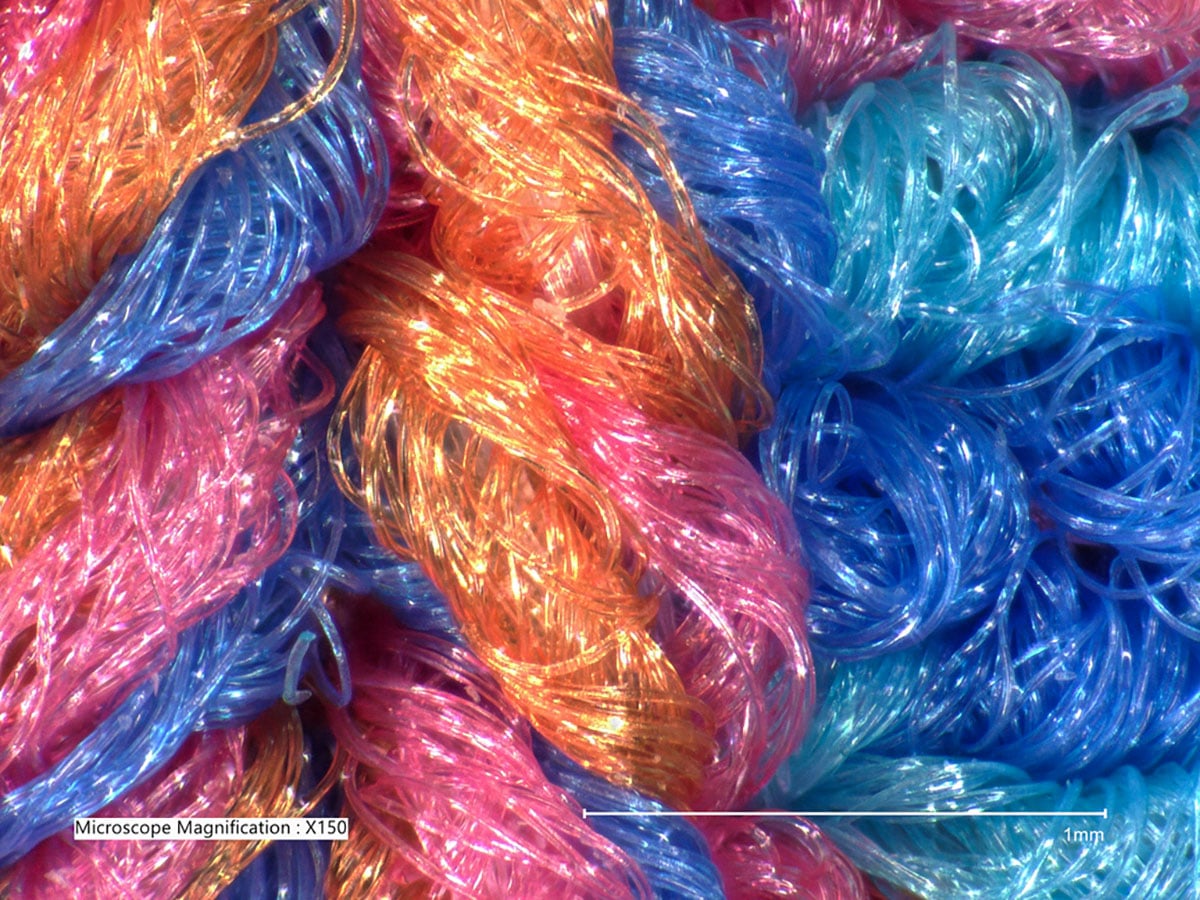
The researchers arranged horizontal and vertical stripes in different combinations to create fabrics that could rapidly snap between multiple stable configurations. Much like a light switch remains securely in either the on or off position, each textile stayed in its selected shape until enough force pushed it into another state.
By testing how yarn properties and geometric patterns affected this snap-through motion, the researchers identified the conditions required to produce multistability. They also created simulations that accurately predicted the textiles’ behavior by treating each fabric as one continuous material rather than calculating the movement of every individual strand of yarn.
Examples of multistable knitted fabrics. Credit: Kausalya Mahadevan / Harvard SEAS
Conductive yarn turns fabric into switches
The researchers then knitted thin conductive yarns into the fabric, converting the snapping structures into flexible electrical switches. As the textile moved from one stable shape to another, it opened or closed an electrical circuit.
One knitted shell switched an LED on and off each time it flipped between its two shapes. Another device was worn across a knee or elbow, where the snapping motion could be detected by an Arduino and used to count steps.
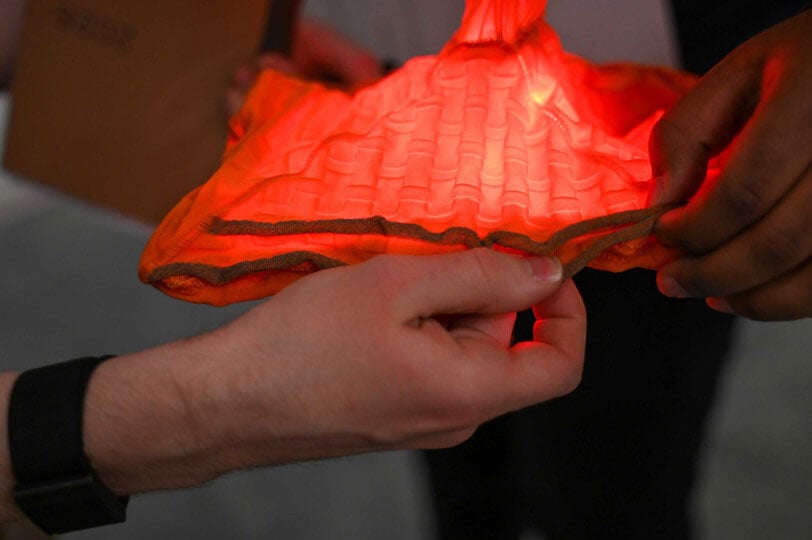
The researchers also constructed a reconfigurable lampshade containing three multistable switches. Each switch controlled a different color of light as the fabric stretched and snapped between states. These devices and other examples were displayed in a recent Art Lab installation.
The researchers made a reconfigurable lampshade with multistable switches that correspond to different colors of light.
Standard machines could enable scale
Mahadevan and her colleagues produced the textiles using machines similar to the standard industrial knitting equipment already found in garment factories. That compatibility could make future devices easier to manufacture at larger scales.
The work also brings textiles into the field of nonlinear mechanical metamaterials, in which structures are designed to bend, buckle and snap in useful, predictable ways. Mahadevan is now exploring how multistability could support soft, seamless fabrics that quietly monitor movement, provide tactile feedback or change into new shapes when needed.
Reference: “Knitting Multistability” by Kausalya Mahadevan, Michelle C. Yuen, David T. Farrell, Conor J. Walsh, Vanessa Sanchez, Robert J. Wood and Katia Bertoldi, 15 June 2026, Advanced Functional Materials.
DOI: 10.1002/adfm.76385
The research was supported by NSF grant DMR-2011754 and ARO MURI program W911NF-22-1-0219. Equipment was supported by ONR DURIP Award N00014-19-1-2220.
Never miss a breakthrough: Join the SciTechDaily newsletter.
Follow us on Google and Google News.