
A soy-derived compound may help counter some of the cardiovascular and cognitive effects of excessive salt intake by reshaping prostaglandin signaling.
Excess salt does more than raise blood pressure. Long-term overconsumption has also been associated with worsening cognitive and emotional health, placing strain on both the cardiovascular system and the central nervous system. These risks have increased interest in practical dietary approaches that could lessen the damage caused by high salt (HS) intake.
One possible approach involves prostaglandins (PGs), powerful local hormones made from the fatty acid arachidonic acid (AA). In the cardiovascular system, they help regulate blood vessel widening and narrowing. In the brain, their effects depend on which receptors they activate, with some pathways supporting nerve cell protection and others contributing to harmful signaling.
Previous research showed that LPC70, a soy lysolecithin containing lysophosphatidylcholine (LPC) and more than 70% phospholipids, reduced hypertension and cognitive problems caused by a high-salt diet (HSD). How LPC70 influenced PG signaling, however, remained uncertain.
Researchers trace protection across organs
Professor Akihiro Mouri, Dr. Hisayoshi Kubota, and Dr. Kazuhiro Kagotani investigated whether LPC70 could regulate PG pathways in different organs and reduce high-salt-related increases in blood pressure and behavioral problems in mice.
Dr. Kubota, the study’s first author, played a major role in measuring blood pressure, evaluating behavior, and examining molecular changes connected to PG signaling. This work helped reveal that LPC70 affected the kidney and brain in different ways.
Prof. Mouri and Dr. Kubota are affiliated with the Department of Regulatory Science for Evaluation and Development of Pharmaceuticals & Devices at Fujita Health University Graduate School of Medical Science and the International Center for Brain Science (ICBS) at Fujita Health University, Japan. Dr. Kagotani is affiliated with Tsuji Oil Mills Co., Ltd, Japan, and Tsuji Health and Beauty Science Laboratory at Mie University, Japan.
The findings were recently published in Neurochemistry International.
“We wanted to understand the role of LPC70 in coordinating changes in PG signaling across organ systems,” mentioned Prof. Mouri. “Our study originated from a collaborative research project with Tsuji Oil Mills Co., Ltd, a company that develops naturally derived food ingredients,” he added.
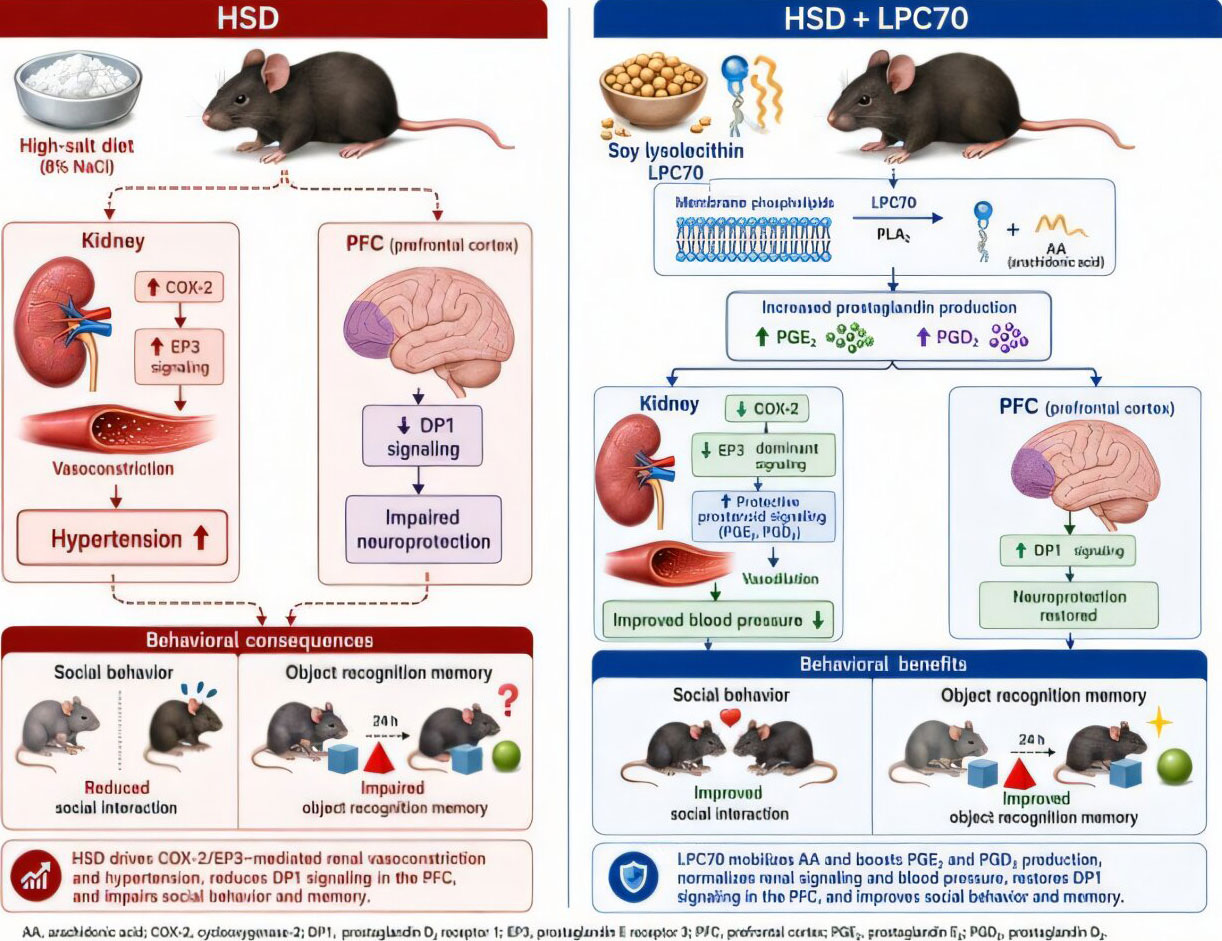
As expected, mice consuming the HSD developed higher blood pressure. They also interacted less with other mice and performed worse on object recognition memory tests, although their movement and anxiety-like behavior did not change substantially. This pattern suggests that excessive salt selectively disrupted more complex social and cognitive functions.
Adding LPC70 to the diet reduced the increase in blood pressure and improved both social interaction and object recognition memory.
Kidney and brain signals shift differently
In the kidneys, the HSD increased levels of cyclooxygenase 2 (COX 2) and the PGE2 receptor EP3. Both are involved in PG signaling and may contribute to hypertension caused by excessive salt. LPC70 reduced these changes, indicating that it may help correct harmful PG signaling within the kidneys.
The response differed in the prefrontal cortex, a brain region important for cognition and social behavior. High salt intake lowered expression of the PGD2 receptor DP1, which supports neuroprotective and anti-inflammatory signaling.
LPC70 restored DP1 expression but did not alter DP2, a receptor associated with neurotoxic signaling. This selective response suggests that the supplement may shift PGD2 activity toward a more protective pattern, helping reduce cognitive and behavioral impairment.
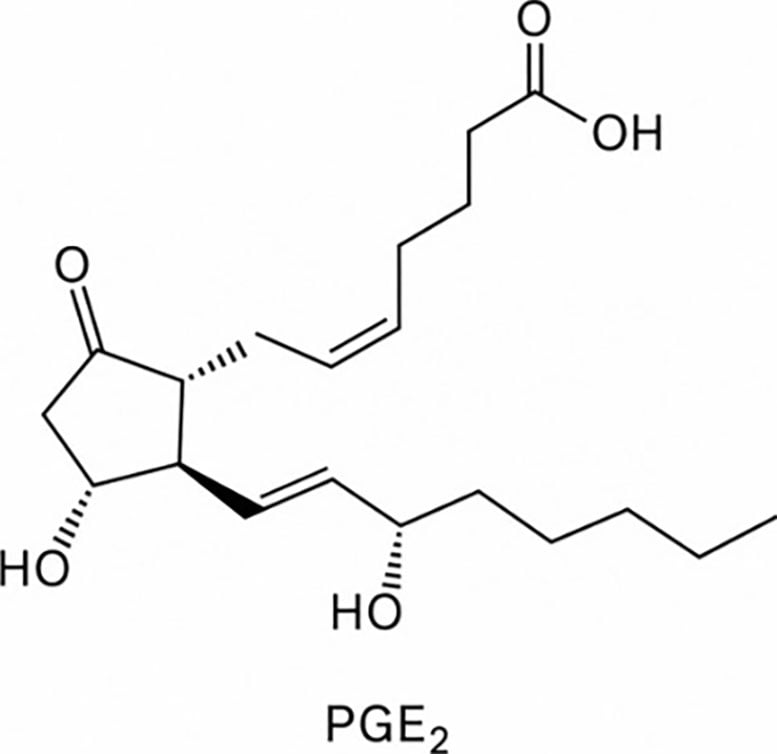
The researchers also examined circulating levels of AA, which provides the raw material for PG production. Although mice receiving the HSD had less AA in circulation, LPC70 increased PGs derived from AA, including PGE2 and PGD2. The result suggests that LPC70 may improve the use of available AA and increase PG production under high salt conditions.
Together, the findings indicate that LPC70 regulates PG signaling according to the organ and receptor involved. It reduced potentially harmful pathways in the kidney while restoring protective signaling in the brain.
A dietary strategy awaits clinical trials
LPC70 may have potential as a functional food ingredient for reducing some of the harmful effects associated with excessive salt intake. The mouse findings suggest that it could support both cardiovascular and cognitive health, particularly where dietary salt consumption is high.
Human research is still needed to determine whether these effects translate into meaningful health benefits.
“Our study elucidates LPC70’s role in PG signaling, laying the groundwork for future clinical research and dietary interventions aimed at reducing hypertension-related cognitive decline and promoting healthy aging globally,” concluded Prof. Mouri.
Reference: “Soy lysolecithin attenuates hypertension and behavioral impairments in mice fed a high-salt diet through receptor-specific regulation of prostaglandin signaling and arachidonic acid-derived prostaglandin production” by Hisayoshi Kubota, Kazuo Kunisawa, Masaya Hasegawa, Hitomi Kurahashi, Kazuhiro Kagotani, Kazuki Nakajima, Yuki Fujimoto, Akihito Hayashi, Ryoji Sono, Takehiko Tsuji, Kuniaki Saito, Toshitaka Nabeshima and Akihiro Mouri, 14 May 2026, Neurochemistry International.
DOI: 10.1016/j.neuint.2026.106184
This work was supported by Grants-in-Aid for Scientific Research from the Japan Society for the Promotion of Science (JSPS: 20K07931, 22K07606, 22K11891, and 23H02843), the Fujita Mind-Brain Research & Innovation Center for Drug Generation (Fujita Mind-BRIDGe) of the Japan’s Peak Research Universities (J-PEAKS) Program (JPJS00420240019), and the Japan Science and Technology Agency FOREST Program (JPMJFR215H). This work was funded by Tsuji Oil Mills Co., Ltd. and supported by grants from the Education and Research Facility of Animal Models for Human Diseases at Fujita Health University, the Smoking Research Foundation, and the Takeda Science Foundation.
Never miss a breakthrough: Join the SciTechDaily newsletter.
Follow us on Google and Google News.
1 Comment
THE NEW TYPES OF NATUALIZATION OF (SALT) A COMPOUNDE WHEN COMPOUNDS ARE INTINAL ISSUES ARE ACCOMALUTION IF THREE-STATES ARE COLLECTIONS NOT TERMS OF (REALITY & AMMOUNTS OF THINGS AND ALL SIMPLE RESULTS A SOURCES INTO THE FEATURES ARE RESULTS INCREASED IN AMOUNTS ARE COMBINATIONS OF THESE QUESTIONS FORMED REDUCED AND ANALYSIZED BY EVERY-THING IS THEORIES A NOTED THREE-TYPES COMBINED WITH ENERGY ITS A WELL-KNOWN ISSUES:THE FOLLOWING AREAS OF INCREASED CELLUAR ISSUES OF THINGS ARE DEVELOPED INTO (SYTHENIZED-COMBINED (PENCILLIN-FORMS/
ARTTHROMYCLIN-ERTHMYCIN DEHATHRIED ROOM-TEMPORARY UNTIL (BIO-FERMENTAION)SEQUNCES FOR 7-14 DAYS INDICATES A SOURCES INTO TO “THEORIES” IS THE FOLLOWING INNER-CORES COLLECTIONS ALL DEVOTED RESULTS AND DESCRIPTIONS QUESTIONS INCLUDES ARE DESCRIPTIONS ARE COMPLETED INTO THESE COLLECTIONS