
Hypertension and other health risks accelerate brain aging, as shown in a 16-year study using MRI data and predictive modeling.
Chinese scientists have conducted a population-based cohort study to examine the long-term impact of unhealthy lifestyles, metabolic abnormalities, and other risk factors on brain aging. The findings showed that these factors significantly accelerate brain aging, and the researchers proposed strategies to support brain health. Their study was published in Research.
Background
As people age, their brains experience a range of structural changes linked to aging, including cerebral atrophy, white matter microstructure damage, and increased white matter hyperintensities. These changes are strongly associated with the onset and progression of cognitive decline and neurodegenerative diseases. Brain age, which is estimated using magnetic resonance imaging (MRI) features, has become a key biomarker for assessing brain aging.
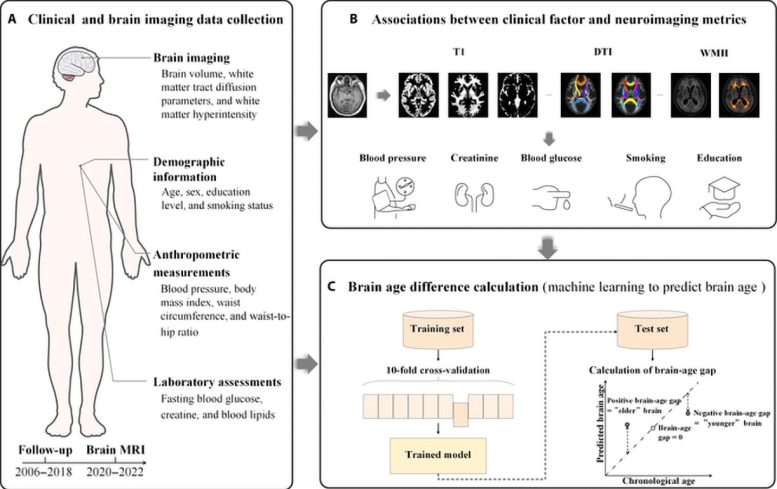
Most existing brain age prediction models use a single neuroimaging method. However, multi-modal brain imaging offers a more detailed view of how individuals’ brains age and improves prediction accuracy. There is growing evidence that health-related risk factors such as hypertension, high blood sugar, and smoking may influence brain structure. Still, the exact relationship between these risk factors and brain aging is not well understood. Identifying the specific factors that speed up brain aging is therefore critical for supporting long-term brain health.
Research progress
This study, utilizing a 16-year clinical follow-up cohort of the Kailuan population, elucidated that long-term adverse lifestyle, metabolic abnormalities, and other risk factors significantly accelerate brain aging.
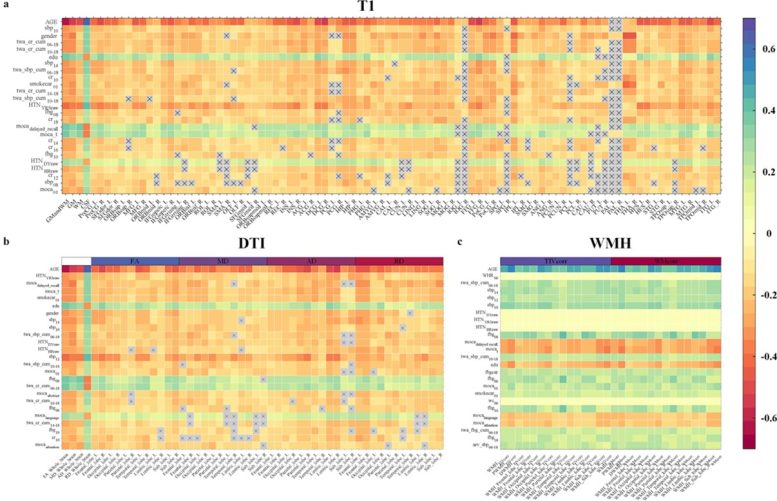
First, the authors constructed a matrix dataset integrating multi-dimensional health risk factors and multi-modal brain imaging features. By applying correlation analysis, correcting for multiple comparisons, they investigated the associations between multi-dimensional risk factors and multi-modal brain imaging features. They further identified the five risk factors most strongly associated with brain imaging features:
- Hypertension
- Hyperglycemia
- Hypercreatinemia
- Smoking
- Relatively low educational level
This finding preliminarily provides key insights into the risk factors that accelerate brain aging.
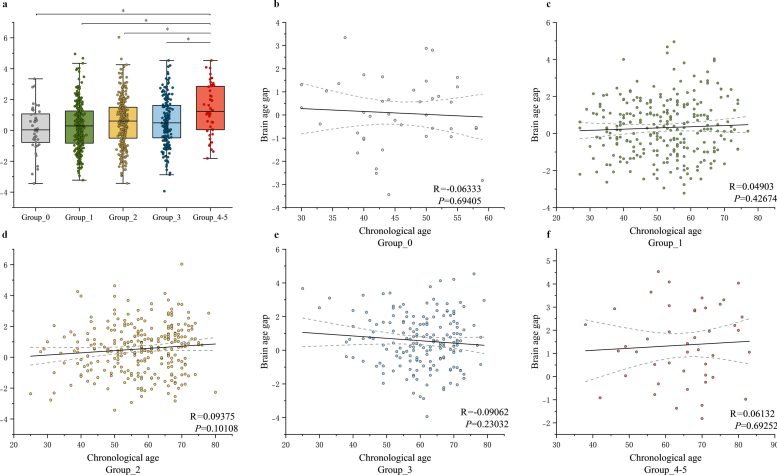
Subsequently, the participants were stratified into five groups based on the number of high-risk factors they exhibited: 0 (healthy control), 1, 2, 3, and 4-5 high-risk factor groups. The brain age prediction model was trained on the healthy group and subsequently applied to the five risk exposure groups to predict their brain ages and compare the differences in brain aging. The results indicate that individuals with 4-5 high-risk factors exhibit a significantly greater brain age gap (BAG) compared to the healthy group and other risk exposure groups. This suggests that a range of health factors across unhealthy lifestyles, metabolic abnormalities, and other risk factors may collectively contribute to the accelerated aging process of the brain.
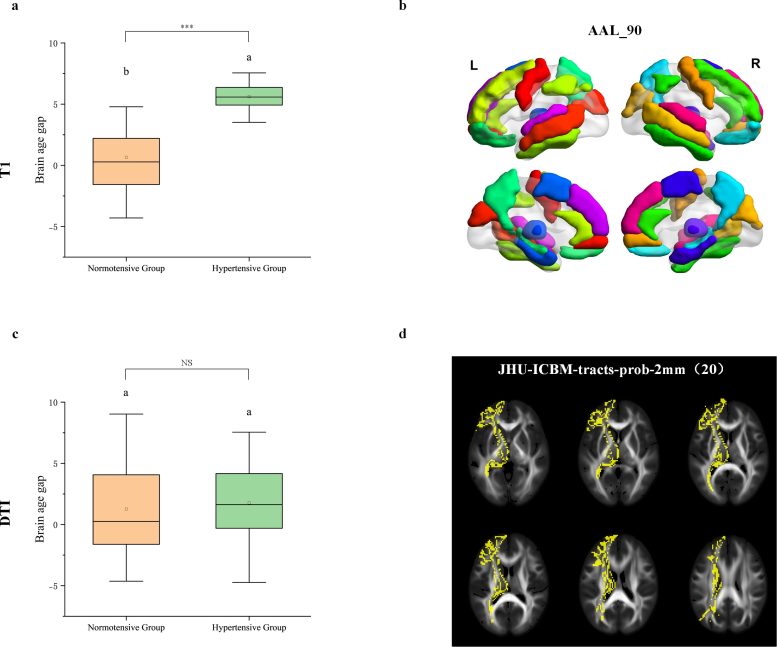
A further in-depth analysis revealed that the BAG predicted by T1-weighted imaging was significantly higher in the hypertensive subjects compared to those normotensive subjects. This indicates that hypertension exerts a pivotal influence on the structural degeneration of brain tissue and is a key factor in accelerating brain aging.
Suggestions for Future Research
This study, based on a long-term longitudinal follow-up of a large population, reveals that the five risk factors—hypertension, hyperglycemia, hypercreatinemia, smoking, and low educational attainment—accelerate brain aging, with hypertension causing the most significant brain damage.
Future research will incorporate longitudinal brain imaging data to assess the dynamic progression pattern of brain aging. In addition, future research is warranted to fully excavate high-dimensional information from multi-modal images, thereby enhancing the predictive and generalization capabilities of the models.
In summary, this study elucidates that a range of health risk factors contribute to the acceleration of brain aging, and effective management of blood pressure, blood glucose, and creatinine levels, along with reduced smoking and improved educational attainment, are essential for promoting brain health.
Reference: “Discovery of High-Risk Clinical Factors That Accelerate Brain Aging in Adults: A Population-Based Machine Learning Study” by Jing Sun, Luyao Wang, Yiwen Gao, Ying Hui, Shuohua Chen, Shouling Wu, Zhenchang Wang, Jiehui Jiang and Han Lv, 21 October 2024, Research.
DOI: 10.34133/research.0500
Funding: National Natural Science Foundation of China, Science and Technology Innovation 2030 – Major Projects, Shanghai Industrial Collaborative Innovation Project, Beijing Municipal Natural Science Foundation
Never miss a breakthrough: Join the SciTechDaily newsletter.
Follow us on Google and Google News.
4 Comments
While advanced imaging may be a very useful tool to help determine what dietary, lifestyle and metabolic factors most accelerate brain aging, as long as the basic programming remains as defective as it presently is machine learning never will be. A few critical factors yet to be included are Dr. Arthur F. Coca’s (by 1935) kind of nearly subclinical non-IgE-mediated food (minimally) allergy reactions, officially (FDA in the US) approved food poisoning (e.g., soy, TBHQ [https://onlinelibrary.wiley.com/doi/full/10.1002/fsn3.4373] and MSG, minimally) and/or outdated dogmatic fatally-flawed prior studies and excessive related/resultant medical errors (e.g., some mere symptoms [high blood pressure] considered to be diseases); GIGO.
The firat three aren’t “risks” -they’re illnesses.
See The Ice In The Drink Project 2.0 on YOUTUBE. A simple easy way to save the world. Cheap too! In fact it’s free. Two corrections: 1, 803 334 9649. 2, 36.5 million gallons of Ice In The Drink. Think of an Olympic size swimming pool frozen solid. Times 55. Addendum: Regular people like us who do not own ships can make an even bigger difference. There are millions of freezers near the Seven Seas of the World. We can use them. That’s the Ice In The Drink Project 2.0 on YOUTUBE. Question: Throughout all of history countless billions of words have been spoken. Only two are so important that our very lives depend on them. What are they? Please say these two words, magic words if
Magic words if you will. Out loud, at least one time a day. Maybe Sunrise? The only real obstacle between us and success is apathy. Ask about my new, new idea. Even easier. Is it possible to consciously create a new zeitgeist? Are we going to be the first? At any rate let’s do this thing. It just might work.