
Close Menu
    Facebook X (Twitter) Instagram
    SciTechDaily
    • Biology
    • Chemistry
    • Earth
    • Health
    • Physics
    • Science
    • Space
    • Technology
    Facebook X (Twitter) Pinterest YouTube RSS
    SciTechDaily
    Home»Health»A High Salt Low Potassium Diet Can Increase Your Risk of Cognitive Decline
    Health

    A High Salt Low Potassium Diet Can Increase Your Risk of Cognitive Decline

    By KeAi Communications Co., Ltd.January 24, 20231 Comment4 Mins Read
    Facebook Twitter Pinterest Telegram LinkedIn WhatsApp Email Reddit
    Share
    Facebook Twitter LinkedIn Pinterest Telegram Email Reddit
    Neuron Brain Neuroscience Concept
    Cognitive decline refers to the gradual decrease in cognitive abilities such as memory, attention, and problem-solving. It is a natural part of aging, but it can also be caused by various medical conditions, such as Alzheimer’s disease and other forms of dementia. It can also be caused by certain lifestyle choices, such as a poor diet, lack of physical activity, and social isolation.

    A Chinese study links high sodium intake and sodium-to-potassium ratio to cognitive decline, while higher potassium intake improves cognitive function.

    Dementia is a debilitating condition that affects a person’s ability to remember, think, and make decisions, making it difficult for them to perform everyday activities. It has become one of the leading causes of death and disability among the elderly worldwide. In China, which has both the largest elderly population and one of the fastest-aging populations, dementia poses significant economic, health, and social challenges.

    Since dementia is irreversible and effective treatments are limited, preventing and detecting cognitive decline early on is crucial. Studies have shown that certain lifestyle factors such as physical activity, diet, and sleep can affect cognitive function. However, the impact of dietary sodium and potassium on cognitive function remains poorly understood.

    In a prospective study published in the KeAi journal Global Transitions, a group of researchers from China looked at the impact of dietary sodium, potassium, sodium to potassium ratio, and salt on the cognitive function of a group of elderly people in China. Participants numbered 4,213 and were aged at least 50 years at baseline. Results are based on cognitive tests and participants’ self-reporting.
    Salt, Potassium, and Memory Chart
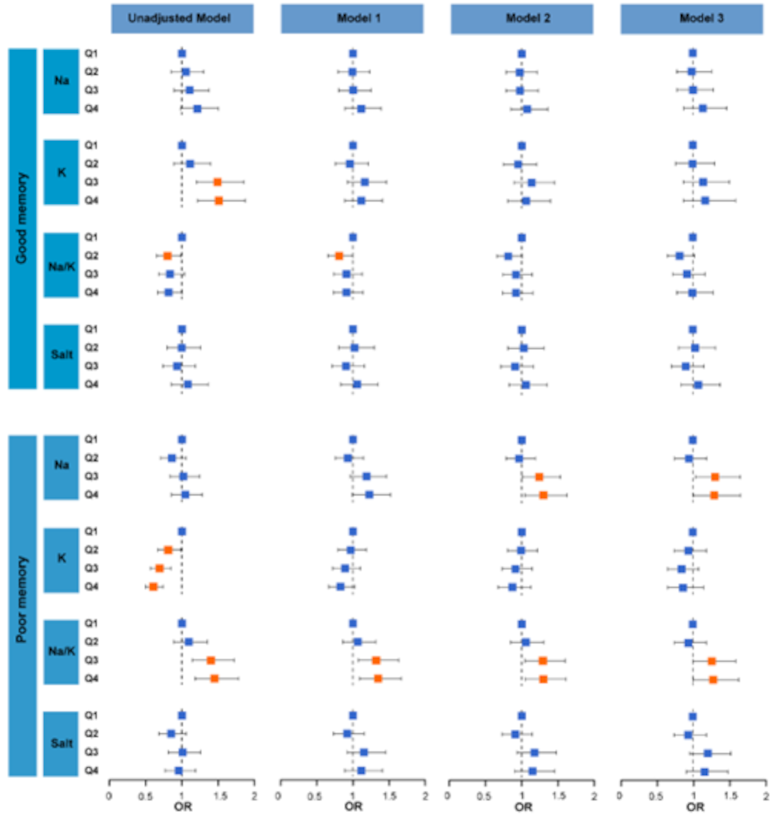
    Association of average sodium, potassium, sodium/potassium, and salt intake, and self-reported memory. Model 1 is adjusted for age, sex, location of residence, area of residence, educational level, working status, marital status, physical activity levels, and smoking and drinking habits. Model 2 is adjusted for energy, carbohydrate, protein, and fat intake (additionally adjusted potassium intake for the model of sodium and sodium intake for the model of potassium) based on Model 1. Model 3 is adjusted for BMI, sleep time, cardiovascular and cerebrovascular diseases, and cognition test scores at baseline based on Model 2. Abbreviations: Q1-Q4, quartile 1-quartile 4; OR, odds ratios; CI, confidence interval; and BMI, body mass index. Orange squares denote significant association (P < 0.05). Credit: Xiaona Na

    Key Findings on Sodium and Potassium

    The research team found that a high intake of sodium (> 5593.2 mg/day) and a high sodium-to-potassium ratio (> 3.8/day) increased the risk of memory impairment in the elderly. Conversely, higher levels of potassium intake (> 1653.3 mg/day) were associated with a higher cognitive score; the average cognitive test score (13.44 at baseline, total score was 27.00) increased by ~1 point when 1000 mg/day of sodium was replaced with an equal intake of potassium.

    In addition, the researchers built on previous studies by demonstrating that the effects of dietary sodium, sodium to potassium ratio, and potassium on cognitive function have the potential to be mediated by cardiovascular and cerebrovascular disease (CCVD), while the link between salt and cognitive function can be mediated by sleep.

    Although China has attempted to restrict salt and sodium in people’s diets for over a decade, the population’s intake remains alarmingly high, outstripping many other countries and the World Health Organization’s recommendation of a maximum of 1400 mg/day of sodium for people aged 50—79 years and 5 g/day of salt. This high salt intake is commonly accompanied by insufficient consumption of potassium (1499.0 mg/day in this study vs. the Chinese recommended level of 3600 mg/day).

    The study’s results also confirm previous findings that dietary sodium to potassium ratio could provide a better measure of how these elements impact cognitive function, than looking at separate sodium or potassium values.

    Recommendations for Sodium-to-Potassium Balance

    Corresponding author, Ai Zhao, adds: “Based on our findings, it is reasonable to suggest that decreasing sodium intake, and properly increasing potassium intake, is beneficial to cognitive function. Given our results and the nutritional situation of the Chinese, it will be important for future studies to focus on determining the optimal ratio of dietary sodium and potassium in the elderly. In addition, the development of strategies to improve the sodium-to-potassium ratio in Chinese diets should be a priority.”

    Reference: “Association of dietary sodium, potassium, sodium/potassium, and salt with objective and subjective cognitive function among the elderly in China: A prospective cohort study” by Xiaona Na, Menglu Xi, Yiguo Zhou, Jiaqi Yang, Jian Zhang, Yuandi Xi, Yucheng Yang, Haibing Yang and Ai Zhao, 3 November 2022, Global Transitions.
    DOI: 10.1016/j.glt.2022.10.002

    The study was funded by the Sanming Project of Medicine. 

    Never miss a breakthrough: Join the SciTechDaily newsletter.
    Follow us on Google and Google News.

    Aging Brain Dementia Diet Popular Public Health
    Share. Facebook Twitter Pinterest LinkedIn Email Reddit

    Related Articles

    This High-Fat Diet Could Be the Secret to Keeping Your Brain Young

    17 Modifiable Lifestyle Factors That Protect Your Brain From Aging and Dementia

    This Simple Diet Tweak Could Help Protect Your Brain Against Dementia

    New Research Links Reused Deep-Fried Oil Linked to Neurodegeneration

    New Research Links Mind Diet to a Slower Pace of Aging, Reduced Dementia Risk

    Best Evidence Yet: Lowering Blood Pressure Can Prevent Dementia

    Fecal Transplants Reverse Hallmarks of Aging in the Gut, Eyes, and Brain

    Exercise Alters Brain Chemistry To Protect Aging Synapses From Alzheimer’s and Dementia

    Scientists Identify the Cause of Alzheimer’s Progression in the Brain – Very Different Than Previously Thought

    1 Comment

    1. Justice Ofori-Elikem on January 26, 2023 2:09 am

      Useful article!

      Reply
    Leave A Reply Cancel Reply

    • Facebook
    • Twitter
    • Pinterest
    • YouTube

    Don't Miss a Discovery

    Subscribe for the Latest in Science & Tech!

    Trending News

    Breakthrough Bowel Cancer Trial Leaves Patients Cancer-Free for Nearly 3 Years

    Natural Compound Shows Powerful Potential Against Rheumatoid Arthritis

    100,000-Year-Old Neanderthal Fossils in Poland Reveal Unexpected Genetic Connections

    Simple “Gut Reset” May Prevent Weight Gain After Ozempic or Wegovy

    2.8 Days to Disaster: Scientists Warn Low Earth Orbit Could Suddenly Collapse

    Common Food Compound Shows Surprising Power Against Superbugs

    5 Simple Ways To Remember More and Forget Less

    The Atomic Gap That Could Cost the Semiconductor Industry Billions

    Follow SciTechDaily
    • Facebook
    • Twitter
    • YouTube
    • Pinterest
    • Newsletter
    • RSS
    SciTech News
    • Biology News
    • Chemistry News
    • Earth News
    • Health News
    • Physics News
    • Science News
    • Space News
    • Technology News
    Recent Posts
    • After 37 Years, the World’s Longest-Running Soil Warming Experiment Uncovers a Startling Climate Secret
    • NASA Satellite Captures First-Ever High-Res View of Massive Pacific Tsunami
    • ADHD Isn’t Just a Deficit: Study Reveals Powerful Hidden Strengths
    • Scientists Uncover “Astonishing” Hidden Property of Light
    • Scientists Discover Stem Cells That Could Regrow Teeth and Bone
    Copyright © 1998 - 2026 SciTechDaily. All Rights Reserved.
    • Science News
    • About
    • Contact
    • Editorial Board
    • Privacy Policy
    • Terms of Use

    Type above and press Enter to search. Press Esc to cancel.