
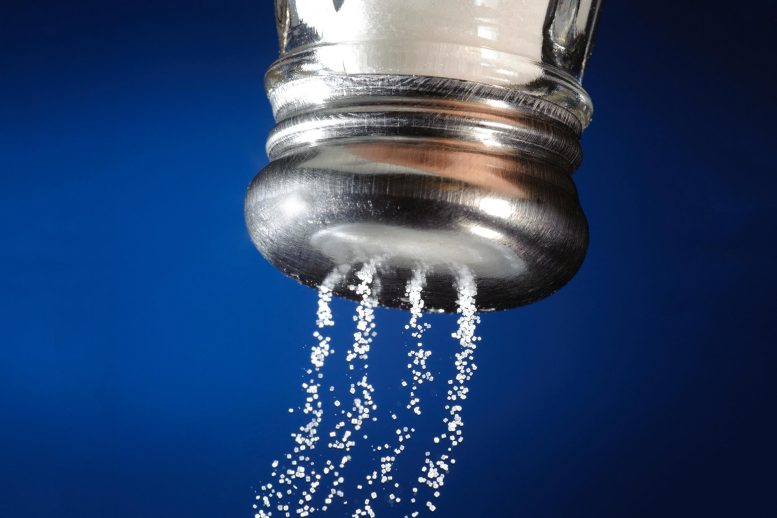
Salt Substitute Reduces Stroke Risk
Replacing salt with a low-sodium alternative lowers the risk of stroke in people with high blood pressure or prior stroke, according to late-breaking research presented in a Hot Line session at ESC Congress 2021[1] and published in the New England Journal of Medicine.[2]
Both elevated sodium intake and low potassium intake are associated with high blood pressure and an increased risk of cardiovascular disease and premature death.[3,4] Salt substitutes, which replace part of the sodium chloride in regular salt with potassium chloride, have been shown to lower blood pressure[5] but their effects on heart disease, stroke, and death had been uncertain. In addition, there had been concerns about causing hyperkalemia in people with chronic kidney disease leading to cardiac arrhythmias and sudden death.
The Salt Substitute and Stroke Study (SSaSS) compared the effect of reduced-sodium salt substitute versus regular salt on stroke, cardiovascular events, mortality and clinical hyperkalaemia.[6] SSaSS was an open, cluster-randomized, trial that enrolled participants between April 2014 and January 2015. Participants were adults with either a previous stroke or age 60 years and above with poorly controlled blood pressure.[7]
The trial was conducted in 600 villages in rural areas of five provinces in China. Two counties within each province were chosen that represented the socio-economic development level of rural counties in that province. Approximately 35 individuals were recruited from each village – for a total of 20,995 participants. Participants were cluster-randomized by village in a 1:1 ratio to provision of salt substitute or continued use of regular salt.
Participants in intervention villages were given free salt substitute (about 75% sodium chloride and 25% potassium chloride) as a replacement for regular salt and advised to use it for all cooking, seasoning, and food preservation. They were also encouraged to use the salt replacement more sparingly than they previously used salt to maximize their sodium reduction. Sufficient salt substitute was provided to cover the needs of the entire household (about 20 g per person per day). Participants in control villages continued their usual habits.
The average age of participants was 65.4 years and 49.5% were female. Some 72.6% had a history of stroke and 88.4% had a history of hypertension.
Significant Reduction in Stroke and Mortality
During an average follow up of 4.74 years, more than 3,000 people had a stroke, more than 4,000 died and more than 5,000 had a major cardiovascular event. The risk of stroke was reduced with salt substitute compared to regular salt (29.14 versus 33.65 per 1,000 patient-years; rate ratio [RR] 0.86; 95% confidence interval [CI] 0.77–0.96; p=0.006).
Regarding secondary outcomes, major cardiovascular events (non-fatal stroke, non-fatal acute coronary syndrome, vascular death) were reduced with salt substitute (49.09 versus 56.29 per 1,000 patient-years; RR 0.87; 95% CI 0.80–0.94; p<0.001) as was total mortality (39.27 versus 44.61 per 1,000 patient-years; RR 0.88; 95% CI 0.82–0.95; p<0.001).
Regarding safety, there was no increased risk of serious adverse events attributed to clinical hyperkalaemia with salt substitute compared to regular salt (3.35 versus 3.30 per 1,000 patient years; RR 1.04; 95% CI 0.80–1.37; p=0.76). Neither were any other risks identified.
Principal investigator Professor Bruce Neal of the George Institute for Global Health, Sydney, Australia said: “This study provides clear evidence about an intervention that could be taken up very quickly at very low cost. A recent modeling study done for China projected that 365,000 strokes and 461,000 premature deaths could be avoided each year in China if salt substitute was proved to be effective.[8] We have now showed that it is effective, and these are the benefits for China alone. Salt substitution could be used by billions more with even greater benefits.”
Low-Cost, High-Impact Health Strategy
He added: “The trial result is particularly exciting because salt substitution is one of the few practical ways of achieving changes in the salt people eat. Other salt reduction interventions have struggled to achieve large and sustained impact.’’
‘’Importantly, salt substitute is very easy to manufacture and it is not expensive. A kilo of regular salt, which lasts for months, costs about US$1.08 in China. The price for a kilo of salt substitute is $1.62/kg,’’ he said. “It is primarily lower-income and more disadvantaged populations that add large amounts of salt during food preparation and cooking.[9] This means that salt substitute has the potential to reduce health inequities related to cardiovascular disease.”
References and notes
- SSaSS: Salt Substitute and Stroke Study into the effect of salt substitutes on cardiovascular events and death
- Tian M, et al. The effect of salt substitute on cardiovascular events and death (SSaSS). N Engl J Med. 10.1056/NEJMoa2105675
- Cogswell ME, Mugavero K, Bowman BA, Frieden TR. Dietary sodium and cardiovascular disease risk–measurement matters. N Engl J Med. 2016;375:580–586.
- Aburto NJ, Hanson S, Gutierrez H, et al. Effect of increased potassium intake on cardiovascular risk factors and disease: systematic review and meta-analyses. BMJ. 2013;346:f1378.
- Greer RC, Marklund M, Anderson CAM, et al. Potassium-enriched salt substitutes as a means to lower blood pressure. Hypertension. 2020;75:266–274.
- Neal B, Tian M, Li N, et al. Rationale, design, and baseline characteristics of the Salt Substitute and Stroke Study (SSaSS)-A large-scale cluster randomized controlled trial. Am Heart J. 2017;188:109–117.
- Poorly controlled blood pressure was defined as: systolic blood pressure =140 mmHg if on blood pressure lowering medication or systolic blood pressure =160 mmHg if not on blood pressure lowering medication.
- Marklund M, Singh G, Greer R, et al. Estimated population wide benefits and risks in China of lowering sodium through potassium enriched salt substitution: modelling study. BMJ. 2020;369:m824.
- Bhat S, Marklund M, Henry ME, et al. A systematic review of the sources of dietary salt around the world. Adv Nutr. 2020;11:677–686.
Funding: The study was supported by the National Health and Medical Research Council (APP1164206 and APP1049417) with the study salt substitute purchased from local manufacturers in each province for years 1, 2 and 5 but provided free of charge by Jiangsu Sinokone Technology Company Limited for years 3 to 4.
Never miss a breakthrough: Join the SciTechDaily newsletter.
Follow us on Google and Google News.