
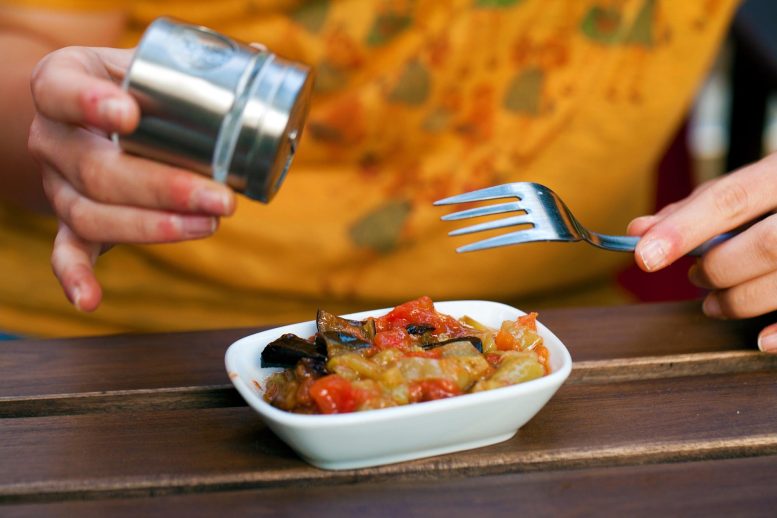
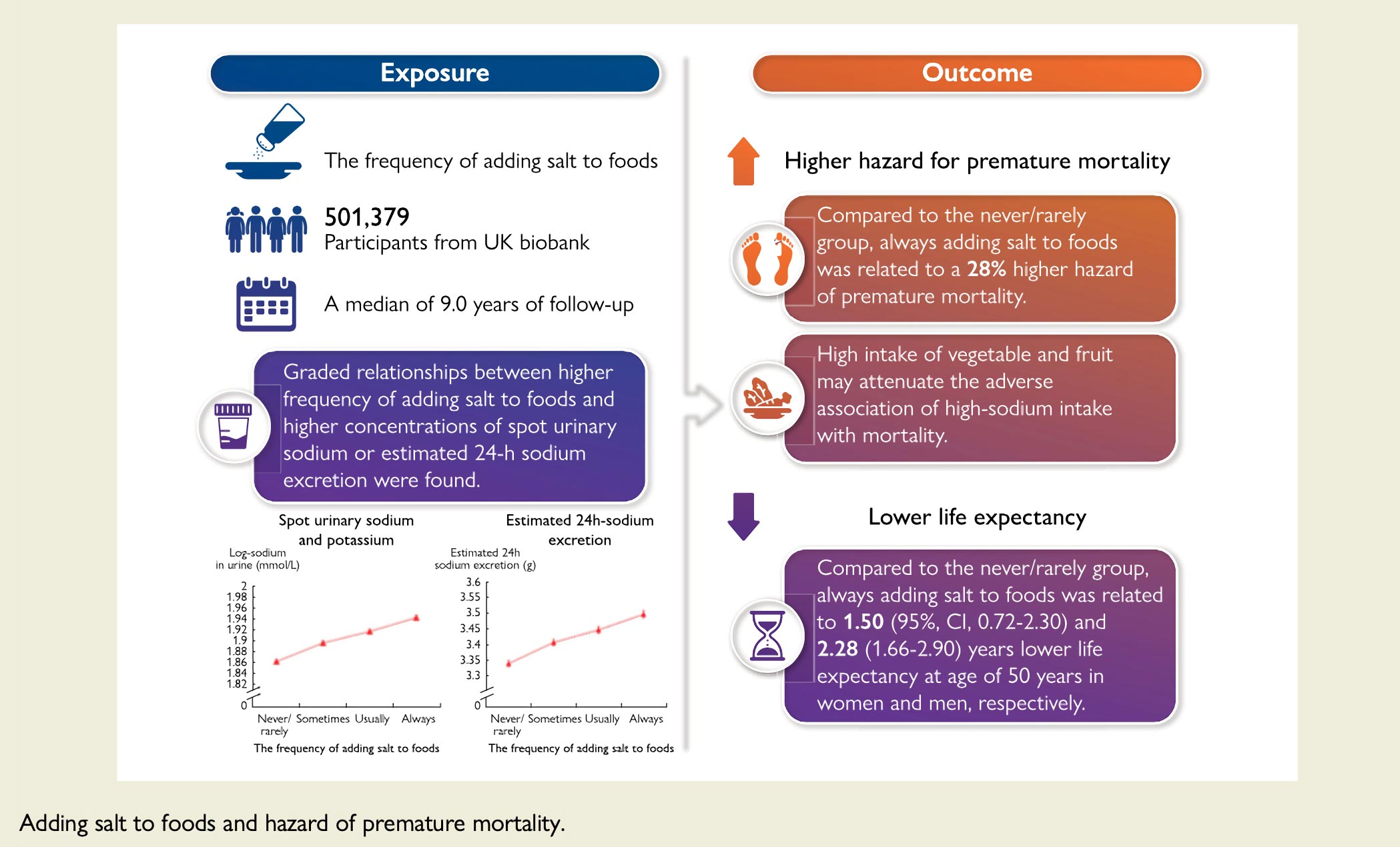
According to new research published in the European Heart Journal, people who always add salt to their food have a 28% increased risk of dying prematurely. This corresponds to reducing life expectancy by 2.28 years for men and 1.5 years for women at age 50.
People who add extra salt to their food at the table are at higher risk of dying prematurely from any cause, according to a research study involving more than 500,000 people, published on July 10, 2022, in the European Heart Journal.[1]
Those who always added salt to their food had a 28% increased risk of dying prematurely, compared to those who never or rarely added salt. In the general population, about three in every hundred people aged between 40 and 69 die prematurely. The increased risk from always adding salt to food seen in the current study suggests that one more person in every hundred may die prematurely in this age group.
Additionally, in a correlated result, the study found a lower life expectancy among people who always added salt compared to those who never, or rarely added salt. At the age of 50, 2.28 years and 1.5 years were knocked off the life expectancy of men and women, respectively, who always added salt to their food compared to those who never, or rarely, did.
The findings have several important public health implications according to the researchers, who were led by Professor Lu Qi, of Tulane University School of Public Health and Tropical Medicine, New Orleans, USA.
“To my knowledge, our study is the first to assess the relation between adding salt to foods and premature death,” he said. “It provides novel evidence to support recommendations to modify eating behaviors for improving health. Even a modest reduction in sodium intake, by adding less or no salt to food at the table, is likely to result in substantial health benefits, especially when it is achieved in the general population.”
Assessing Salt Intake Beyond Processed Foods
Many foods, particularly pre-prepared and processed foods, have high levels of salt added before they even reach the table, which makes assessing overall sodium intake notoriously difficult. Studies assessing salt intake by means of urine tests often only take one urine test and therefore do not necessarily reflect usual behavior. Additionally, foods that are high in salt are often accompanied by foods rich in potassium, such as fruit and vegetables, which is good for us.[2] While potassium is known to protect against the risk of heart diseases and metabolic diseases such as diabetes, sodium increases the risk of conditions such as cancer, high blood pressure, and stroke.
For these reasons, the scientists chose to examine whether or not people added salt to their foods at the table, independent of any salt added during cooking.
“Adding salt to foods at the table is a common eating behavior that is directly related to an individual’s long-term preference for salty-tasting foods and habitual salt intake,” said Prof. Qi. “In the Western diet, adding salt at the table accounts for 6-20% of total salt intake and provides a unique way to evaluate the association between habitual sodium intake and the risk of death.”
The researchers analyzed data from 501,379 people taking part in the UK Biobank study. When joining the study between 2006 and 2010, the participants were asked, via a touch-screen questionnaire, whether they added salt to their foods (i) never/rarely, (ii) sometimes, (iii) usually, (iv) always, or (v) prefer not to answer. Those who preferred not to answer were not included in the analysis. The researchers adjusted their analyses to take into account factors that could affect outcomes, such as age, sex, race, deprivation, body mass index (BMI), smoking, alcohol intake, physical activity, diet, and medical conditions such as diabetes, cancer and heart and blood vessel diseases. They followed the participants for a median (average) of nine years. Premature death was defined as death before the age of 75 years.
Protective Role of Fruits and Vegetables
As well as finding that always adding salt to foods was linked to a higher risk of premature death from all causes and a reduction in life expectancy, the researchers found that these risks tended to be reduced slightly in people who consumed the highest amounts of fruit and vegetables, although these results were not statistically significant.
“We were not surprised by this finding as fruits and vegetables are major sources of potassium, which has protective effects and is associated with a lower risk of premature death,” said Prof. Qi.
He added: “Because our study is the first to report a relation between adding salt to foods and mortality, further studies are needed to validate the findings before making recommendations.”
Expert Opinions on Sodium Intake
In an editorial to accompany the paper,[3] Professor Annika Rosengren, a senior researcher and professor of medicine at the Sahlgrenska Academy, University of Gothenburg, Sweden, who was not involved with the research, writes that the net effect of a drastic reduction in salt intake for individuals remains controversial.
“Given the various indications that a very low intake of sodium may not be beneficial, or even harmful, it is important to distinguish between recommendations on an individual basis and actions on a population level,” she writes.
She concludes: “Classic epidemiology argues that a greater net benefit is achieved by the population-wide approach (achieving a small effect in many people) than from targeting high-risk individuals (a large effect but only achieved in a small number of people). The obvious and evidence-based strategy with respect to preventing cardiovascular disease in individuals is early detection and treatment of hypertension, including lifestyle modifications, while salt-reduction strategies at the societal level will lower population mean blood pressure levels, resulting in fewer people developing hypertension, needing treatment, and becoming sick. Not adding extra salt to food is unlikely to be harmful and could contribute to strategies to lower population blood pressure levels.”
A strength of Prof. Qi’s study is the large number of people included. It also has some limitations, which include: the possibility that adding salt to food is an indication of an unhealthy lifestyle and lower socioeconomic status, although analyses attempted to adjust for this; there was no information on the quantity of salt added; adding salt may be related to total energy intake and intertwined with the intake of other foods; participation in UK Biobank is voluntary and therefore the results are not representative of the general population, so further studies are needed to confirm the findings in other populations.
Prof. Qi and his colleagues will be carrying out further studies on the relationship between adding salt to foods and various chronic diseases such as cardiovascular disease and diabetes. They also expect potential clinical trials to test the effects of a reduction in adding salt on health outcomes.
References:
- “Adding salt to foods and hazard of premature mortality” by Hao Ma, Qiaochu Xue, Xuan Wang, Xiang Li, Oscar H Franco, Yanping Li, Yoriko Heianza, JoAnn E Manson and Lu Qi, 10 July 2022, European Heart Journal.
DOI: 10.1093/eurheartj/ehac208 - An example of a typically salty food that also contains vegetables are tacos, which are often filled with beans and vegetables.
- “Salt – the sweet spot?” by Annika Rosengren, 10 July 2022, European Heart Journal.
DOI: 10.1093/eurheartj/ehac336
Funding: National Heart, Lung, and Blood Institute, NIH/National Institute of Diabetes and Digestive and Kidney Diseases, National Heart, Lung, and Blood Institute, NIH/National Institute of Diabetes and Digestive and Kidney Diseases
Never miss a breakthrough: Join the SciTechDaily newsletter.
Follow us on Google and Google News.
4 Comments
Sounds like a nonsense “study”! Sodium is essential to our biology and physiology just as much as potassium is! It’s called the sodium-potassium pump which is a part of basically every cell! It just happens to need one less sodium ion than potassium ion! So it’s probably the fact that most don’t get anywhere near their potassium requirement (which is around 5-7grams daily) and far more sodium (than normal) and not REAL salt which when eaten as is is quite self-regulating because of the chloride and other mineral salts it ought to naturally contain! The average table salt (really just sodium chloride) also usually comes with aluminum silicates and most sodium in food is in the form of nitrates or glutamates which are anything but healthy and usual come with other quite unhealthy additives such as flavors/colors/etc! This is all false assumptions based on the initial belief that salt and/or is bad, and there are plenty of very good studies indicating that more REAL salt actually does your body good, especially your heart and other muscles! Go listen to Dr Ken Berry’s YouTube interview videos on the subject with top researchers!
Why is it a nonsense study? They investigated table salt not your ‘REAL salt’- you go out of your way to point out how unhealthy table salt is – which is precisely what this study shows!
i have no idea what to make of this since i cook almost all my own meals, so i obviously am adding salt to what i cook, even if i don’t add more when i’m eating it
Here I am, with my chronically low Na+ blood levels… I just finished a bowl of veggies that I salted with maybe a bit too much sea salt. I’ve had seizures from low sodium and for years have carried salt and sugar packets to make my oral rehydration solution. Yes, I use the actual stuff now and then but my brain feels no difference. I expect to salt my food but I taste it first- apparently there aren’t people who picture up the salt shaker beforehand they pick up a fork.
A study from a long time ago determined that a major predictor of how much salt people added to their food was the size of the holes in the shaker. Those cheap white plastic ones in cafeterias have huge holes.