
Close Menu
    Facebook X (Twitter) Instagram
    SciTechDaily
    • Biology
    • Chemistry
    • Earth
    • Health
    • Physics
    • Science
    • Space
    • Technology
    Facebook X (Twitter) Pinterest YouTube RSS
    SciTechDaily
    Home»Space»NASA’s Mars Perseverance Rover: Searching for Sand Transport
    Space

    NASA’s Mars Perseverance Rover: Searching for Sand Transport

    By NASAJuly 14, 2022No Comments3 Mins Read
    Facebook Twitter Pinterest Telegram LinkedIn WhatsApp Email Reddit
    Share
    Facebook Twitter LinkedIn Pinterest Telegram Email Reddit
    Mars Perseverance Sol 488
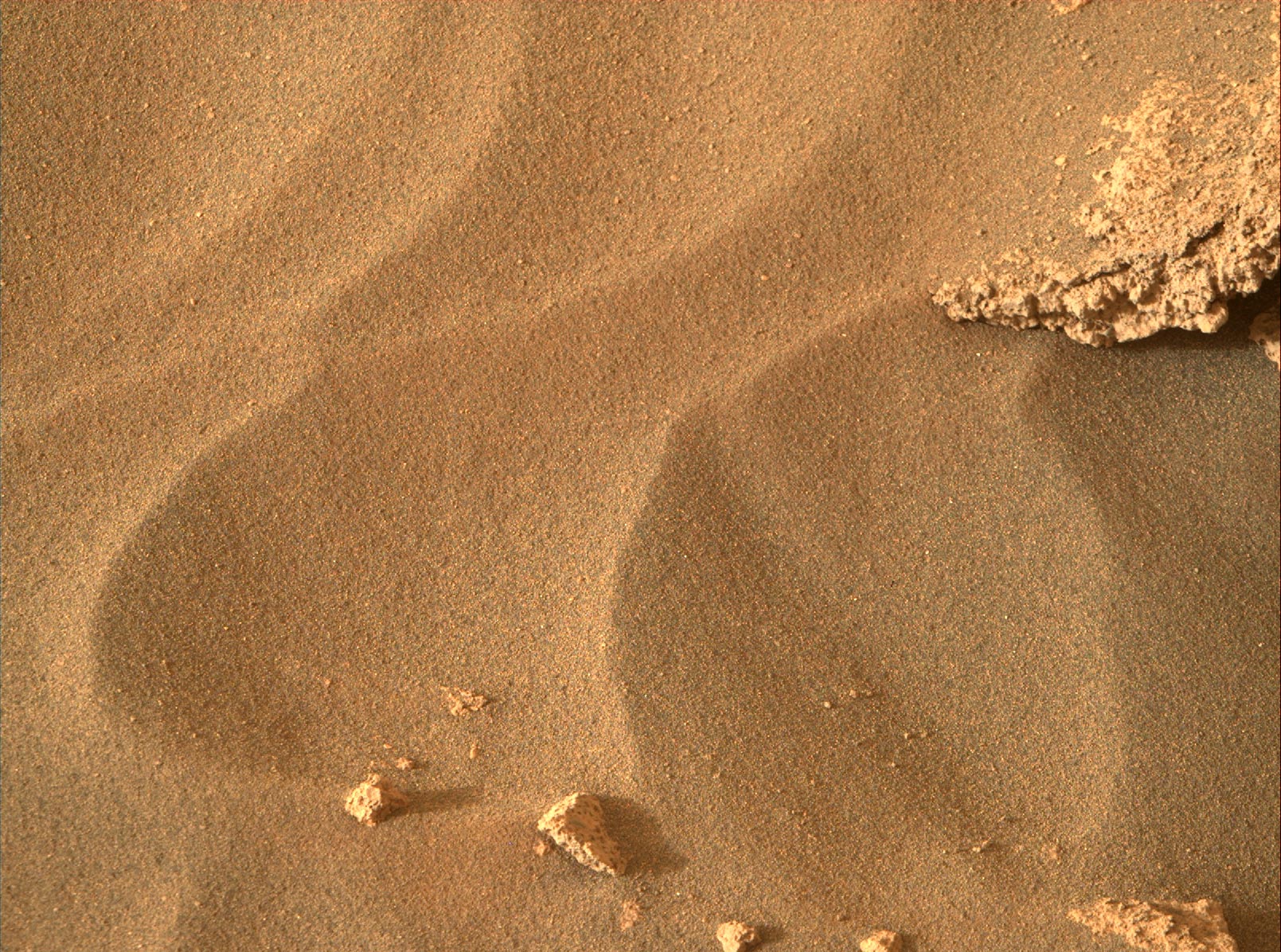
    Mars Perseverance Sol 488 – Right Mastcam-Z Camera: Sand ripples imaged with Mastcam-Z on sol 488. These ripples will be reimaged for change detection while the rover is parked here at Skinner Ridge rock. Credit: NASA/JPL-Caltech/ASU

    NASA’s Perseverance Rover uses its sampling stops to conduct change detection experiments, which monitor sand movement caused by Martian winds.

    NASA’s Mars Perseverance Rover is currently stopped for sampling at Skinner Ridge rock. An important aspect of Perseverance’s mission is sampling activities, and therefore the rover’s strategic path is developed around sampling stops. During these stops, the rover must remain stationary for at least twelve sols (Mars-days) in order to conduct proximity science and activities related to abrasion and coring. However, there is another advantage to staying in one place for such a long time.

    Sampling stops provide rare opportunities to perform “change detection” experiments, which are used to monitor aeolian — or wind-driven — transport of sand. The fundamental idea behind change detection is straightforward: to search for wind-induced movement of sand, compare identical images of the surface acquired at different times. The relative intensity and direction of the winds that were blowing in the interval between the two photos may be inferred from these observations. Sand deposits and aeolian bedforms (such as the sand ripples seen in the accompanying Mastcam-Z image at the top of this article) are ideal targets for change detection.

    The Mars Perseverance rover is not the first spacecraft to perform this type of imaging experiment. In fact, change detection experiments have been conducted since the earliest missions sent to Mars, stretching back for many decades. Theories developed before robotic exploration predicted that contemporary Martian winds would rarely, if ever, be capable of transporting sand. Paradoxically, change detection images acquired from orbiting cameras have revealed the active migration of sand dunes across the planet.

    Developing models that can effectively explain and predict aeolian activity on Mars is critical for interpreting the planet’s climatic and geologic history. It’s also essential for mitigating risks to landed spacecraft and future human explorers. Surface missions enable scientists to study ongoing aeolian activity in greater detail and with higher spatiotemporal resolution than can be achieved from orbit, which is necessary for reconciling the discrepancy between theory and observation. Sand motion has been observed and studied in situ at spacecraft landing sites, including Gale crater and Jezero crater. Images acquired during Perseverance’s ongoing activities at Skinner Ridge rock and at future sampling stops will be used to further characterize the aeolian environment in Jezero and will provide new insight into enigmatic Martian winds.

    Written by Mariah Baker, Planetary Scientist at Smithsonian National Air & Space Museum

    Never miss a breakthrough: Join the SciTechDaily newsletter.
    Follow us on Google and Google News.

    JPL Mars Mars 2020 Perseverance Rover NASA
    Share. Facebook Twitter Pinterest LinkedIn Email Reddit

    Related Articles

    NASA’s Perseverance Rover Discovers Mysterious Striped Rock on Mars

    NASA’s Perseverance Rover Begins Ambitious Ascent of Jezero Crater Rim

    NASA’s Perseverance Mars Rover To Begin Epic Climb up Steep Martian Crater Rim

    Potential Evidence of Life Discovered on Mars by NASA’s Perseverance Rover

    Is There Life on Mars? NASA’s AI Rovers Might Soon Tell Us

    Charting the Red Planet: How Open Science Fuels Mars Exploration

    Perseverance Triumphs: How SHERLOC Was Brought Back to Life on Mars

    Atmospheric Time Capsules: Why Scientists Are Intrigued by Air in NASA’s Mars Sample Tubes

    NASA’s Perseverance Rover Crosses Ancient Martian River To Reach New Scientific Frontiers

    Leave A Reply Cancel Reply

    • Facebook
    • Twitter
    • Pinterest
    • YouTube

    Don't Miss a Discovery

    Subscribe for the Latest in Science & Tech!

    Trending News

    Scientists Discover 132-Million-Year-Old Dinosaur Tracks on South Africa’s Coast

    Scientists Uncover the Secret Ingredient Behind the Spark That May Have Started Life on Earth

    Physicists Observe Matter in Two Places at Once in Mind-Bending Quantum Experiment

    Stanford Scientists Discover Hidden Brain Circuit That Fuels Chronic Pain

    New Study Reveals Why Ozempic Works Better for Some People Than Others

    Climate Change Is Altering a Key Greenhouse Gas in a Way Scientists Didn’t Expect

    New Study Suggests Gravitational Waves May Have Created Dark Matter

    Scientists Discover Why the Brain Gets Stuck in Schizophrenia

    Follow SciTechDaily
    • Facebook
    • Twitter
    • YouTube
    • Pinterest
    • Newsletter
    • RSS
    SciTech News
    • Biology News
    • Chemistry News
    • Earth News
    • Health News
    • Physics News
    • Science News
    • Space News
    • Technology News
    Recent Posts
    • 320 Light-Years Away, a Planet Confirms a Fundamental Cosmic Assumption
    • Astronomers Solve Decades-Long Mystery About Saturn’s Spin – “Something Strange Was Happening”
    • Scientists Uncover Strange New State of Matter Inside Uranus and Neptune
    • The Crown Jewel of Dentistry? Breakthrough Tech Could Transform Tooth Repair
    • The Surprising Non-Medical Factor That Determines Cancer Survival
    Copyright © 1998 - 2026 SciTechDaily. All Rights Reserved.
    • Science News
    • About
    • Contact
    • Editorial Board
    • Privacy Policy
    • Terms of Use

    Type above and press Enter to search. Press Esc to cancel.