

WashU Medicine-led trial evaluating investigational drug from Eli Lilly and Company aims to stop disease before symptoms arise
Researchers at Washington University School of Medicine in St. Louis have enrolled the first participants in an international clinical trial designed to prevent Alzheimer’s disease in young adults at high risk. The study aims to determine whether halting early molecular changes associated with the disease can prevent its onset altogether.
The trial is enrolling participants as young as 18 who show few or no detectable Alzheimer’s-related brain changes—potentially up to 25 years before dementia symptoms are expected to appear. It is limited to individuals from families with inherited genetic mutations that nearly guarantee early-onset Alzheimer’s, typically developing in their 30s, 40s, or 50s. However, researchers anticipate that the findings will contribute to broader efforts in Alzheimer’s prevention and treatment.
Known as the Primary Prevention Trial, the study evaluates remternetug, an investigational antibody developed by Eli Lilly and Company. The drug is designed to clear or prevent the buildup of amyloid beta plaques—considered a key early driver of Alzheimer’s. Both genetic and sporadic forms of the disease begin with amyloid accumulation in the brain, often decades before memory and cognitive symptoms emerge. By eliminating early amyloid plaques or stopping their formation, researchers hope to disrupt the disease process at its earliest stage, potentially preventing Alzheimer’s symptoms from ever developing.
Potential for Transformative Alzheimer’s Treatment
“We have seen tremendous progress in the treatment of Alzheimer’s disease in the past few years,” said Eric McDade, DO, a professor of neurology and the trial’s principal investigator. “Two amyloid-targeting drugs were shown to slow symptoms of the disease and have now been approved by the Food and Drug Administration (FDA) as treatments for people with mild cognitive impairment or mild dementia due to Alzheimer’s disease. This provides strong support for our hypothesis that intervening when amyloid beta plaques are at the very earliest stage, long before symptoms arise, could prevent symptoms from emerging in the first place.”
The trial is part of the Dominantly Inherited Alzheimer Network (DIAN) Trials Unit (DIAN-TU), a clinical trials platform designed to find medicines to prevent or treat Alzheimer’s disease. It is closely associated with DIAN, a National Institutes of Health (NIH)-funded international research network led by WashU Medicine that involves research institutes in North America, Australia, Europe, Asia, and South America. DIAN follows families with mutations in any of three genes that cause Alzheimer’s at a young age. A child born into such a family has a 50% chance of inheriting such a mutation, and those who do so typically develop signs of dementia near the same age his or her parent did. All the participants in the Primary Prevention Trial come from such families.
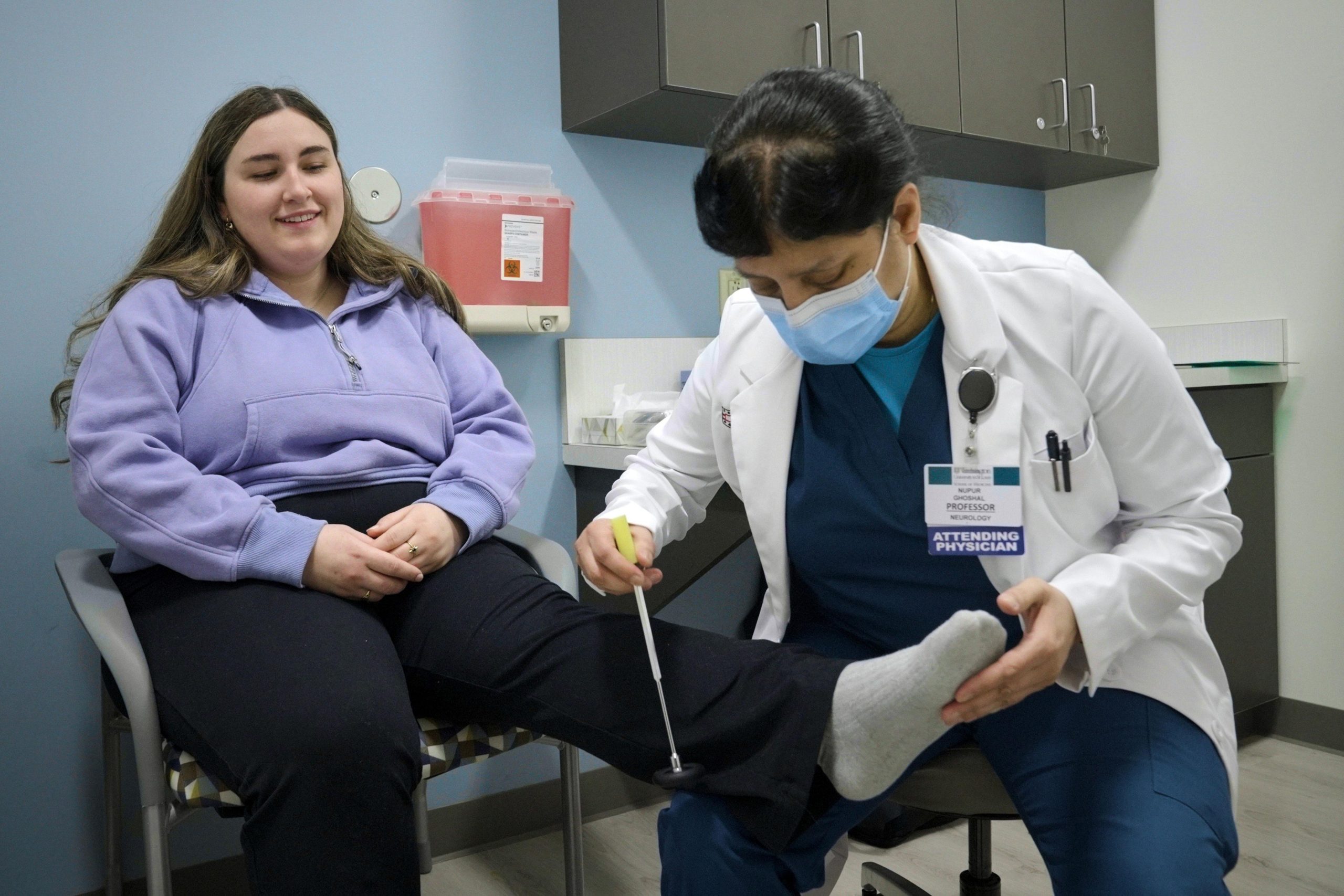
“My grandfather passed away from Alzheimer’s, and so did his mother and all but one of his brothers,” said Hannah Richardson, 24, a participant in the Primary Prevention Trial. “My mom and my uncle have been participating in DIAN trials since I was about 10 years old. My mom was always very open about her diagnosis and how it spurred her advocacy for Alzheimer’s research, and I’ve always known I wanted to follow in her footsteps. I am happy to be involved in the Primary Prevention Trial and be involved in research because I know how important it is.”
A Change in Drug Selection
The trial was first announced in 2021. At that time, the researchers planned to use a different investigational drug — gantenerumab, by Roche/Genentech. However, Roche/Genentech discontinued the development of gantenerumab after data from other Alzheimer’s trials were not supportive.
Remternetug was chosen as a replacement because, in early phase trials in symptomatic patients with more common forms of Alzheimer’s, it has been shown to robustly remove amyloid plaques to a comparable extent as donanemab, an FDA-approved Alzheimer’s therapy also produced by Lilly. Importantly, remternetug can be given via injection just under the skin, a faster and less invasive route of administration than IV infusion, which is how the approved treatments are currently delivered. Additionally, participants will receive remternetug or placebo every 3 months, a less frequent dosing schedule than the bi-weekly or monthly dosing schedules required for the two FDA-approved Alzheimer’s medications. The results will help scientists determine the optimal dosing schedule for prevention.
Each participant will be treated for two years. McDade expects to report the results of the trial within the next four to five years, depending on how long it takes to meet enrollment goals.
“We are pleased to partner with the DIAN-TU team to evaluate whether remternetug can help slow or prevent the accumulation of amyloid plaque, a defining event in the early cascade of Alzheimer’s disease onset,” said Mark Mintun, MD, Group Vice President-Neuroscience R&D at Lilly.
The Primary Prevention Trial will enroll about 240 participants from families that carry mutations in one of the three key genes that cause early-onset Alzheimer’s. Both those who have and have not inherited the mutation are eligible, with noncarriers serving as a comparison group for their relatives. Participants must be 11 to 25 years younger than the expected age of symptom onset based on their family history, and have no signs of cognitive impairment and no or very few amyloid deposits in their brains. At the end of the experimental period, participants who carry a mutation will be eligible to receive the drug for an additional four years as part of an open-label extension of the study.
McDade and colleagues are primarily looking to see whether remternetug prevents amyloid plaques from building up in the brain. They will also be measuring the effects of the drug on molecular signs of Alzheimer’s disease in the blood and cerebrospinal fluid. Because the participants are so young, the researchers do not expect to see any changes to cognitive function during the time period of the trial. WashU Medicine will continue following participants long-term beyond the clinical trial to assess for the potential effects on cognition.
Funding and Collaborative Efforts
More than $130 million has been earmarked for the trial, including grants totaling an estimated $98.3 million from the NIH’s National Institute on Aging (NIA) and $14 million from the Alzheimer’s Association and the GHR Foundation. The NIA has been a major supporter of DIAN and its clinical trials unit since the network was established in 2008.
“The Alzheimer’s Association is proud to be a longstanding part of this strong collaboration between academic researchers, government, industry, philanthropy, and the DIAN families,” said Maria C. Carrillo, PhD, Alzheimer’s Association chief science officer and medical affairs lead. “This innovative study in this special Alzheimer’s patient population has the potential to significantly impact how we prevent Alzheimer’s disease, saving individuals and families from the anguish of this fatal disease.”
In addition, WashU has pledged to raise an additional $6.5 million, and longtime WashU benefactor and Alzheimer’s research supporters Joanne Knight of St. Louis and family have committed up to $11.5 million in support of the trial.
“Alzheimer’s disease has impacted our family for decades across multiple generations,” said Joanne Knight. “We are so thrilled to have the opportunity to support this trial aimed at preventing the devastating effects of the disease.”
Already, the Knight Alzheimer’s Primary Prevention Challenge has garnered contributions from more than 150 donors. The trial is being conducted in close partnership with Lilly, which also is providing significant funding.
“This a groundbreaking approach,” said GHR Foundation’s Chief Operating Officer Fred Miller. “For the first time, we’re working to prevent the buildup of Alzheimer’s pathology before it starts. The research will provide insight on how we prevent Alzheimer’s disease for these families, as well as the nearly 13 million Americans projected to have Alzheimer’s disease by 2050 and countless others around the world.”
Along with the DIAN-TU Primary Prevention Trial, WashU Medicine also runs the international DIAN-TU Tau NexGen Trial, which is aimed at identifying drugs to prevent or slow Alzheimer’s. Like the Primary Prevention Trial, the Tau NexGen Trial involves members of families that carry dominant Alzheimer’s mutations, but those in Tau NexGen are at or near the age of symptom onset and have already accumulated significant brain changes. Tau NexGen evaluates whether a combination of the FDA-approved drug lecanemab, which targets amyloid, and another drug that targets an Alzheimer’s-related protein called tau can reverse, halt, or slow the progression of disease.
Funding: Alzheimer’s Association, Eli Lilly and Company, GHR Foundation, NIH/National Institute on Aging, Joanne Knight and family
Never miss a breakthrough: Join the SciTechDaily newsletter.
Follow us on Google and Google News.
2 Comments
Taking very low dose of 4 mg. of lithium a day. And eating plant base , no fried food is good for the brain. Eating Japanese natto fermented soy clers the arteries.
Chinese say all disease enters by the mouth and nose….. the secret to life is ”” discipline” ….amen ! Lololo !
Amen! to a plant based diet, sans any fried foods.
Fermented foods are reported to be beneficial.
As for lithium?
I chew one fresh lithium battery per week.