
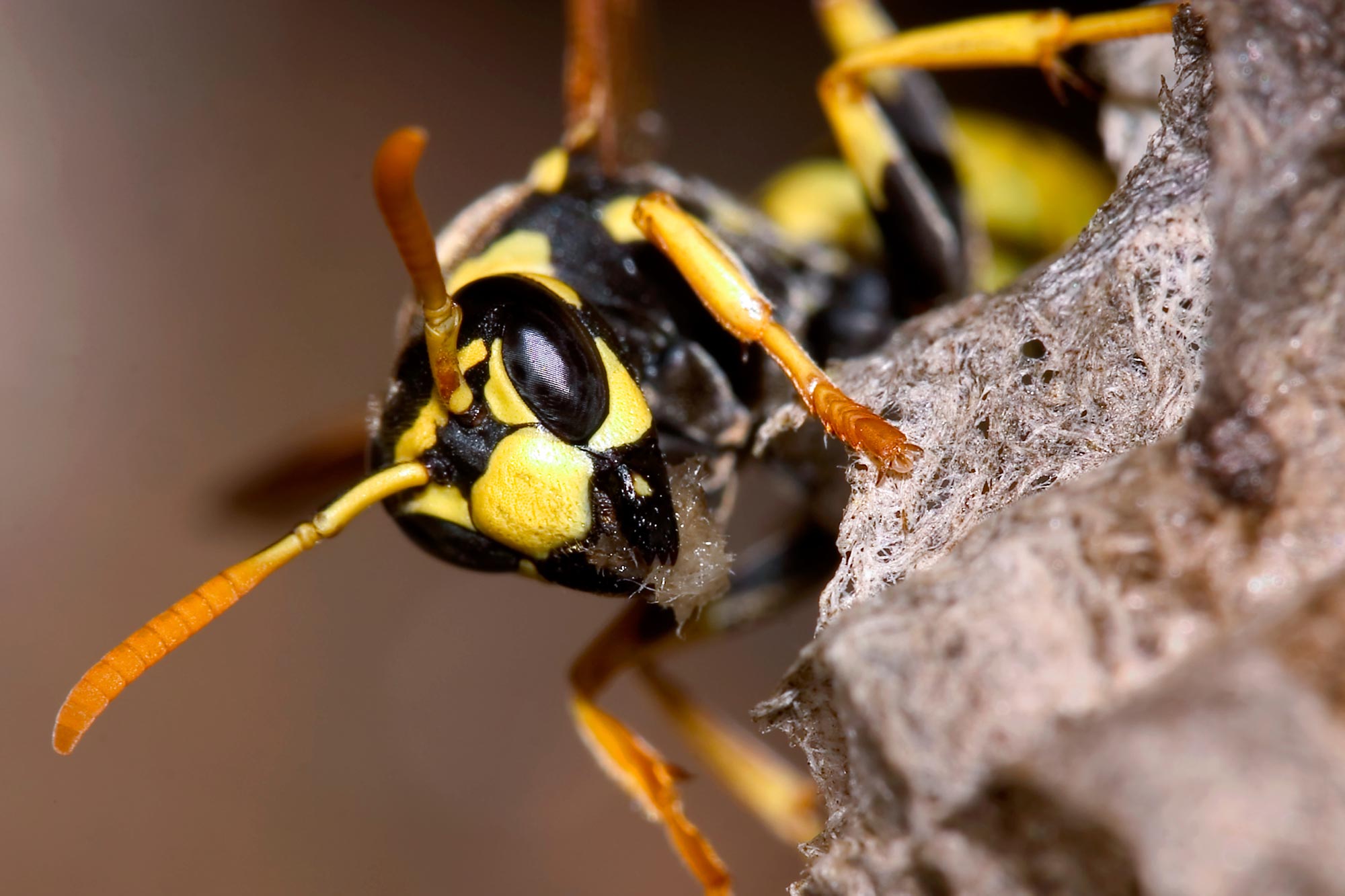
Weather extremes may be contributing to an unusually quiet summer for Britain’s ecologically important social wasps.
A summer picnic often feels complete only when a wasp arrives to investigate the food. Common social wasps are familiar warm-weather visitors, whether they are circling outdoor meals or building an unwanted nest in the loft.
Summer 2026, however, feels unusually quiet.
As a wasp biologist, I’ve noticed it acutely, because my students need wasps for their experiments, and we simply can’t find them.
A second sign that something is wrong is the absence of wasp stories in the media. Wasps tend to be more active in warmer weather. Their colonies grow faster and bigger, and they end up making news headlines by bothering humans. This time last year – also a warm spring and hot summer – the media airwaves were filled with “plagues of wasps” stories. Now, even professional pest controllers have also reported receiving very few requests to remove nests.
Admittedly, these are anecdotes, not data: the Big Wasp Survey – the only national wasp monitoring survey – is yet to start sampling this summer. But the signs are not good.
If the survey data confirm a decline, the consequences could extend beyond quieter picnics. Wasps perform important ecological roles as pest controllers, pollinators, and decomposers.
Weather extremes may have reduced colonies
Spring started well for wasps. In the warm, dry spring, a glut of glorious foundresses—new queens—emerged from hibernation to start their nests alone, carrying out all the nest building, egg laying, foraging and brood rearing. This nest-founding period is a risky time. If a new queen survives until her first brood emerges as adult workers, though, then the odds are in her favor as she no longer needs to undertake risky foraging.
But spring 2026 was strange: the warm, dry start should have been good. Warm, dry spring weather improves a nest’s chance of survival as it ensures a good nectar supply for the queen to develop her ovaries and good prey populations for her to feed the brood. But we experienced unprecedented heat for the time of year, punctuated by cold, damp days and followed by unexpectedly chilly nights.
Such weather extremes may have caused queens to abandon their nests or die, reducing the initial spring queen bounty to a more modest population.
Repeated heat may exceed wasp limits
And then came the heatwave. And another. And another. Some insects may benefit from this. Wildlife charity Butterfly Conservation is hoping 2026 could be a “bumper summer of butterflies” because warm, dry days mean uninterrupted foraging, mating, and egg-laying.
But all insects have a thermal tolerance called critical thermal maximum (CTmax). If their CTmax is exceeded, insects succumb to desiccation, muscle spasms and eventual stupor.
For honeybees, this is around 49°C – which might sound high, yet ground surfaces exceeded 50°C in the UK heatwaves this summer. But the temperature doesn’t need to reach an animal’s CTmax to affect their productivity and behavior. For example, bumblebee cognition and foraging efficiency are impaired by heatwaves of 32°C.
Bumblebee Conservation Trust raised concerns that 2026 may exacerbate a declining trend in bumblebee populations as flowers wither and bees fail to forage effectively.
Wasps are thought to be quite resilient to extreme weather. They are one of the most successful invasive species around the globe. And as a social insect, their thermoregulation behavior (such as wing fanning to cool the larvae) and nest architecture (which has insulating envelopes surrounding the brood combs) may help buffer any environmental perturbations.
Insects also have waxy molecules called cuticular hydrocarbons that coat their exoskeletons, protecting them from desiccation. Social wasp cuticular hydrocarbons change structure in response to heat, better protecting them from desiccation in excessive heat.
Their varied diets should also buffer them from imbalances in prey populations. However, their CTmax may be lower than other social insects’—at around 45°C—which may have made them especially vulnerable to the high ground temperatures of the 2026 heatwaves.
The remaining wasps look unusually small
There’s something else that I’ve noticed: the few wasps I’ve seen are rather small. The adult size of many insects is fixed during their development, depending on the quality and quantity of food they receive as larvae. Wasps don’t get bigger once they’ve pupated.
The first workers to emerge in spring are usually small because the queen is limited in how much food she can provide for them alone. But by early August, the foraging capacity of the colony has increased exponentially, brood are better fed, and the emerging workers are substantially larger.
So why are we still seeing “spring-sized” wasps? It’s possible that limited diversity and abundance of prey may mean their nutrition is restricted. The problem may also be more directly linked to heat. Insect larvae reared at higher temperatures will develop faster and reach pupation at a smaller size.
Global warming is thought to explain the trend in social wasps shrinking in size over the last 100 years. We could be seeing this in real-time this year.
Public sightings could clarify the decline
Share your alfresco meal with a wasp. When it approaches, don’t flap it away. Watch to see what it wants. In the absence of wild prey, it might be desperate for some protein (your picnic ham) to feed her brood. In the absence of flowers for nectar, it might be in need of something sugary (some jam) for her own nutrition.
My research team would also like you to share your wasp observations with us, so that we can better understand these important insects. Snap a photo of her eating and submit your data to the Wasp Picnic Survey 2026: Ham or Jam?. Keep the observations coming all summer. The wasps (and wasp scientists) will thank you.
Adapted from an article originally published in The Conversation.
Never miss a breakthrough: Join the SciTechDaily newsletter.
Follow us on Google and Google News.
3 Comments
They’re alive and well here in Jokelahoma
Could it be fallout from the high altitude smog we have?
I think I saw one yesterday, the biggest one I’ve ever seen. I am on the West Coast of Canada. Pollinators are around, mainly bees (local and bumble) and probably wasps. A few years back I had a ‘volunteer’ Golden Rod. You want to see pollinators of all sizes and shapes, plant Golden Rod.