
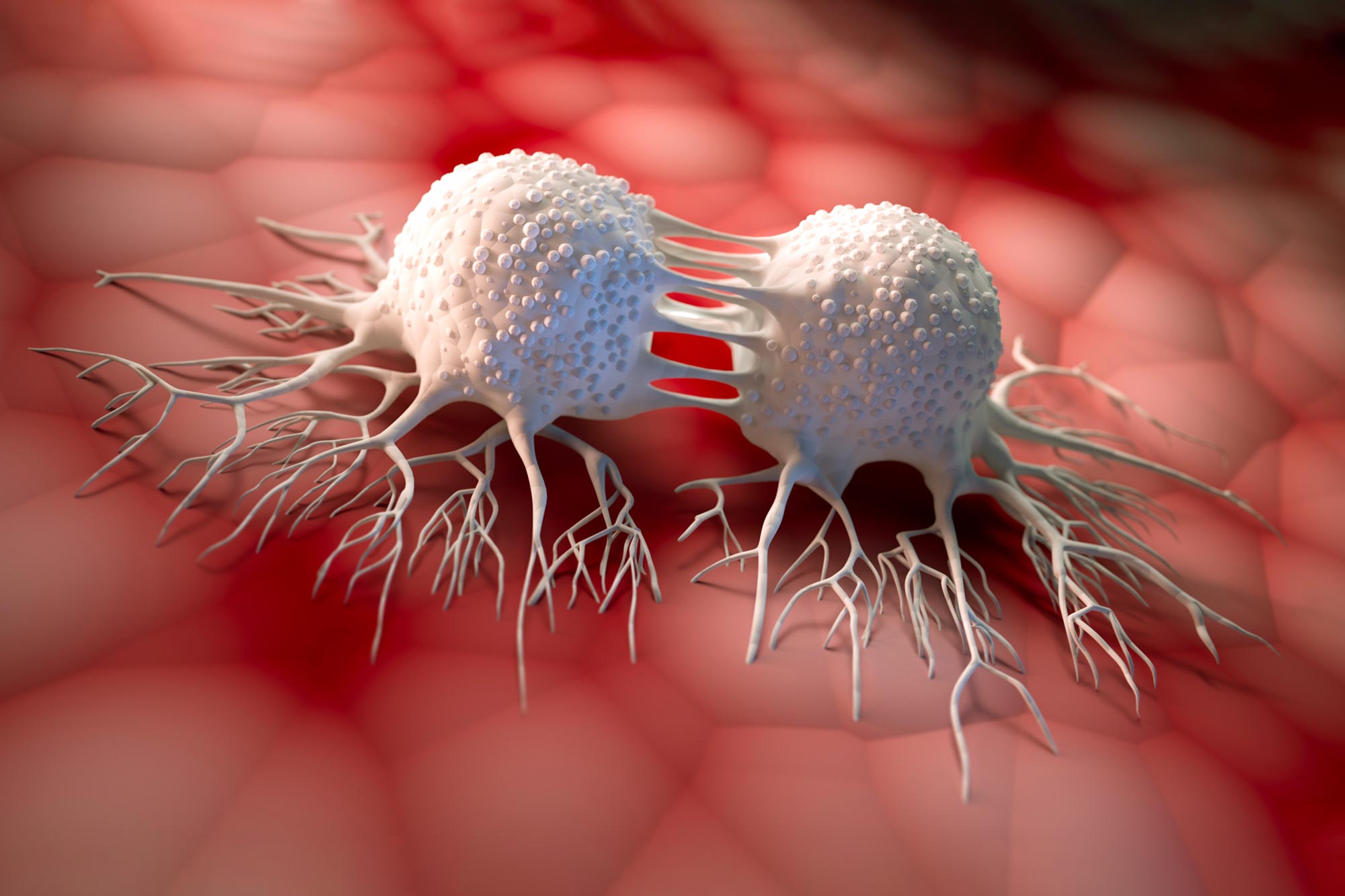
An experimental drug called CS18 weakened several cancer survival mechanisms and helped overcome treatment resistance in laboratory and animal studies.
Cancer treatments can work at first, only for surviving tumor cells to find another route around the attack. Researchers at Baylor College of Medicine have developed an experimental drug called CS18 that is designed to interfere with several of those survival mechanisms at once, potentially making cancer cells more vulnerable to therapy.
The findings, published in Science Advances, provide a basis for further investigation of CS18 as a possible future cancer treatment.
“Therapeutic resistance is a main obstacle to achieve effective and durable cancer treatments,” said corresponding author Dr. Weei-Chin Lin, professor of medicine – hematology and oncology and of molecular and cellular biology at Baylor. “While some therapies are effective at the beginning, many patients eventually relapse because cancer cells can activate compensatory and convergent biological pathways that allow them to overcome the toxic effects of therapy, promoting survival.”
One target controls several cancer pathways
Rather than blocking one survival pathway at a time, the researchers focused on topoisomerase IIß-binding protein 1 (TopBP1), which acts as a kind of biological control center for several processes that promote cancer. Their goal was to determine whether disrupting one particular region of TopBP1 could simultaneously weaken multiple pathways involved in treatment resistance.
“Of all the ‘biological switches’ on TopBP1, switch BRCT7/8 interacts with several key regulators of cancer growth, including MIZ1, a suppressor of cancer driver MYC; mutant p53, which can acquire cancer-promoting functions; and PLK1 and CIP2A, proteins that help cancer cells survive and divide,” said Lin, a member of Baylor’s Dan L Duncan Comprehensive Cancer Center. “All together, these diverse roles position TopBP1-BRCT7/8 as a promising target for intervention.”
Thousands of compounds led to CS18
The search for a molecule capable of blocking BRCT7/8 began with thousands of chemical compounds. Using computer modeling followed by laboratory experiments, the researchers identified compounds that could bind to the target and interfere with its cancer-promoting functions.
One candidate, called 3B6, provided a starting point. The researchers modified its chemical structure and tested numerous versions before arriving at CS18 as the most effective candidate.
“When CS18 binds to BRCT7/8, the cancer-promoting activities of MYC and mutant p53 decreased, proteins involved in DNA repair became less active, and cancer cells were more likely to die,” Lin said. “In addition, CS18 increased the activity of genes that stop uncontrolled cancer growth. Altogether, CS18 appears to reduce several of the defenses that help cancer cells survive therapy.”
CS18 strengthened existing cancer treatments
The researchers observed these effects across several cancer cell types, including triple-negative breast cancer, ovarian cancer, lung adenocarcinoma, lung squamous cell carcinoma, and acute myeloid leukemia. CS18 was also less toxic to non-cancerous cells.
The next question was whether weakening these survival mechanisms could make established cancer drugs work more effectively. Combining CS18 with treatments already in use, including PARP inhibitors and osimertinib, killed cancer cells more effectively than either drug used by itself.
The effect was especially notable in lung cancer cells that had already developed resistance to osimertinib.
“In the case of lung cancer cells that were already resistant to osimertinib, adding CS18 restored the cells’ sensitivity to osimertinib, increasing cancer cell death,” Lin said. “We observed a significant reduction of tumor growth in animal models with no major weight loss or other signs of toxicity.”
The findings position CS18 as a candidate for further development rather than an established treatment. The researchers propose that it could eventually be investigated as part of combination therapies designed to prevent or overcome cancer drug resistance.
Reference: “Development of a structurally distinct TopBP1 inhibitor that enhances PARP blockade and reverses osimertinib resistance” by Fang-Tsyr Lin, Shwu-Jiuan Lin, Kang Liu, Yang Xiao, Lidija A. Wilhelms Garan, Helena Folly-Kossi and Weei-Chin Lin, 5 August 2026, Science Advances.
DOI: 10.1126/sciadv.aeg1996
This work was supported by the National Institutes of Health grants (R01CA203824, R01CA269971, T32CA174647 and T32GM136560) and Department of Defense grants (W81XWH-18-1-0329, W81XWH-19-1-0369, W81XWH-22-1-0226, W81XWH-22-1-0534 and HT9425-24-1-0045). Further support was provided by a Rivkin Center for Ovarian Cancer Pilot Award and a Taiwan Ministry of Science and Technology grant (MOST 107-2635-B-038-001).
Never miss a breakthrough: Join the SciTechDaily newsletter.
Follow us on Google and Google News.
1 Comment
Thanks to the researchers.