
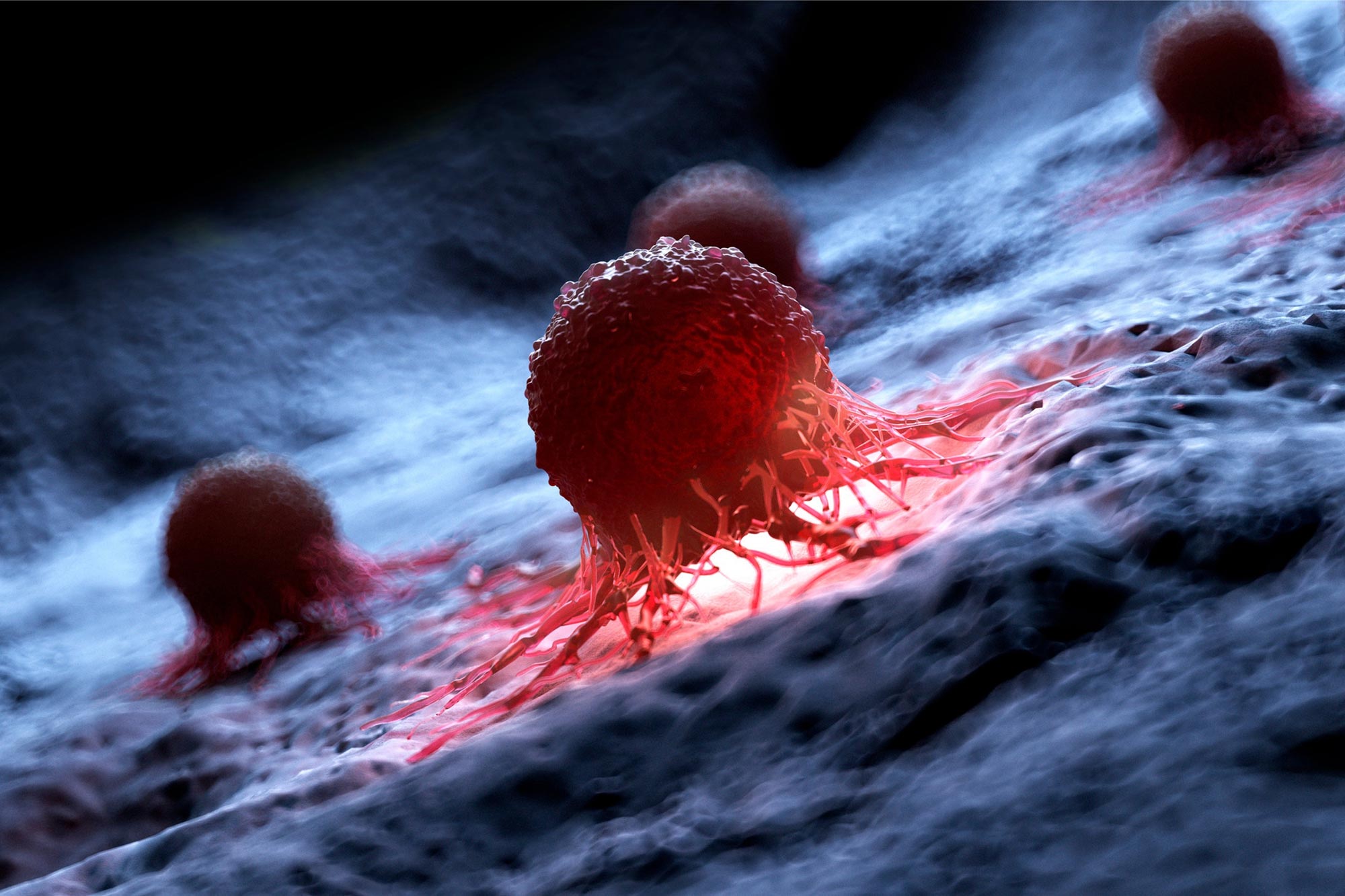
New research challenges the notion that tumors operate as ‘two-speed’ entities.
Scientists from the University of Cologne and the Centre for Genomic Regulation (CRG) in Barcelona have revealed that cancer grows consistently across its entire mass, rather than concentrating growth at its outer edges. Published in the journal eLife, this research challenges longstanding beliefs about the mechanisms of cancer growth and spread.
“We challenge the idea that a tumor is a ‘two-speed’ entity with rapidly dividing cells on the surface and slower activity in the core. Instead, we show they are uniformly growing masses, where every region is equally active and has the potential to harbor aggressive mutations,” says Dr. Donate Weghorn, co-corresponding author of the study and researcher at the Centre for Genomic Regulation in Barcelona.
“Our findings have implications for tumor evolution. The constant churn of cells dying and being replaced by new ones throughout the tumor volume gives cancer many opportunities for evolutionary innovations, such as escaping from immune surveillance,” explains Prof. Johannes Berg, co-corresponding author of the study and researcher at the University of Cologne.
Old Theories of Tumor Growth
For the last fifty years, researchers have hypothesized that tumors grow faster at their outer edges. Cancer cells on the surface are thought to have natural advantages compared to cells deep within. For example, peripheral cells have better access to nutrients and oxygen from surrounding healthy tissues. They can also get rid of their waste more easily.
As a tumor grows, its center gets further and further away from the blood vessels in the area where it is growing. The cells in a tumor’s core get less and less oxygen and nutrients. The cells are also under more mechanical pressure, with compression limiting their ability to divide.

Despite this theory, the study found tumors grow throughout their mass. The researchers made the discovery thanks to spatial genomics, a technique used to study the genetic information of cells in their exact locations within a tissue. They obtained data from previous studies where hundreds of small samples were taken from different parts of liver tumors, both in two- and three-dimensional space. This provided a detailed map of the mutations throughout the tumor.
They looked at the mutations in each of the samples, and developed a method to measure the direction and spread of these mutations, allowing the researchers to calculate the angles between the positions of parent cells and their mutated offspring. In the surface growth model, these angles would point outwards.
Instead, the researchers found the angles were spread evenly in all directions, showing uniform growth throughout the tumor.
Mutations and Tumor Growth
The study also looked at how mutations were spread within the tumor. If cancer cells grew mostly at the edges, mutations would be more clustered. They found that mutations were spread out, suggesting that cells were dividing all over the tumor.
To validate their findings further, the researchers used computer simulations to create different virtual tumors, some with surface growth and others with volume growth. The researchers compared the patterns of mutations from the simulations to the patterns found in the real tumor data. They found that mutation patterns in the real tumors matched the patterns from the volume growth simulations but not the surface growth simulations.
One of the limitations of the study is that it focused on liver cancer, so the findings might not apply universally to all types of cancer. Another limitation is that the study mainly provides insights into the early stages of tumor growth, which might not fully capture the behavior of larger or metastatic types of cancer.
“The emergence of mutants that confer resistance to therapy is an important aspect of clinical relevance. Our work focuses on early-stage tumor growth, but expanding the research to late-arising mutations can tell us more about those mutations and why they ultimately foil many therapeutic approaches,” concludes Dr. Berg.
Reference: “High-density sampling reveals volume growth in human tumours” by Arman Angaji, Michel Owusu, Christoph Velling, Nicola Dick, Donate Weghorn and Johannes Berg, 3 October 2024, eLife.
DOI: 10.7554/eLife.95338.2
Never miss a breakthrough: Join the SciTechDaily newsletter.
Follow us on Google and Google News.