
Close Menu
    Facebook X (Twitter) Instagram
    SciTechDaily
    • Biology
    • Chemistry
    • Earth
    • Health
    • Physics
    • Science
    • Space
    • Technology
    Facebook X (Twitter) Pinterest YouTube RSS
    SciTechDaily
    Home»Health»A Flip of a Genetic Switch: Stopping a Rare Childhood Cancer in Its Tracks
    Health

    A Flip of a Genetic Switch: Stopping a Rare Childhood Cancer in Its Tracks

    By Cold Spring Harbor LaboratoryFebruary 18, 2023No Comments4 Mins Read
    Facebook Twitter Pinterest Telegram LinkedIn WhatsApp Email Reddit
    Share
    Facebook Twitter LinkedIn Pinterest Telegram Email Reddit
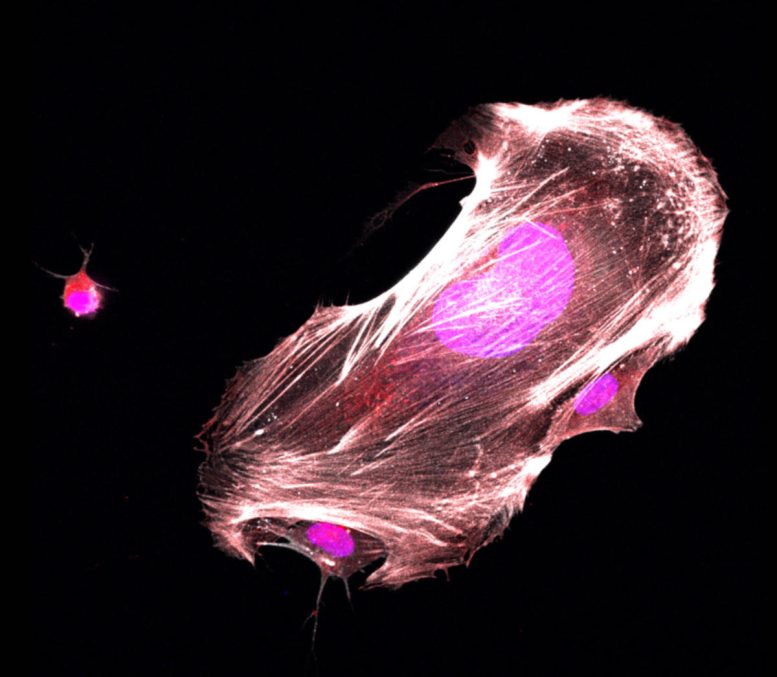
    Transformed Ewing Sarcoma Cell
    Scientists discovered targeting a protein called ETV6 can turn Ewing sarcoma cancer cells back to normal-looking and -behaving connective tissue cells, as seen above. Credit: Vakoc lab/Cold Spring Harbor Laboratory

    Cold Spring Harbor Laboratory researchers have found a potential new treatment for Ewing sarcoma that targets a protein called ETV6. Inhibiting this protein transforms cancer cells back to normal cells and halts their growth, indicating that a drug targeting ETV6 could effectively treat Ewing sarcoma with minimal side effects.

    Researchers at Cold Spring Harbor Laboratory (CSHL) have identified a new drug target for Ewing sarcoma, a rare form of cancer typically diagnosed in children and young adults. Their experiments reveal that the cells responsible for this cancer can be effectively reprogrammed with the flick of a genetic switch.

    Shutting down a single protein forces the cancer cells to take on a new identity and behave like normal connective tissue cells, a dramatic change that reins in their growth. This discovery suggests researchers may be able to stop Ewing sarcoma by developing a drug that blocks the protein known as ETV6.

    Ewing sarcoma causes tumors to grow in bones or the soft tissues surrounding them. Once a tumor begins to spread to other parts of the body, it can be very difficult to halt the disease’s progression. Even for patients with positive outcomes, treating Ewing sarcoma often causes toxic side effects. New treatments are badly needed, says CSHL Professor Christopher Vakoc, who led the research on ETV6.
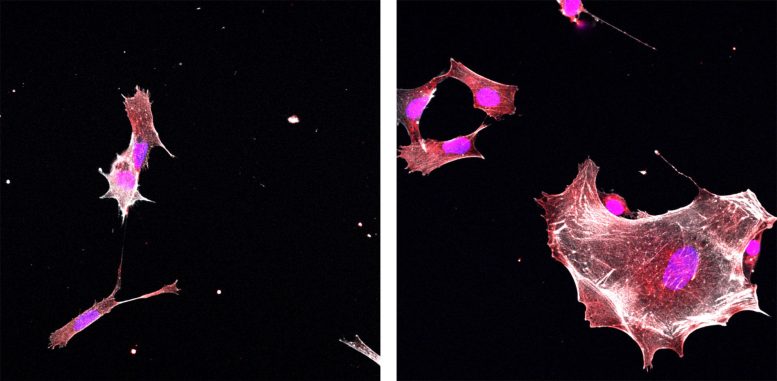
    ETV6 Before and After
    When scientists blocked a protein called ETV6 in Ewing sarcoma cancer cells (left), they reverted back to normal connective tissue cells (right), which dramatically changed their shape, size, and behavior. Credit: Vakoc lab/Cold Spring Harbor Laboratory

    Vakoc and his colleagues became excited about ETV6 when their experiments revealed that Ewing sarcoma cells seem uniquely dependent on this protein. “This protein is present in all cells. But when you perturb the protein, most normal cells don’t care,” he says. “The process by which the sarcoma forms turns this ETV6 molecule—this relatively innocuous, harmless protein that isn’t doing very much—into something that’s now controlling a life-death decision of the tumor cell.”

    Postdoctoral researcher Yuan Gao works in Vakoc’s lab. When Gao blocked ETV6 in Ewing sarcoma cells grown in the lab, she witnessed a dramatic transformation. “The sarcoma cell reverts back into being a normal cell again,” she says. “The shape of the cell changes. The behavior of the cells changes. A lot of the cells will arrest their growth. It’s really an explosive effect.”

    Vakoc and Gao hope other researchers will use what they’ve learned to begin exploring potential therapies for Ewing sarcoma that work by switching off ETV6. They say their biochemical analyses, which identify specific spots in the ETV6 protein that are key to its function in cancer cells, could help guide drug development. Because their experiments have shown that most cells are unaffected by the loss of ETV6 activity, they are optimistic that such a drug might be able to eliminate cancer cells while causing few, if any, side effects.

    Reference: “ETV6 dependency in Ewing sarcoma by antagonism of EWS-FLI1-mediated enhancer activation” by Yuan Gao, Xue-Yan He, Xiaoli S. Wu, Yu-Han Huang, Shushan Toneyan, Taehoon Ha, Jonathan J. Ipsaro, Peter K. Koo, Leemor Joshua-Tor, Kelly M. Bailey, Mikala Egeblad and Christopher R. Vakoc, 19 January 2023, Nature Cell Biology.
    DOI: 10.1038/s41556-022-01060-1

    The study was funded by the National Cancer Institute, the Pershing Square Sohn Cancer Research Alliance, the National Institutes of Health, Friends of T.J. Foundation, the Christina Renna Foundation, the Michelle Paternoster Foundation, the William J. Riley Foundation, and the Howard Hughes Medical Institute.

    Never miss a breakthrough: Join the SciTechDaily newsletter.
    Follow us on Google and Google News.

    Cancer Cell Biology Cold Spring Harbor Laboratory Genetics Tumor
    Share. Facebook Twitter Pinterest LinkedIn Email Reddit

    Related Articles

    Not Just One Type – Identifying Cancer Genes’ Multiple Personalities

    Cancer DNA Blood Tests Validated – Fast, Cheap and Less Invasive Method to Diagnose and Monitor Cancer

    Scientists Discover a Way to Control the Immune System’s “Natural Killer” Cells With “Invisible” Stem Cells

    Breaking Bad: How Shattered Chromosomes Make Cancer Cells More Aggressive and Drug-Resistant

    Massive Genetic Map of Cancer Mutations Cataloged – Available to Doctors and Researchers Worldwide

    Strange New Organelle That Helps Prevent Cancer Discovered in Our Cells

    Major Implications for Human Disease Uncovered in Mysterious Microproteins

    When Mutant Cells Team Up, an Even Deadlier Blood Cancer Emerges [Video]

    New Model Captures Shape and Speed of Tumor Growth for the First Time

    Leave A Reply Cancel Reply

    • Facebook
    • Twitter
    • Pinterest
    • YouTube

    Don't Miss a Discovery

    Subscribe for the Latest in Science & Tech!

    Trending News

    AI Could Detect Early Signs of Alzheimer’s in Under a Minute – Far Before Traditional Tests

    What if Dark Matter Has Two Forms? Bold New Hypothesis Could Explain a Cosmic Mystery

    This Metal Melts in Your Hand – and Scientists Just Discovered Something Strange

    Beef vs. Chicken: Surprising Results From New Prediabetes Study

    Alzheimer’s Breakthrough: Scientists Discover Key Protein May Prevent Toxic Protein Clumps in the Brain

    Quantum Reality Gets Stranger: Physicists Put a Lump of Metal in Two Places at Once

    Scientists May Have Found the Key to Jupiter and Saturn’s Moon Mystery

    Scientists Uncover Brain Changes That Link Pain to Depression

    Follow SciTechDaily
    • Facebook
    • Twitter
    • YouTube
    • Pinterest
    • Newsletter
    • RSS
    SciTech News
    • Biology News
    • Chemistry News
    • Earth News
    • Health News
    • Physics News
    • Science News
    • Space News
    • Technology News
    Recent Posts
    • Asthma and Depression Don’t Mix the Way Scientists Expected
    • Why Promising Cancer Drugs Failed: Scientists Uncover the Missing Piece
    • Popular Sweetener Linked to DNA Damage – “It’s Something You Should Not Be Eating”
    • Ancient “Rock” Microbes May Reveal How Complex Life Began
    • Hidden “Trade Winds” Inside Cells Could Explain Cancer Spread
    Copyright © 1998 - 2026 SciTechDaily. All Rights Reserved.
    • Science News
    • About
    • Contact
    • Editorial Board
    • Privacy Policy
    • Terms of Use

    Type above and press Enter to search. Press Esc to cancel.