
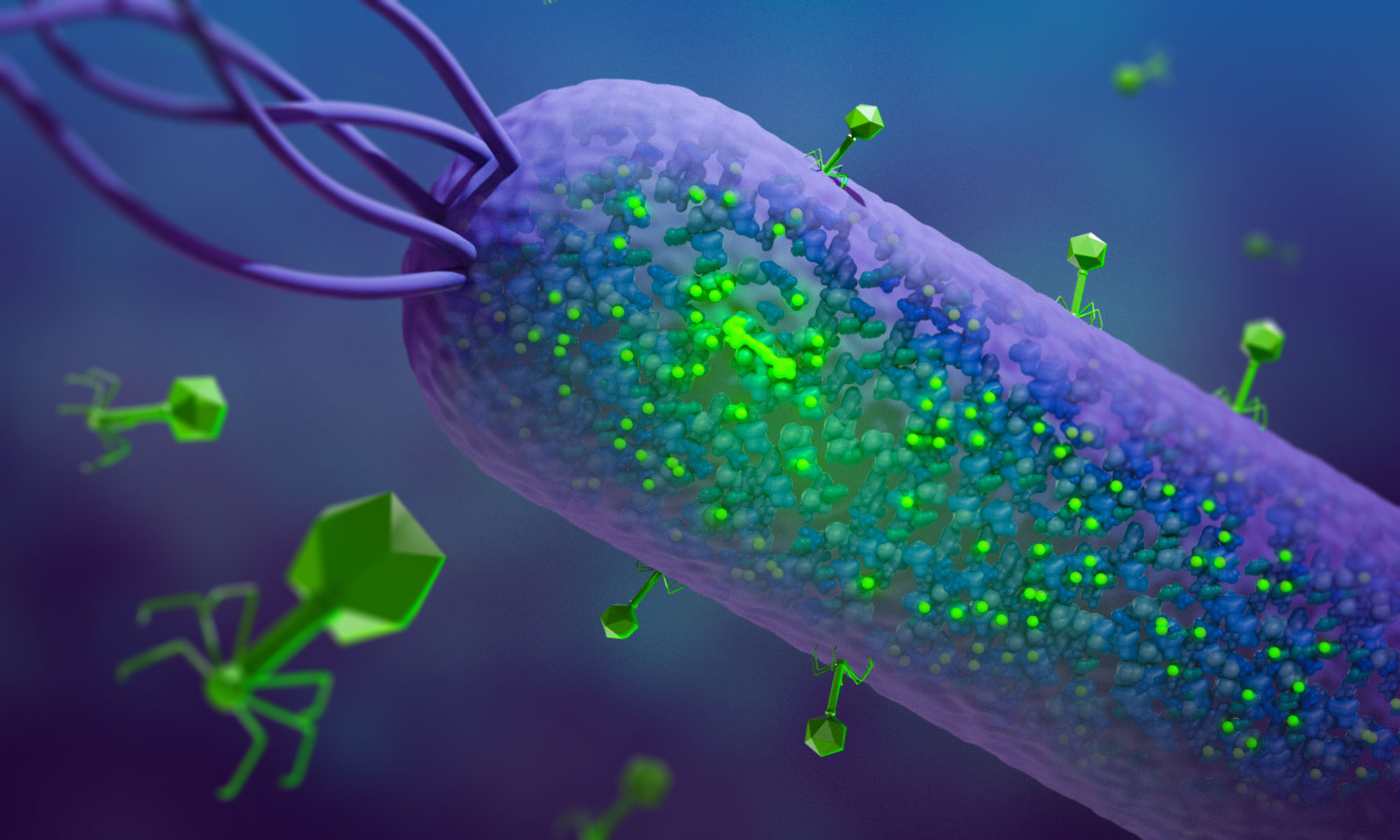
Scientists found that phages, viruses that infect bacteria, trigger widespread protein modifications inside host cells that help them evade bacterial immune defenses.
When a phage infects a bacterium, it must overcome the cell’s defenses before those defenses can destroy the invading virus. Researchers have now uncovered an unusual strategy used by T7 phage: a single enzyme triggers a massive wave of protein modifications inside the infected bacterium, helping disable its immune systems.
Phages, viruses that infect bacteria, are locked in a constant molecular arms race with their hosts. Bacteria evolve defenses against infection, while phages develop ways to evade or suppress those defenses. The new work shows for the first time how one phage protein can initiate a cascade of molecular changes capable of disarming multiple bacterial defense mechanisms.
The findings grew out of a long collaboration between two groups at EMBL Heidelberg: the Typas Group, which specializes in high-throughput research on bacterial interactions, and the Savitski Team, which develops and applies advanced proteomics technologies.
“Phage research has led to a lot of exciting developments, the CRISPR-Cas9 gene editing system among them,” said Mikhail Savitski, Senior Scientist and Head of Proteomics Core Facility at EMBL Heidelberg. “Using the sensitive technologies we had available in the lab, we wanted to understand in an unbiased way how phages affect bacterial proteins during infection.”
Phage infection modifies nearly every protein
The researchers turned to a familiar laboratory system involving E. coli, the rod-shaped bacterium found in the human gut, and T7 phage, which infects E. coli. They focused on phosphorylation, a rapid chemical modification that can change how a protein functions by activating or disabling it.
What they saw was striking. Within minutes of infection, almost every bacterial protein became phosphorylated in at least some portion of its population inside the cell.
The likely source was T7 kinase, a phage enzyme first identified in the 1970s. But the scale of its activity was unlike anything researchers had seen before. T7 kinase appeared to phosphorylate more targets than any other kinase currently known in nature, prompting the researchers to describe it as a ‘loose cannon’.
“We realized that we were seeing a quite unprecedented molecular event: a catastrophic phosphorylation across the entire proteome in a completely nonspecific manner,” said Savitski. “That had never been seen before, and it was fascinating that there was also no pattern to it.”
That result created a puzzle. Earlier studies had shown that removing T7 kinase from the phage genome has little apparent effect on the infection process.
“As puzzles go, it leaves you a bit flabbergasted,” said Savitski. “You have a kinase with apparently no phenotype that seems to phosphorylate everything in the proteome.”
The researchers confirmed that the kinase acts only briefly. As previously reported, T7 kinase shuts itself down within 5-6 minutes after infection.
Its structure provided another clue. A region known as the shutoff domain was unnecessary for phosphorylation itself, but it contained chemical features that suggested it might bind DNA. The researchers proposed that this domain could anchor the kinase to DNA, placing it near bacterial proteins that also bind DNA.
DNA-binding proteins emerged as key targets
“Methodologically, it is not easy to test such things, but we designed an elegant experiment that could measure exactly how much of a protein population is phosphorylated inside a cell,” said Tara Bartolec, postdoc at EMBL Heidelberg and one of the first authors of the paper.
Using that approach, the researchers found that T7 kinase preferentially phosphorylated bacterial proteins that bind DNA, presumably interfering with their function.
Those proteins are often central to bacterial defense systems because they help recognize and destroy phage DNA after it enters the cell. Consistent with that idea, the researchers found that T7 kinase could help the virus infect bacterial strains equipped with such defense mechanisms.
The mechanism could broaden phage therapies
Comparisons with kinases from other phages suggest that the researchers may have identified an evolutionarily conserved strategy used by certain phages to suppress bacterial immune systems.
The researchers now plan to investigate other types of protein modification and determine how they influence phage infection. The findings may also eventually support bioengineering strategies aimed at designing phages or predicting which phages are most likely to succeed as therapies.
”To be effective for therapy, phages should be capable of infecting diverse versions (strains) of the same pathogen,” said Typas. “Interestingly, pathogenic strains are exquisitely diverse in their immune repertoire, and can always pick up new systems. So engineering phages with broad anti-defense systems, such as the T7 kinase, might be key in this quest for effective phage therapies. We identified the first one here, but we are sure there are many more out there.”
Reference: “Pervasive phosphorylation by phage T7 kinase disarms bacterial defences” by Tara Bartolec, Karin Mitosch, Clément Potel, Federico Corona, Alessio Ling Jie Yang, Nicolai Karcher, Mira Lea Burtscher, Alexandra Koumoutsi, Isabelle Becher, Lena Sarah Müller, Jacob Bobonis, Manjeet Kumar, Marco Galardini, Athanasios Typas and Mikhail M. Savitski, 19 August 2026, Nature.
DOI: 10.1038/s41586-026-10934-5
This work was supported by the European Molecular Biology Laboratory.
Never miss a breakthrough: Join the SciTechDaily newsletter.
Follow us on Google and Google News.