
Close Menu
    Facebook X (Twitter) Instagram
    SciTechDaily
    • Biology
    • Chemistry
    • Earth
    • Health
    • Physics
    • Science
    • Space
    • Technology
    Facebook X (Twitter) Pinterest YouTube RSS
    SciTechDaily
    Home»Space»Diamonds Provide Evidence of a Lost Planet That Once Roamed Our Solar System
    Space

    Diamonds Provide Evidence of a Lost Planet That Once Roamed Our Solar System

    By Frank Jordans, The Associated PressApril 17, 2018No Comments3 Mins Read
    Facebook Twitter Pinterest Telegram LinkedIn WhatsApp Email Reddit
    Share
    Facebook Twitter LinkedIn Pinterest Telegram Email Reddit
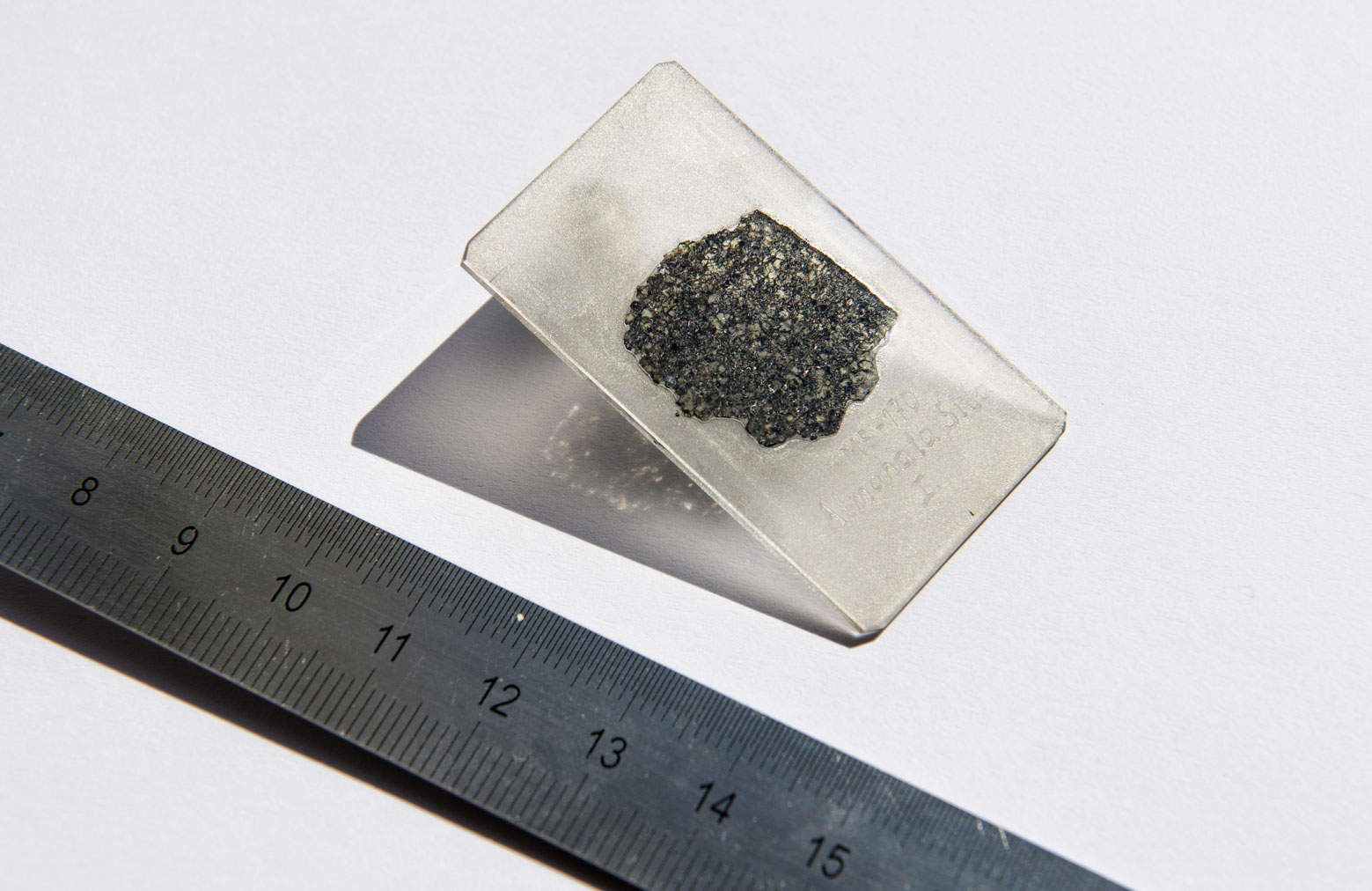
    A Diamond May Have Come From a Lost Planet
    Photo provided by Hillary Sanctuary of EPFL shows a thin slice of the meteorite sample from a meteorite that fell to Earth more than a decade ago providing compelling evidence of a lost planet that once roamed our solar system, according to a study published Tuesday. (Hillary Sanctuary/EPFL via AP)

    Fragments of a meteorite that fell to Earth more than a decade ago provide compelling evidence of a lost planet that once roamed our solar system, according to a study published Tuesday.

    Researchers from Switzerland, France and Germany examined diamonds found inside the Almahata Sitta meteorite and concluded they were most likely formed by a proto-planet at least 4.55 billion years ago.

    The diamonds in the meteorite, which crashed in Sudan’s Nubian Desert in October 2008, have tiny crystals inside them that would have required great pressure to form, said one of the study’s co-authors, Philippe Gillet.

    “We demonstrate that these large diamonds cannot be the result of a shock but rather of growth that has taken place within a planet,” he told The Associated Press in a telephone interview from Switzerland.

    Diamond Inclusions in a Ureilite Meteorite
    Electron micrograph and chemical map of an inclusion in a graphitized region. a Bright-field (BF) STEM image and b chemical (EDX) map from graphite growth in diamond matrix around an inclusion. Blue dashed lines indicate the diamond–graphite boundary. The yellow arrows point out the Fe–S-rich regions in graphite. Notice the clear rounded form of the inclusion in graphitized part indicating partial melting. Nature Communications (2018) doi:10.1038/s41467-018-03808-6

    Gillet, a planetary scientist at the Federal Institute of Technology in Lausanne, said researchers calculated a pressure of 200,000 bar (2.9 million psi) would be needed to form such diamonds, suggesting the mystery planet was as least as big as Mercury, possibly even Mars.

    Scientists have long theorized that the early solar system once contained many more planets — some of which were likely little more than a mass of molten magma. One of these embryo planets — dubbed Theia — is believed to have slammed into a young Earth, ejecting a large amount of debris that later formed the moon.

    “What we’re claiming here,” said Gillet, “is that we have in our hands a remnant of this first generation of planets that are missing today because they were destroyed or incorporated in a bigger planet.”

    Addi Bischoff, a meteorite expert at the University of Muenster, Germany, said the methods used for the study were sound and the conclusion was plausible. But further evidence of sustained high pressure would be expected to be found in the minerals surrounding the diamonds, he said.

    Bischoff wasn’t involved in the study, which was published in the journal Nature Communications.

    Reference: “A large planetary body inferred from diamond inclusions in a ureilite meteorite” by Farhang Nabiei, James Badro, Teresa Dennenwaldt, Emad Oveisi, Marco Cantoni, Cécile Hébert, Ahmed El Goresy, Jean-Alix Barrat and Philippe Gillet, 17 April 2018, Nature Communications.
    DOI: 10.1038/s41467-018-03808-6

    Never miss a breakthrough: Join the SciTechDaily newsletter.
    Follow us on Google and Google News.

    Astronomy Diamonds Meteorites Planetary Science Popular
    Share. Facebook Twitter Pinterest LinkedIn Email Reddit

    Related Articles

    Ancient Meteorite Reveals a Forgotten Planet That Existed 4.5 Billion Years Ago

    Scientists Discover Evidence of Methane in Martian Meteorites

    NASA’s Kepler Mission Discovers Multiple Transiting Planets Orbiting Two Suns

    Kepler Data Used to Identify 41 New Transiting Planets

    NASA’s Curiosity Readies for First Drive on Mars

    Color HiRISE Image of Curiosity Rover on Mars

    A Connection Between Volatiles in the Subsurface of Mars and the Impact Process

    Diogenites Provide Clues of the Earliest Days of Our Solar System

    High-Energy UV Radiation Triggers Methane on Mars

    Leave A Reply Cancel Reply

    • Facebook
    • Twitter
    • Pinterest
    • YouTube

    Don't Miss a Discovery

    Subscribe for the Latest in Science & Tech!

    Trending News

    125-Million-Year-Old Crocodile Fossil Reveals Astonishing New Secrets

    Scientists Discover an “Impossible” Way Muscle Filaments Can Grow

    A Star’s Spin Could Solve a Longstanding Black Hole Mystery

    NASA Finds Earth Microbes Could Hide in the Moon’s Deep Shadows

    New Study: Intermittent Fasting Lowers Blood Sugar in Type 1 Diabetes

    Alzheimer’s Brain Changes May Begin 7 Years Earlier Than Scientists Thought

    This New Molecule Could Transform How We Recover Gold From Electronic Waste

    A Billion Years Before the Grand Canyon, a Giant Cliff May Have Stretched Across America

    Follow SciTechDaily
    • Facebook
    • Twitter
    • YouTube
    • Pinterest
    • Newsletter
    • RSS
    SciTech News
    • Biology News
    • Chemistry News
    • Earth News
    • Health News
    • Physics News
    • Science News
    • Space News
    • Technology News
    Recent Posts
    • NASA’s Roman Telescope Begins a Million-Mile Journey Into Deep Space
    • Researchers Have Discovered a New Way To Reduce Chronic Nerve Pain
    • Less Sugar Early in Life Linked to Lower Dementia Risk Decades Later
    • Naked Comet Photobombs Public Telescope Image
    • JWST Finds Giant Planets Face a Cosmic Race Against Time
    Copyright © 1998 - 2026 SciTechDaily. All Rights Reserved.
    • Science News
    • About
    • Contact
    • Editorial Board
    • Privacy Policy
    • Terms of Use

    Type above and press Enter to search. Press Esc to cancel.