
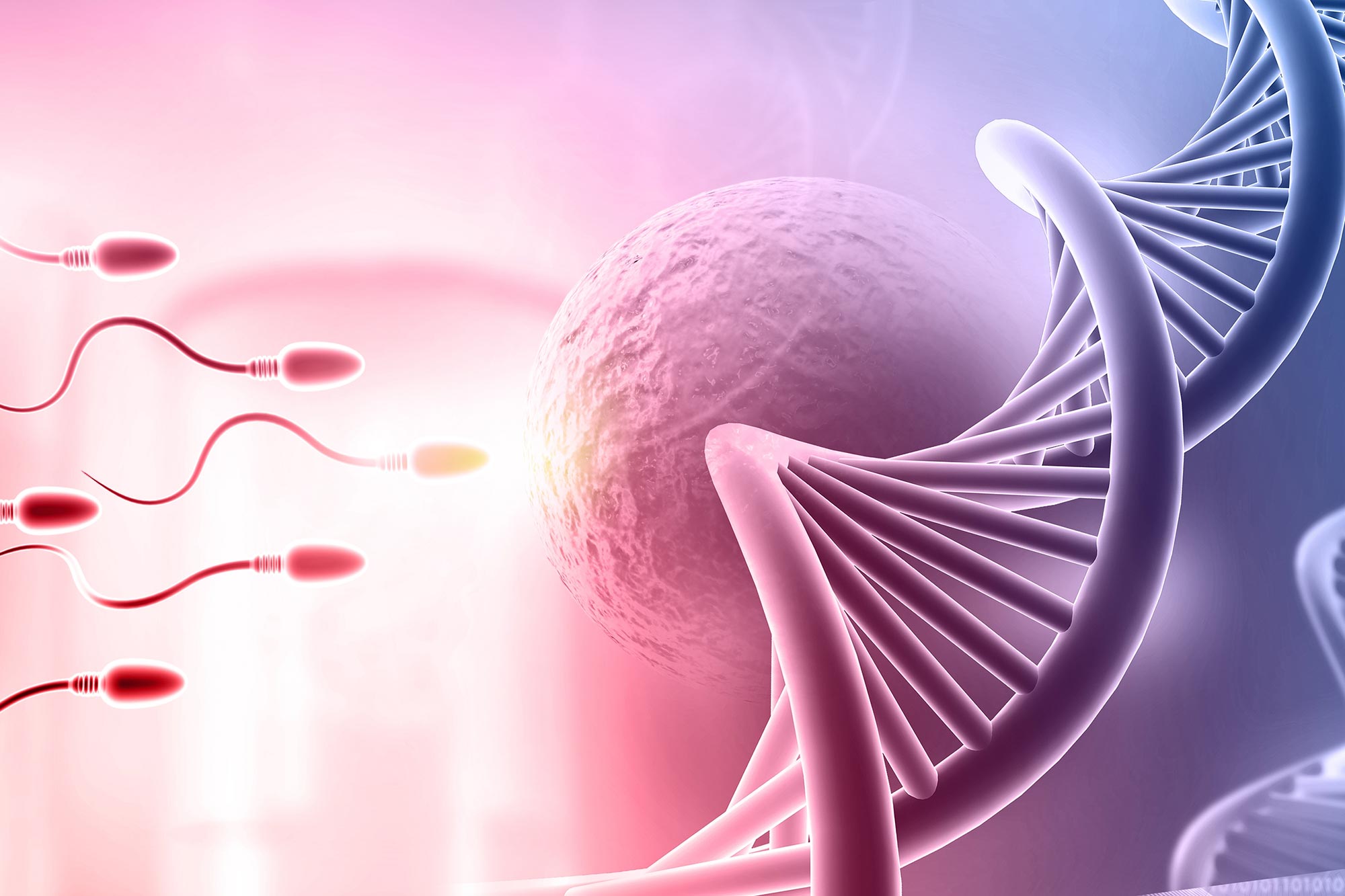
Some of the genetic differences that make every child unique may arise in a father’s sperm years earlier than scientists thought.
Researchers have discovered that some genetic reshuffling in human sperm occurs before meiosis, the specialized cell division that creates reproductive cells. The finding pushes the origins of certain inherited differences further back in sperm development than previously recognized.
The study, published in Nature, was conducted by scientists at the Wellcome Sanger Institute, the University of Cambridge, and collaborating institutions. It focused on non-crossover gene conversion, a subtle process in which one chromosome copies a short DNA sequence from its matching partner.
How Sperm DNA Is Reshuffled
Every child inherits one set of chromosomes from each parent, but those chromosomes are not passed down as untouched copies. During the production of sperm and eggs, recombination rearranges genetic material to create combinations that are different from those found in either parent.
Two main processes contribute to this mixing. Crossovers exchange large chromosome segments in a two-way swap, while non-crossover gene conversion copies a much shorter stretch of DNA in one direction. Gene conversion does not necessarily create a new DNA sequence, but it can change which inherited version is present at a particular location.
Scientists have traditionally placed both processes within meiosis. Before entering meiosis, however, the precursor cells that eventually produce sperm undergo repeated rounds of ordinary cell division, or mitosis. These cells must be continually maintained so that sperm production can continue throughout adulthood.
Thousands of Events Found in Sperm
To determine whether gene conversion might begin during this earlier stage, the researchers examined 15 sperm samples from 13 donors between the ages of 24 and 74. Highly accurate long-read sequencing allowed them to analyze extended sections of individual DNA molecules and identify small recombination events that are difficult to detect with conventional methods.
The team found 7,143 crossovers and 2,382 non-crossover gene conversion events directly in sperm DNA. They then compared these patterns with long-read genomic data from blood and information reported in earlier studies.
A substantial proportion of the gene conversions appeared to have formed before meiosis began. Their molecular signatures differed from those produced during meiosis and instead closely resembled DNA repair activity seen in ordinary body tissues.
Even Identical Twins Show Differences
Gene conversion patterns varied in both frequency and location from one person to another. Differences also appeared between identical twins, despite their nearly identical inherited genomes. This suggests that sperm diversity is influenced not only by genetic instructions but also by biological events that unfold independently within each individual.
The results support a two-stage model of recombination in sperm. Some DNA copying occurs during the routine cell divisions that preserve sperm-producing cells, while additional reshuffling takes place later during meiosis.
This earlier activity adds another layer to the process that makes each sperm genetically distinct. It also challenges the long-standing assumption that nearly all meaningful recombination in sperm begins only after cells enter meiosis.
Fragile DNA Sites and Inherited Disease
Many of the newly identified copying events occurred in parts of the genome that are naturally vulnerable to breakage. Repairing these unstable regions can protect the genome, but mistakes during that process may produce changes that can be transmitted to the next generation.
Studying how these changes develop could offer new clues about inherited diseases and the processes that protect reproductive health and DNA integrity.
A New Window Into Sperm Diversity
“We found that gene conversion in sperm does not appear to come from a single process. Alongside the familiar meiotic pathway, there is a substantial component with features consistent with DNA repair before meiosis. Being able to see thousands of these events directly in sperm gives us a new window into how genetic diversity is generated,” said Dr. Regev Schweiger, first author at the Gray Faculty of Medical and Health Sciences, Tel Aviv University.
“High-accuracy long-read sequencing lets us observe both crossovers and the much harder-to-detect non-crossovers directly in sperm. This gives us far greater power to study recombination within individuals and has revealed biology that would be very difficult to resolve from previous data,” said Professor Richard Durbin, co-senior author at the University of Cambridge and associate faculty at the Wellcome Sanger Institute.
“Understanding where and when genetic variation arises is fundamental to understanding how the human genome maintains integrity while generating diversity. Our findings show that DNA repair before meiosis contributes more to genetic diversity in sperm than previously appreciated and opens new opportunities to investigate why these processes vary between individuals and how they shape the variation passed to the next generation,” said Dr. Raheleh Rahbari, co-senior author at the Wellcome Sanger Institute.
Reference: “Long-read sequencing reveals pre-meiotic gene conversion in sperm” by Regev Schweiger, Sangjin Lee, Chenxi Zhou, Tsun-Po Yang, Stacy Li, Rashesh Sanghvi, Matthew Neville, Katie Smith, Kirsty Roberts, Ayrun Nessa, Sam Wadge, Kerrin S. Small, Peter J. Campbell, Kristian Almstrup, Peter H. Sudmant, Raheleh Rahbari and Richard Durbin, 26 August 2026, Nature.
DOI: 10.1038/s41586-026-10901-0
Never miss a breakthrough: Join the SciTechDaily newsletter.
Follow us on Google and Google News.