

New study shows how the frontoparietal cortex manages information flow and guides responses.
The frontoparietal cortex, the brain’s information hub, helps coordinate responses when circumstances change. While driving, for example, the brain must draw on a remembered route and the skills needed to operate the car while also responding to a street closure or changing traffic.
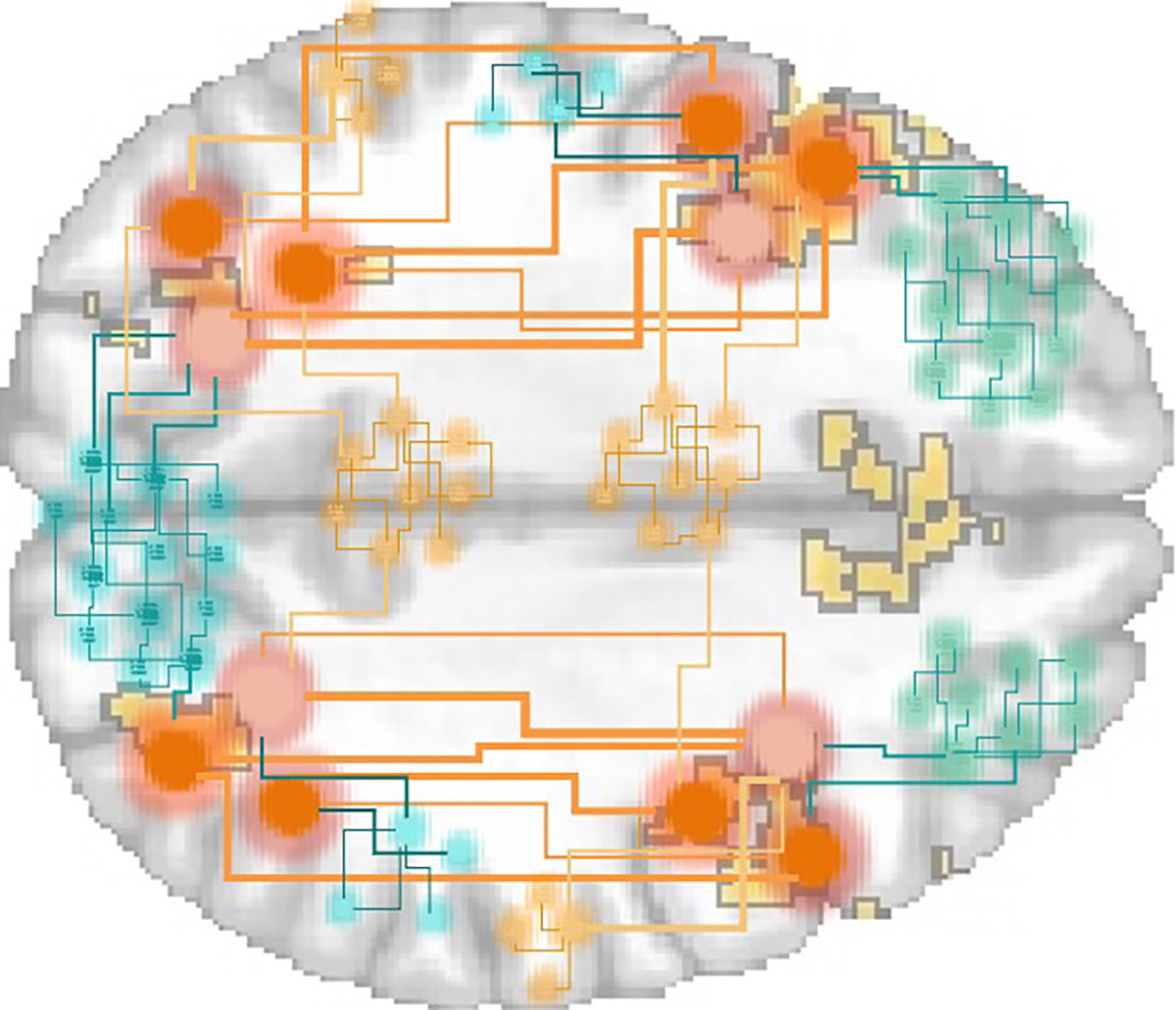
Researchers at the University of Iowa examined how this network of brain regions handles decisions when previously learned information no longer gives people the right answer. By combining brain imaging with computational modeling, they tracked how its communication with other brain systems changed as people worked out what to do.
“Rather than simply becoming more active during difficult tasks, we observed how this network dynamically changes how it communicates with other brain regions depending on what information is needed at each stage of a decision,” says Kai Hwang, an associate professor in the Department of Psychological and Brain Sciences and the study’s corresponding author.
When the right response becomes wrong
The experiments involved 38 participants, ages 18 to 35, who learned to associate combinations of colors, faces, and scenes with particular responses. Each combination called for a button press using the index or middle finger of either hand.
Once participants had learned those associations, the researchers changed the pairings. Getting the answer right now meant learning a new connection between what appeared on the screen and which hand and finger to use.
“If they always get it right, they know they’ve made the correct association, but once they start doing it wrong, they will have to guess, ‘Oh, did the context change, or did I not see the color clearly?’ That creates uncertainty,” Hwang says.
That uncertainty allowed the team to examine how the frontoparietal cortex connected with other brain systems. The researchers used experimental data and functional MRI scans, which measure changes associated with brain activity, to build a computational model that isolated distinct signals from different brain areas.

“Our study shows in more detail how the frontoparietal cortex operates — what kind of information it extracts from other systems and how it uses its connectivity pattern to integrate information that is coming in from different areas of the brain,” Hwang says. “That’s the main contribution.”
Stephanie Leach, the study’s first author and a sixth-year graduate student in Hwang’s lab, helped design the project, led the in-person experiments, and co-led the writing of the manuscript.
“Having the opportunity to conduct this research has been especially rewarding because it has allowed me to contribute to answering questions about the most fascinating, mysterious, and complex system we know—the human brain,” Leach says.
Combining incomplete signals to guide behavior
Neuroscientists have long known that the frontoparietal cortex helps guide decisions by selecting signals relevant to a task and setting others aside. Hwang’s team explored that process in a study published in 2025, finding that the network produces a continually updated, high-level summary of information from other brain regions. It weighs signals that may be incomplete or uncertain, combines them into a coherent picture, and directs other areas of the brain to respond.
“It’s like where other areas of the brain don’t have all the information, so they send what they have to the frontoparietal cortex for guidance,” Hwang explains.
The newer experiments examined the flexibility of that arrangement as participants encountered changing rules. The findings may help researchers investigate how information exchange differs in neurological and psychiatric disorders, including attention-deficit/hyperactivity disorder (ADHD) and schizophrenia.
Possible applications include understanding why people sometimes struggle to adjust their behavior to a setting, such as speaking too loudly in a library, or have difficulty controlling impulses, as often occurs with ADHD.
“These are situations where people struggle with regulating their behavior. That, to me, is an integration problem. If that integration function is not working properly, then that could very likely mean they didn’t use the right context to regulate their behavior,” Hwang says.
Reference: “Frontoparietal Hub Connectivity Integrates Information from Multiple Sources” by Stephanie C. Leach, Shannon E. Stokes, Jiefeng Jiang and Kai Hwang, 28 July 2026, Journal of Neuroscience.
DOI: 10.1523/JNEUROSCI.0594-26.2026
The National Institute of Mental Health and the Iowa Neuroscience Institute funded the research.
Never miss a breakthrough: Join the SciTechDaily newsletter.
Follow us on Google and Google News.