
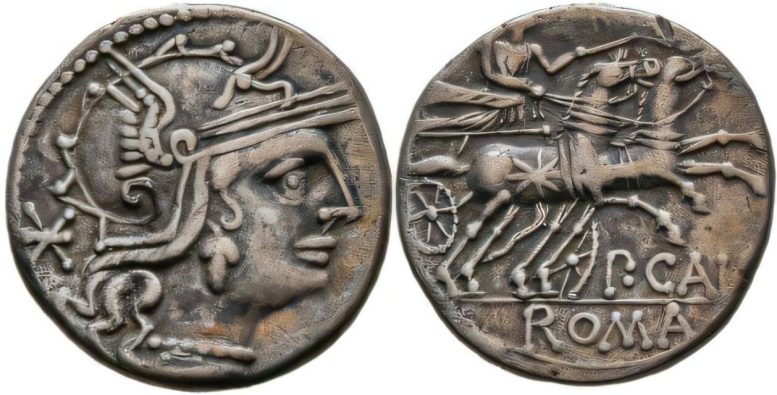
Rome conquered with its legions, but nearly four million ancient coins reveal what truly held its vast territories together: money, markets, and trade.
Researchers have reconstructed how money moved across the Roman world from 155 BCE to 2 CE, revealing an economy that became increasingly connected as Roman power spread. Their findings show how currency initially followed the legions into new territories but remained in circulation only after those regions developed permanent commercial, administrative, religious, and civic institutions.
The work demonstrates how data science is transforming the study of ancient history. Instead of relying only on written accounts, inscriptions, and individual artifacts, researchers can now combine millions of digitized archaeological records to uncover patterns that would otherwise remain invisible.
Four Million Coins Reveal A Hidden Network
The study was led by Eduardo Amaral Haddad, a professor at the University of São Paulo’s School of Economics, Business, and Accounting (FEA-USP), and Inácio Fernandes Araújo, now a professor at the Luiz de Queiroz College of Agriculture (ESALQ-USP). Both are affiliated with the Regional and Urban Economics Lab at the University of São Paulo (NEREUS-USP) in Brazil.
Their study, published in Humanities and Social Sciences Communications, combined regional economics, spatial analysis, geographic information systems, and international archaeological databases. Its goal was not simply to map where coins appeared, but to use their movement as evidence of how the Roman economy developed.
“Each coin preserved by archaeology provides three key pieces of information: where it was minted, when it was produced, and where it was found some 2,000 years later. Taken in isolation, that information reveals little. However, when millions of records are analyzed together, they can reveal the paths taken by money, the intensity of economic exchanges, the integration between different regions, and even the institutional evolution of one of the largest economies of antiquity,” says Haddad.
FAPESP supported the research through two projects (14/25030-2 and 19/00057-9).
A Side Interest Becomes A Major Study
The project began in 2014 during Haddad’s sabbatical at Princeton University in the United States. Although he was there to conduct economics research, an interest in ancient history drew him to weekly seminars organized by the Department of Classical Studies.
“At one of those meetings, I attended a presentation of a study that used shipwreck remains and pottery shards to reconstruct trade networks in the ancient Mediterranean. That idea stuck with me. Shortly thereafter, while exploring the university library, I found a catalog of Roman coins that contained the information I needed: the date of minting, the location where each coin was produced, and the site where it was found during archaeological excavations. I photocopied the catalog, thinking it would be possible to analyze those networks using tools from regional and urban economics,” he recalls.
What began as a personal interest grew into a long-term research effort. Haddad later enrolled in a distance-learning graduate program on the ancient Mediterranean at the University of Leicester in the United Kingdom. A paper he completed during that program eventually became the basis of a published article.
The broader project became possible because archaeology itself was changing. Roman coin records that had long been dispersed among museums, libraries, private collections, and researchers’ archives were being digitized and standardized. Institutions such as the American Numismatic Society helped develop shared systems for recording finds, allowing once-isolated collections to be studied together.
Building A Digital Map Of Roman Money
The principal source was Coin Hoards of the Roman Republic Online (CHRR), which records groups of coins from the Republican period. The researchers also used ORBIS, developed by Stanford University, to estimate the time and cost of traveling along ancient roads, rivers, and sea routes.
Additional geographical information came from the Pleiades gazetteer and the Roman Road Network databases. Together, these resources supplied location data for settlements, roads, and ports throughout the ancient Mediterranean.
After reviewing and combining the records, the researchers assembled a dataset of approximately four million coins from 24,646 hoards. These finds represented 5,167 connections between the places where coins were minted and the locations where they were eventually discovered.
Using hoards rather than treating every coin as a fully independent observation helped reduce distortions created by differences in survival, loss, recovery, and reuse. A hoard also provides a concentrated record of coins that circulated together, making it especially valuable for reconstructing monetary networks.
Modern Economics Meets Ancient Rome
The team then applied mathematical tools normally used to examine modern movements of people, goods, and income. Instead of mapping present-day cities and supply chains, the researchers used those methods to investigate the economic connections that supported Rome more than 2,000 years ago.
“We needed to consider that circulation from the perspective of human interaction in space according to an economic logic,” Haddad explains.
The period examined captures a dramatic transformation of the Mediterranean. The Roman Republic lasted from 509 BCE to 27 BCE, when Octavian Augustus established the Principate. Its final two centuries included the consolidation of Roman power after the Second Punic War (218–201 BCE), the conquest of the Hellenistic Mediterranean, expansion into Hispania, Gaul, the Balkans, and the East, and the civil wars that ended Republican rule.
The first analysis tested whether the coins were scattered randomly or followed a recognizable pattern. They were strongly clustered along major Roman trade routes, indicating that their distribution reflected organized networks of transportation and exchange.
Roads And Ports Carried More Than Armies
The researchers next compared the coin records with the Roman road system. “After verifying a correlation between the location and concentration of the coins, we began to cross-reference that information with Roman roads. And we found something very interesting: a clear spread of coins originating from Rome,” says Haddad.
Currency closely followed the Republic’s infrastructure. Roads, ports, and large urban centers did not merely move soldiers and supplies. They also carried payments, goods, and commercial relationships into territories under Roman control.
To understand why some regions developed intense monetary activity while others remained at the edges of the system, the researchers created an approximate model of the Roman economy. It was based on social accounting matrices, which economists use to trace exchanges among different groups and institutions.
“Answering that question required more than maps. It was necessary to reconstruct, albeit approximately, the functioning of the Roman economy itself. To do so, we organized information from historical and archaeological literature into a model inspired by so-called social accounting matrices, a tool used to analyze contemporary economies. The model describes the relationships among the main economic actors of the time: the government, households, landowners, merchants, slaves, and the army. It seeks to represent the flows of goods and payments that linked those institutions. It also distinguishes between different types of production and consumption, ranging from food and raw materials to manufactured goods and luxury items, the trade in which could extend over much greater distances,” Haddad reports.
How Coins Replaced Payments In Goods
The model also accounted for the gradual monetization of Roman life. Many transactions were still conducted through payments in goods during part of the Republic, but coins increasingly became important for supplying the army, supporting enslaved labor, and financing government activities.
That transition left physical traces in the archaeological record. Coin hoards could therefore be treated not simply as collections of old money but as evidence of the economic relationships connecting households, merchants, landowners, soldiers, and public institutions.
The results partly supported the traditional view that the Roman army spread currency into conquered lands. Soldiers had to be paid, while merchants and suppliers followed the legions and created new demand for coins. Military activity was particularly important during the first stage of expansion.
The army alone, however, could not sustain a permanent monetary economy. Its influence declined as newly conquered territories became more securely integrated into the Roman system.
Conquest Introduced Money, But Markets Kept It Moving
“What we realized was that military expansion introduced monetary circulation, but it only became established once those territories were effectively integrated, creating economic, religious, administrative, and civic structures capable of generating a permanent demand for currency,” Haddad says.
The legions acted as an initial catalyst, but civilian institutions kept money circulating. Lasting incorporation required more than occupying land. Rome needed markets, towns, government offices, religious centers, transportation links, and stable networks of exchange.
This helps explain why military accounts alone provide an incomplete picture of Roman expansion. The movement of coins captures the slower process through which conquered regions became economically connected to Rome and to one another.
The weakening effect of distance was especially revealing. Coins initially remained relatively close to their mints, but they traveled farther as Roman territory and infrastructure expanded.
Distance Mattered Less As Rome Expanded
“In the early periods analyzed, coins remained relatively close to the places where they had been minted. However, as the Republic expanded its borders, they began to be found at increasingly greater distances. In statistical models, this appears as a progressive reduction in the effect of distance on coin circulation. In other words, regions previously separated by geographical barriers became progressively integrated through a common network of transportation, markets, and institutions,” Haddad explains.
“As territorial expansion occurs, we begin to find coins at increasingly greater distances. The role of distance gradually diminishes, suggesting a growing integration of the territory,” he adds.
This finding extends beyond numismatics (the discipline dedicated to the study of coins as historical documents). The distance between a coin’s mint and its final discovery site can act as an indirect measure of economic integration. The farther coins traveled through routine exchange, the more closely different regions appear to have been connected.
The analysis also identified several economic zones. Rome occupied the center, where spending associated with public administration was especially important. The Italian Peninsula formed a highly integrated commercial core, while a mixed intermediate zone separated established territories from newly acquired lands.
“At the center of the system was the city of Rome itself, where expenditures related to public administration predominated. Surrounding it was a highly integrated economic core corresponding to the Italian Peninsula, where monetary circulation primarily reflected market activities. Further out lay an intermediate belt, a sort of buffer zone between the consolidated core and the recently incorporated regions. Within it, administrative, economic, and military expenditures coexisted. In the areas of most recent expansion, however, expenditures related to conquest and territorial occupation predominated. As those regions were pacified and permanently incorporated into the Roman world, the share of military expenditures decreased, giving way to the growth of civil, administrative, and commercial activities,” Haddad explains.
Reference: “Economic footprints: mapping coin circulation and economic networks in ancient Rome” by Eduardo A. Haddad, and Inacio Araujo, 9 June 2026, Humanities and Social Sciences Communications.
DOI: 10.1057/s41599-026-07815-7
Never miss a breakthrough: Join the SciTechDaily newsletter.
Follow us on Google and Google News.