
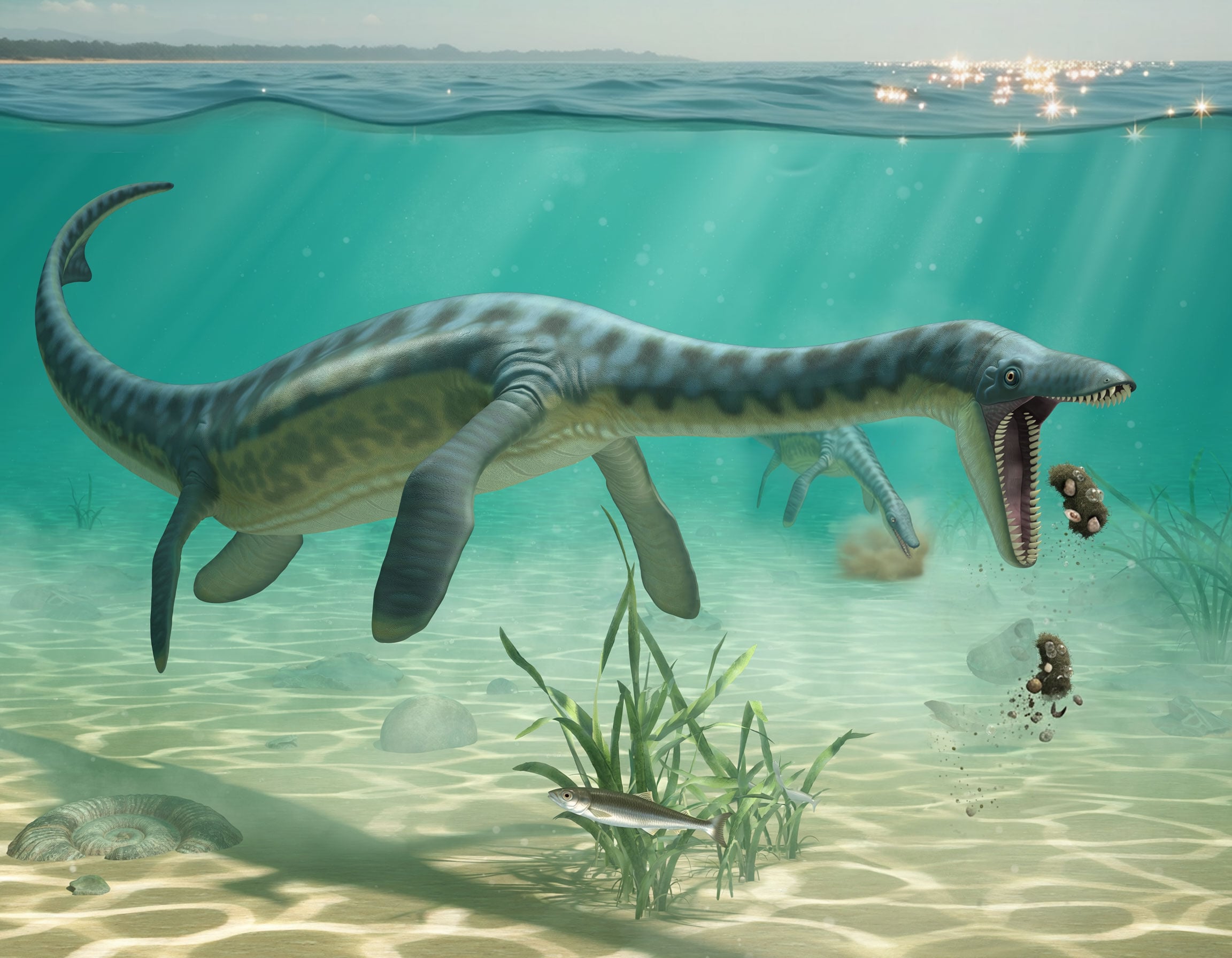
Unusual fossils from an ancient North Sea delta may reveal where plesiosaurs fed.
Fossilized vomit is not the kind of evidence paleontologists usually dream about finding. But it may have revealed an unexpected part of plesiosaur behavior.
More than 20 fossilized masses recovered from rocks beneath the North Sea contain shells and other hard remains from marine prey. Yet the fossils were preserved in sediments from an ancient river delta, not the open ocean where those organisms lived.
Research published in Geological Magazine suggests plesiosaurs may have fed offshore, then moved into shallower coastal waters before regurgitating material they could not digest.
A Meal Preserved for Millions of Years
Paleontologist Dr. Dirk Knaust identified the fossils as regurgitalites, preserved masses of vomit that can provide direct evidence of an extinct animal’s diet.
The specimens came from drill cores collected at a site now about 50 kilometers (31 miles) off the Norwegian coast. During the Jurassic, the area was part of a shallow river delta.
The shellfish inside the pellets required the more stable salinity of the open sea. Freshwater entering the delta would have made conditions unsuitable for them, suggesting the animals were eaten elsewhere.
Knaust concluded that plesiosaurs likely gathered prey from the seafloor in deeper water, then moved closer to shore before expelling the hard remains.
Rare Evidence of Feeding Behavior
Previous research suggests some plesiosaurs fed near the seafloor. Their long necks and downward-angled heads may have helped them collect prey, while their teeth were better suited to gripping food than crushing thick shells.
Dr. Knaust said: “There has been a lot of research into fossilized vomit over the last decade, but most of it has focused on vertebrates eating other vertebrates. This is the first time that plesiosaur vomit, and the shellfish in it, have been identified, and these creatures tell us a great deal.”
Most pellets would have been destroyed by waves and tides. Some survived because they were rapidly buried by sediment or swept into crustacean burrows on the seafloor.
Knaust said: “This vomit survived partly because it was so compacted and covered in mucus. Even so, most pellets would have been completely broken up by the waves and tides. Some clusters were, however, quickly covered by sediment arriving from the rivers, and some ended up in burrows left by crustaceans on the seafloor, where they were partially preserved and fossilized.”
A Prehistoric Whodunit
Identifying the animal responsible was not simple. In one drill core, Knaust found an ichthyosaur bone and coprolites (fossilized feces) only a few centimeters from the regurgitated material.
“This was quite spectacular,” Knaust said. “To begin with, I thought it was a dinosaur bone but when we looked at the CT scan we realized, no, it must be from an ichthyosaur – a group of marine reptiles similar to but unrelated to dolphins. So then I thought the vomit and feces might have belonged to an ichthyosaur, but it wasn’t that simple. There were many other marine animals to consider, and the composition of their vomit differs.”
The pellets contained bivalve shells, serpulid shells (hard, tube-dwellings built by filter-feeding worms), crinoids (invertebrates which attached themselves to the sea floor by a stalk), and belemnites (the hard parts of squid-like cephalopods).
Some masses measured at least 10 centimeters (about 4 inches), meaning they came from a relatively large animal.
Narrowing Down the Suspects
Knaust considered cephalopods (a group including squid, octopus, and cuttlefish), fish, sharks, and crocodiles.
Cephalopods did not match the size and composition of the fossils, while fish produced regurgitated material that was too small. Sharks and crocodiles were plausible because both lived in the region, but Jurassic species mainly fed on fish. No fish skeletons were found in the pellets.
That made plesiosaurs the closest match.
“The plesiosaur most closely matches the size and feeding profile of the vomit producer,” he said.
Plesiosaurs as the Likely Source
Plesiosaurs were marine reptiles that ranged from about two to 13 meters (about 7 to 43 feet) long and survived for more than 140 million years.
Knaust points specifically to cryptoclidid plesiosaurs, which grew about four to eight meters (about 13 to 26 feet) long and lived from the Middle Jurassic into the Early Cretaceous (approximately 174-100.5 million years ago).
He also suggests they may have used sheltered coastal waters after feeding.
“Plesiosaurs may have come close to shore to relax or sleep after hunting, and that’s likely when they vomited,” Knaust said. “We see fur seals and marine crocodiles doing something similar today, but while they go onto land, plesiosaurs probably remained submerged due to their weight and shape.”
Dinosaurs also lived on nearby delta surfaces, and fragments of their footprints have been identified in the drill core record.
The Behavior May Have Been Widespread
Plesiosaur fossils have been found worldwide, with Britain preserving a particularly rich record.
During the Jurassic, the North Sea site and rocks now exposed along parts of southern England were part of the same narrow marine region. Knaust therefore thinks similar behavior may have occurred around ancient British coastlines and elsewhere.
“The plesiosaur is such a fascinating animal,” Knaust said. “These findings add to other kinds of evidence that help us to understand their abilities and behavior. And this is still just the beginning. There’s so much more we can learn from picking through what extinct animals threw up after dinner.”
Reference: “The fate of supposed plesiosaur vomit from Jurassic delta deposits offshore Norway” by Dirk Knaust, 23 September 2026, Geological Magazine.
DOI: 10.1017/S0016756826100806
Never miss a breakthrough: Join the SciTechDaily newsletter.
Follow us on Google and Google News.