

A soft implant that attaches without stitches lowered blood pressure in rats, pointing toward a way to treat hypertension with less damage to surrounding tissue.
Nearly half of all adults in the United States have high blood pressure, a leading cause of heart disease. Medications and changes to diet or lifestyle can help, but roughly one in 10 people with the condition has drug-resistant hypertension. For these patients, controlling blood pressure can become a persistent challenge.
“For many patients, even taking a combination of three to five medicines doesn’t alleviate their high blood pressure,” said Tao Zhou, the study’s corresponding author and the Wormley Family Early Career Assistant Professor of Engineering Science and Mechanics at Penn State. “In these cases, bioelectronic devices that use electrical signals to modulate the body’s natural response systems offer a promising form of alternative treatment.” Zhou is also affiliated with Penn State’s Center for Neural Engineering, Huck Institutes of the Life Sciences, and Materials Research Institute.
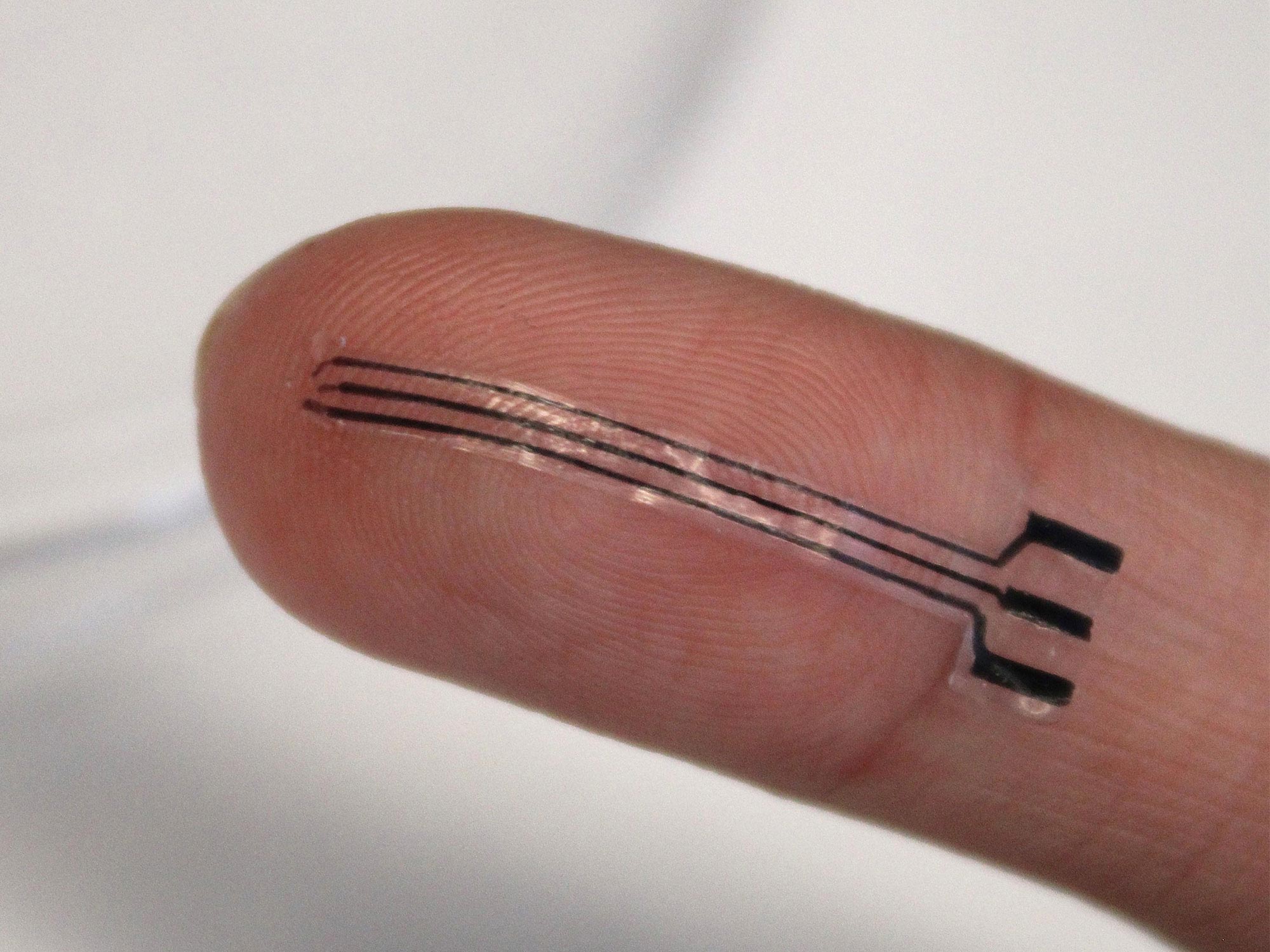
Zhou and his colleagues have developed CaroFlex, a soft, stretchy, 3D-printed device that attaches to an artery and delivers gentle electrical stimulation. In a rodent model, it lowered blood pressure while causing much less damage to surrounding tissue, the researchers reported in a paper recently published in Device.
Electrical pulses lower blood pressure in rats
The device works through a pressure-control system the body already has. Specialized nerve endings called baroreceptors detect changes in how much artery walls stretch. They trigger the baroreceptor reflex, or baroreflex, which helps regulate blood pressure, including by changing how tightly blood vessels constrict. Baroreceptors occur throughout the body, with many concentrated in the carotid sinus, a small region near where the carotid artery branches.
This artery carries oxygen-rich blood to the head and neck. Applying electrical stimulation at the carotid sinus can activate those receptors and engage the reflex to lower blood pressure, Zhou explained.
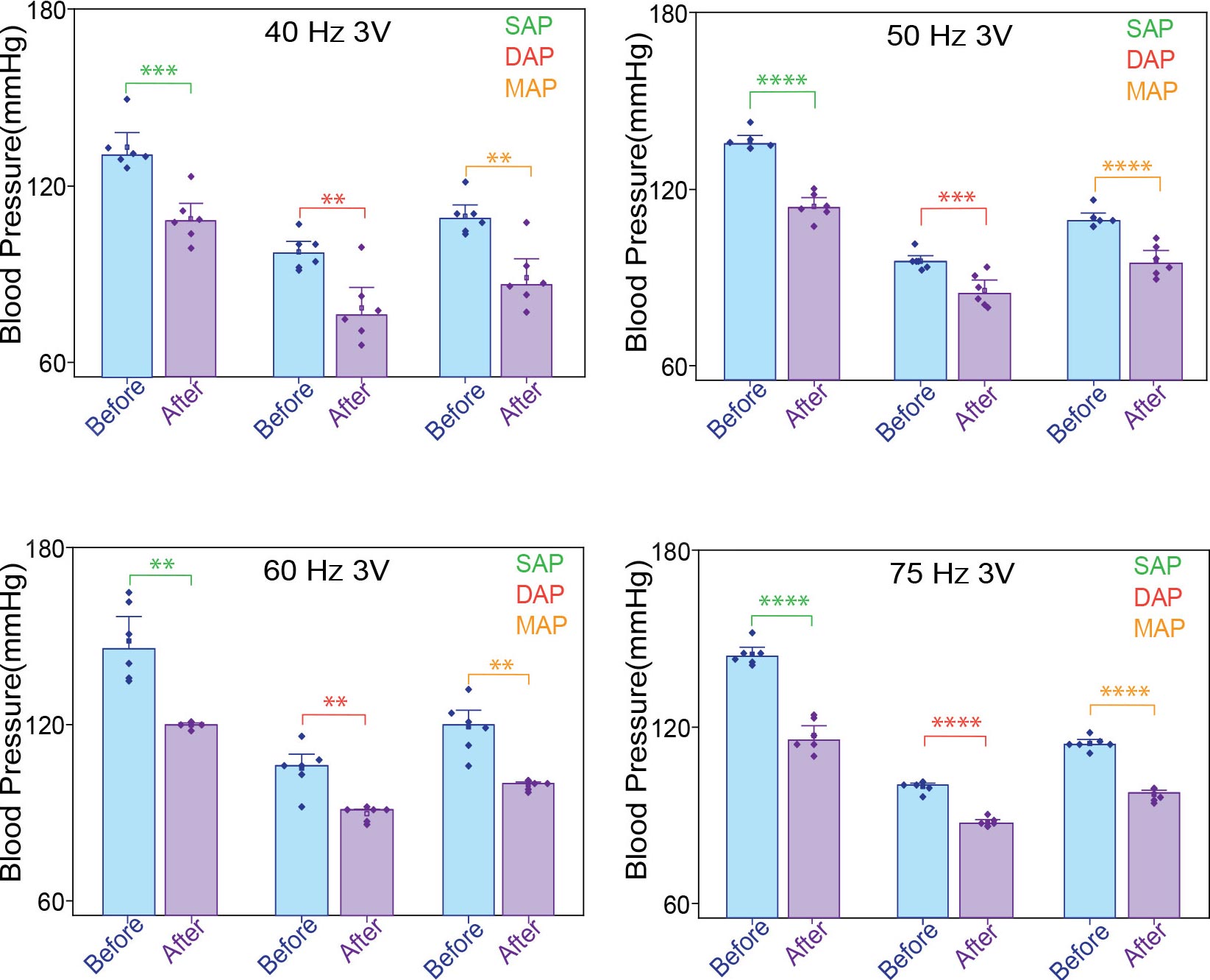
To test whether CaroFlex could do this in a living animal, the researchers implanted it at the carotid sinus in rats. Sensors on the animals’ bodies monitored blood pressure during a 10-minute testing window. Four of the five electrical frequencies tested reduced blood pressure, with readings falling by more than 15% on average.
When the researchers examined tissues in contact with CaroFlex after two weeks, they found no apparent damage or immune response.
Soft electrodes hold on without stitches
A few commercially available devices already use electrical stimulation to engage this reflex. The engineering challenge is keeping an electrode connected to an artery that continually stretches and shrinks. Conventional devices are generally made from rigid metals and plastics, which do not fit the mechanical behavior of soft tissue well. “These devices are usually held in place with stitches,” Zhou said. “These stitches can cause damage to the devices, and more importantly, the tissues they’re integrated with over time, as arteries stretch and shrink to help move blood around the body.”
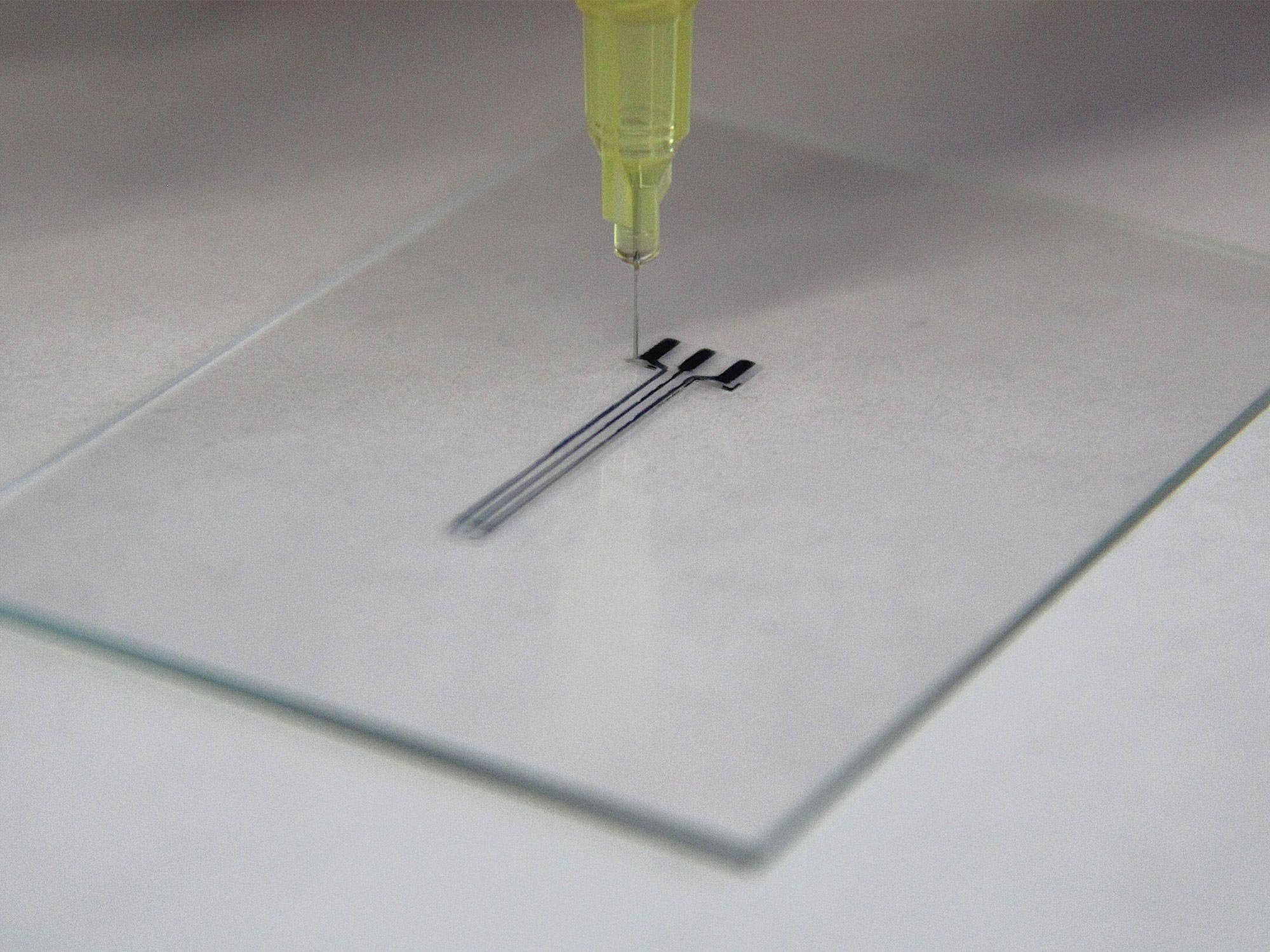
CaroFlex is made primarily from hydrogel, a soft, jelly-like material that better matches the tissue’s flexibility. Conductive hydrogels form the electrodes that deliver electrical stimulation, while adhesive hydrogels provide a strong, nontoxic attachment designed to let the device stick painlessly to biological tissue without stitches. The team used 3D printing to build this combination of electrical and adhesive components.
Laboratory tests on tissue samples examined whether the materials could provide both flexibility and a dependable attachment. CaroFlex stretched to more than twice its original size before breaking. Its adhesive film maintained strong, continuous adhesion, including when made from mixtures that had been stored for six months. The researchers also compared CaroFlex with traditional platinum bioelectrodes. By passing electrical currents through each type, they measured how the different materials affected conductivity. CaroFlex adhered more closely to the tissue and provided a more reliable electrical connection than the conventional electrodes, the team reported.
Human trials remain a future goal
With CaroFlex shown to function in living tissue and evidence of tissue compatibility, Zhou said the next steps are to fine-tune its effectiveness and scale up the approach. The eventual goal is clinical trials to test it as a treatment for hypertension in humans.
“Our lab is actively leading several developments in 3D-printed bioelectronics for use across the body, which is exciting,” Zhou said. “This fabrication approach allows us to design, fabricate, and adapt bioelectronics for potential clinical trials and commercial distribution much more efficiently than traditional methods of manufacturing.”
Reference: “3D printable suture-free bioadhesive electronic interface for hypertension therapy” by Marzia Momin, Salahuddin Ahmed, Arafat Hossain, Jia Sun, Xinyi Wang, Basma AlMahmood, Jiashu Ren, Li-Pang Huang, Umar Farooq, John Bisognano and Tao Zhou, 5 May 2026, Device.
DOI: 10.1016/j.device.2026.101150
This work was supported by the National Institutes of Health and the U.S. National Science Foundation.
Never miss a breakthrough: Join the SciTechDaily newsletter.
Follow us on Google and Google News.