
An unusually powerful polar vortex caused the Antarctic ozone hole to swell to its seventh-largest size on record in 2026, covering more than twice the area of the United States.
Unusual weather patterns over Antarctica caused the ozone hole to expand dramatically in 2026, making it one of the largest observed in nearly five decades. Despite its extraordinary size, scientists from NASA and NOAA emphasize that Earth’s protective ozone layer continues to recover and remains on course to heal later this century.
The 2026 Antarctic ozone hole ranked as the seventh-largest in 48 years of observations, based on its average seasonal area. Scientists attributed the expansion primarily to an exceptionally strong polar vortex, a powerful circulation of winds surrounding Antarctica. However, they also noted that decades of international efforts to reduce ozone-destroying chemicals prevented the hole from becoming even larger.
Between September 7 and October 13, 2026, when ozone depletion was most intense, the hole covered an average of approximately 9.6 million square miles (25 million square kilometers). That is more than twice the size of the United States. Scientists closely monitor ozone high in the atmosphere because it serves as Earth’s natural “sunscreen,” protecting living organisms from harmful ultraviolet radiation. This beneficial ozone in the stratosphere differs from ground level ozone, an air pollutant often produced by human activities.
“The annual ozone hole has been forming later in the season in recent years, which tells us the ozone layer is healing,” said Paul Newman, a senior scientist at the University of Maryland and longtime leader of NASA’s ozone research team at the agency’s Goddard Space Flight Center. “But an unusually powerful polar vortex has extended ozone depletion in the Antarctic this season, allowing the hole to grow to proportions we haven’t seen in a decade.”
The ozone hole reached its maximum size on September 18, expanding to 10.5 million square miles (27.1 million square kilometers). That was approximately 90% of the size of the largest ozone hole ever measured, which occurred on September 9, 2000.
“The 2026 ozone hole is large but could have been 1 to 2 million square miles (3.5 million square kilometers) larger if ozone-depleting substances were as prevalent in the atmosphere today as they were at their year 2000 peak,” Newman said.
How a Powerful Polar Vortex Fueled Ozone Loss
Ozone destruction begins with human-made chemicals containing chlorine and bromine. After entering the environment, these compounds gradually rise into the stratosphere, where ultraviolet sunlight breaks them apart and releases chlorine and bromine atoms. These atoms can then participate in chemical reactions involving particles in clouds that form in the extremely cold Antarctic stratosphere, leading to the breakdown of ozone.
A major factor in this process is the polar vortex, a seasonal ring of strong winds that circulates around Antarctica high in the atmosphere. By trapping exceptionally cold air over the continent, the vortex creates conditions that allow polar stratospheric clouds to develop. These clouds provide an important environment for the chemical reactions responsible for ozone depletion.
In 2026, the polar vortex was unusually extensive because atmospheric disturbances that normally weaken and disrupt it were less active than usual.
“The polar vortex was unusually large this year in part because planetary-scale weather systems that typically well up from the lower atmosphere and break up the vortex were especially weak in August and September,” said Amy Butler, a research scientist at the NOAA Chemical Sciences Laboratory. “That weak wave action kept the strongest polar vortex winds further from the South Pole by several degrees of latitude, creating a larger area for conditions ideal for ozone depletion to occur.”
NASA and NOAA Measurements Reveal Ozone Conditions
Although the 2026 ozone hole covered an exceptionally large area, the amount of ozone lost within it was less severe than during some of the most extreme depletion events recorded over the previous 10 to 20 years.
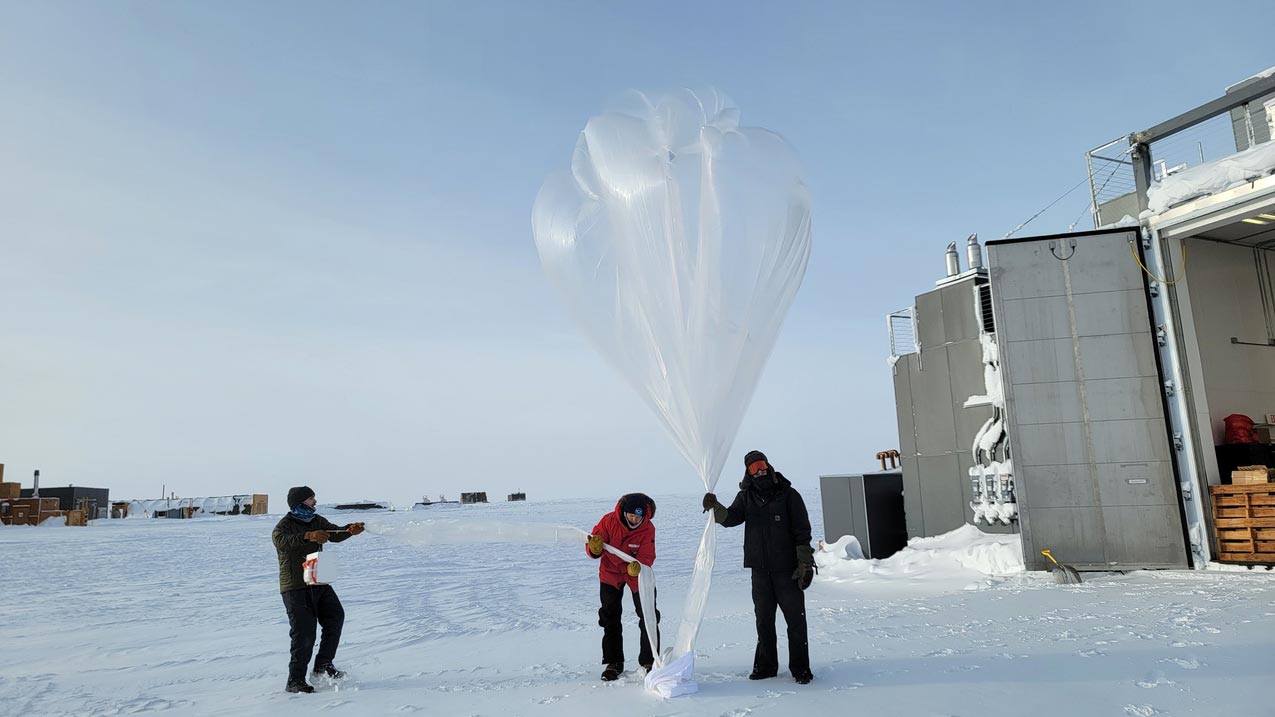
To measure ozone concentrations, NOAA researchers used instruments carried into the atmosphere by balloons launched from the South Pole Baseline Atmospheric Observatory. They also collected measurements with the Dobson Ozone Spectrophotometer, an optical instrument designed to measure atmospheric ozone. Their observations showed that ozone directly above the South Pole fell to its lowest concentration of the year on October 17, reaching 105 Dobson units.
A Dobson unit is a standard measurement used to describe the total amount of ozone in a vertical column of the atmosphere. For comparison, 100 Dobson units would form a layer just 1 millimeter thick, roughly the thickness of a dime, if all the ozone were compressed to standard temperature and pressure at sea level. The lowest concentration ever measured above the South Pole was 92 Dobson units in October 2006.
Satellites have provided another essential source of ozone measurements since 1979. For the 2026 assessment, scientists drew on observations from instruments aboard NASA’s Aura satellite, NOAA-20, NOAA-21, and the Suomi National Polar-orbiting Partnership satellite, a mission operated jointly by NASA and NOAA. Together, these observations help researchers track changes in ozone levels and assess the atmosphere’s recovery over time.
Why Earth’s Ozone Layer Is Still Recovering
Despite the unusually large ozone hole in 2026, long-term measurements continue to demonstrate the benefits of international action to protect the atmosphere. NASA and NOAA scientists point to the Montreal Protocol, adopted in 1987, as a major reason the ozone layer is gradually recovering.
Under the agreement, countries committed to phasing out substances that damage ozone, including chlorofluorocarbons, and replacing them with alternatives that pose less risk to the ozone layer. These restrictions have substantially reduced the amount of ozone-destroying chemicals entering the atmosphere.
According to Stephen Montzka, a senior scientist at NOAA’s Global Monitoring Laboratory, chlorine concentrations in the Antarctic stratosphere associated with ozone-depleting substances have fallen by approximately one-third from their peak levels in the 1980s. This decline has helped reduce the severity of ozone destruction, even during years when atmospheric conditions favor the formation of a particularly large hole.
When Will the Antarctic Ozone Hole Recover?
Chlorofluorocarbons and other ozone-depleting compounds were once common ingredients in products and materials used around the world, including refrigerators, air conditioners, and building insulation.
Although many of these chemicals have been phased out, their effects persist. Some remain in the atmosphere for decades, while others continue to escape from aging equipment, discarded products, and landfills. As a result, ozone recovery is a gradual process that depends on the continued decline of these long-lasting pollutants.
Scientists currently estimate that the Antarctic ozone hole will recover by the 2070s as the remaining ozone-destroying substances slowly disappear from the atmosphere. The enormous hole observed in 2026 demonstrates how strongly unusual weather can influence ozone depletion from one year to the next. At the same time, its reduced severity compared with the worst years on record provides further evidence that international efforts to protect Earth’s ozone layer are making a lasting difference.
Never miss a breakthrough: Join the SciTechDaily newsletter.
Follow us on Google and Google News.