
Close Menu
    Facebook X (Twitter) Instagram
    SciTechDaily
    • Biology
    • Chemistry
    • Earth
    • Health
    • Physics
    • Science
    • Space
    • Technology
    Facebook X (Twitter) Pinterest YouTube RSS
    SciTechDaily
    Home»Earth»AIM Monitors Electric-Blue Noctilucent Clouds over Antarctica
    Earth

    AIM Monitors Electric-Blue Noctilucent Clouds over Antarctica

    By Dr. Tony Phillips, Science@NASADecember 24, 20131 Comment4 Mins Read
    Facebook Twitter Pinterest Telegram LinkedIn WhatsApp Email Reddit
    Share
    Facebook Twitter LinkedIn Pinterest Telegram Email Reddit
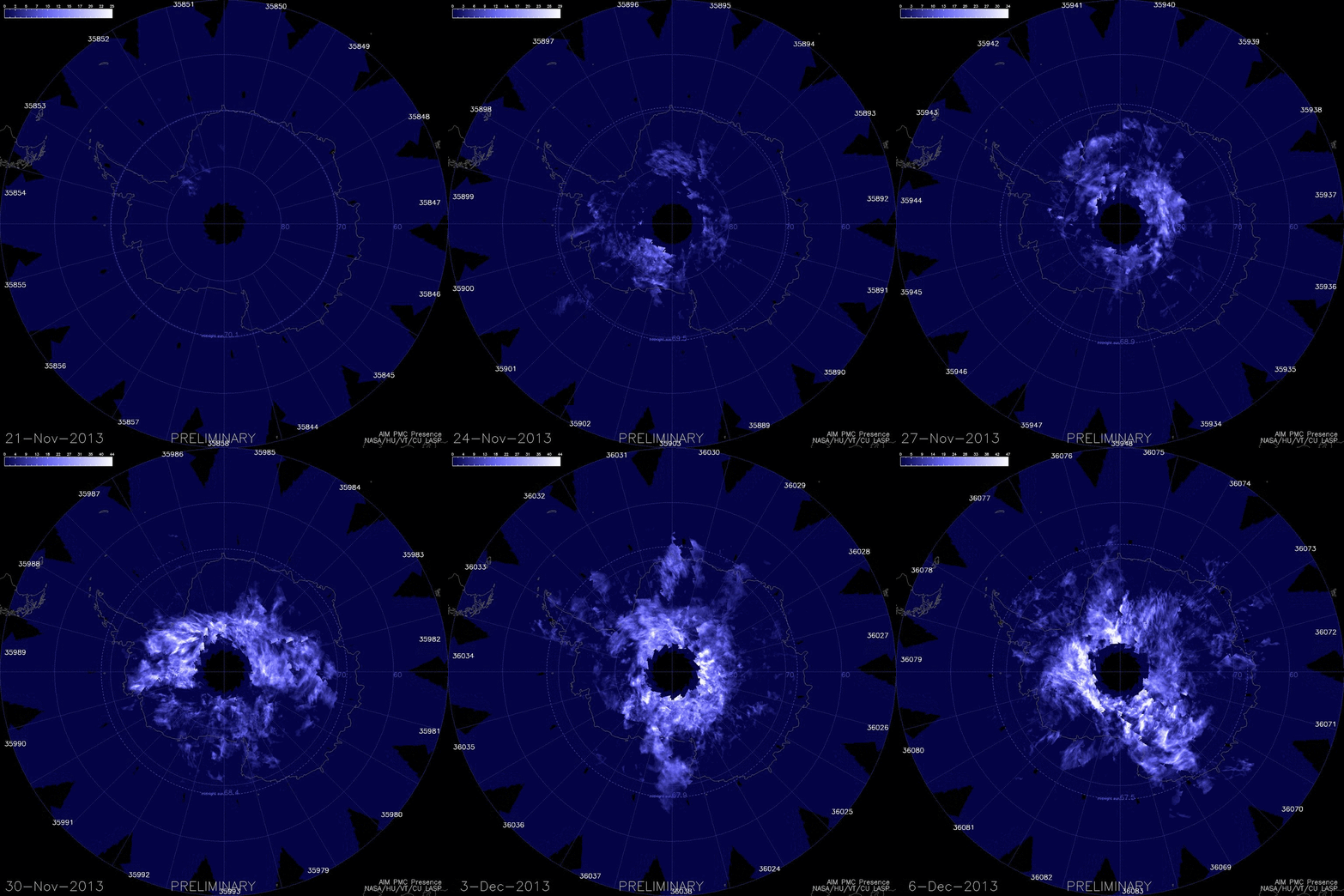
    Electric Blue Clouds Appear over Antarctica
    This image shows the “geophysical light bulb” turn on over Antarctica. Credit: AIM

    New data from NASA’s AIM spacecraft show a vast bank of noctilucent clouds blanketing Antarctica.

    Data from NASA’s AIM spacecraft show that noctilucent clouds are like a great “geophysical light bulb.” They turn on every year in late spring, reaching almost full intensity over a period of no more than 5 to 10 days.

    News flash: The bulb is glowing.

    As December unfolds, a vast bank of noctilucent clouds is blanketing Antarctica. It started on November 20th as a tiny puff of electric-blue and quickly expanded to overlie nearly the entire continent. AIM is monitoring the progress of the clouds as they swirl and ripple around the south pole.

    “The clouds appeared over the south pole earlier than usual this year,” says AIM science team member Cora Randall of the Laboratory for Atmospheric and Space Physics in Colorado. “Since AIM was launched, only the 2009 season got an earlier start.


    A vast bank of electric-blue clouds has appeared over Antarctica, signaling the start of the season for southern hemisphere noctilucent clouds.

    Noctilucent clouds–or “NLCs” for short–are Earth’s highest clouds. Seeded by disintegrating meteoroids, they form at the edge of space 83 km (52 mi) above Earth’s surface. When sunlight hits the tiny ice crystals that make up these clouds, they appear to glow electric blue.

    Summer is when NLCs are at their brightest and most widespread. Now is summer in the southern hemisphere. The clouds brighten over the south pole in November through February, and shift to the north pole in May through August.

    Why summer? The answer has to do with wind patterns and the flow of humidity in our atmosphere. Summer happens to be the time when the greatest number of water molecules are wafted up from the lower atmosphere to mix with “meteor smoke” at the edge of space. Ironically, summer is also the time when the upper atmosphere is coldest, allowing the ice crystals of NLCs to form.

    In recent years NLCs have intensified and spread. When noctilucent clouds first appeared in the 19th century, you had to travel to polar regions to see them. Since the turn of the century, however, they have been sighted as close to the equator as Colorado and Utah.

    Some researchers believe this is a sign of climate change. One of the greenhouse gases that has become more abundant in Earth’s atmosphere since the 19th century is methane.
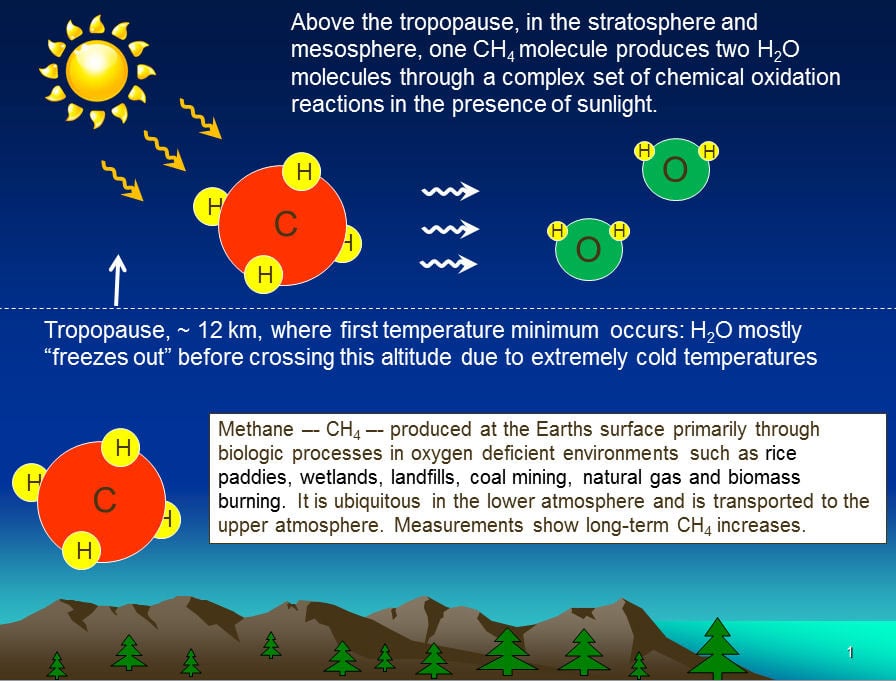
    Noctilucent Clouds are Blanketing Antarctica
    A graphic prepared by Prof. James Russell of Hampton University shows how methane, a greenhouse gas, boosts the abundance of water at the top of Earth’s atmosphere. This water freezes around “meteor smoke” to form icy noctilucent clouds. Credit: Science@NASA

    “When methane makes its way into the upper atmosphere, it is oxidized by a complex series of reactions to form water vapor,” explains Hampton University Professor James Russell, the principal investigator of AIM. “This extra water vapor is then available to grow ice crystals for NLCs.”

    If this idea, one of several, is correct, noctilucent clouds are a sort of “canary in a coal mine” for one of the most important greenhouse gases. And that, says Russell, is a great reason to study them.

    Studying NLCs is the prime mission of the AIM spacecraft. Since it was launched in 2007, AIM has made many key discoveries including the role of meteor dust in seeding NLCs and the way NLCs are affected by long-distance teleconnections in the atmosphere. More discoveries may be in the offing as NASA has just extended the mission for another two years.

    Never miss a breakthrough: Join the SciTechDaily newsletter.
    Follow us on Google and Google News.

    Antarctica NASA Planetary Science Weather
    Share. Facebook Twitter Pinterest LinkedIn Email Reddit

    Related Articles

    “Uncharted Territory” – Exceptionally Low Antarctic Sea Ice Observed by NASA

    Enduring Antarctic Sea Ice – Icebreaker Cut Through on Expedition That Located Shackleton’s Lost Ship

    NASA’s AIM Mission Spots First Night-Shining Clouds of Antarctic Summer

    AIM Spacecraft Observes Early Noctilucent Ice Clouds Over Antarctica

    New NASA/NOAA Animations Reveal Water Vapor Over Oceans

    NASA Study Reveals West Antarctic Glaciers in Irreversible State of Decline

    Researchers Discover the Coldest Place on Earth

    NASA Satellites View Super Typhoon Haiyan

    NASA Satellite Image Shows La Niña Peaking in Intensity

    1 Comment

    1. Luca the Brain on January 2, 2014 10:22 pm

      Blue Lights in space are of the Orion Nebula. A growing understanding is required, for I am in the dark, and deficient of space travel.

      Reply
    Leave A Reply Cancel Reply

    • Facebook
    • Twitter
    • Pinterest
    • YouTube

    Don't Miss a Discovery

    Subscribe for the Latest in Science & Tech!

    Trending News

    Artificial Sweeteners May Harm Future Generations, Study Suggests

    Splashdown! NASA Artemis II Returns From Record-Breaking Moon Mission

    What If Consciousness Exists Beyond Your Brain

    Scientists Finally Crack the 100-Million-Year Evolutionary Mystery of Squid and Cuttlefish

    Beyond “Safe Levels”: Study Challenges What We Know About Pesticides and Cancer

    Researchers Have Found a Dietary Compound That Increases Longevity

    Scientists Baffled by Bizarre “Living Fossil” From 275 Million Years Ago

    Your IQ at 23 Could Predict Your Wealth at 27, Study Finds

    Follow SciTechDaily
    • Facebook
    • Twitter
    • YouTube
    • Pinterest
    • Newsletter
    • RSS
    SciTech News
    • Biology News
    • Chemistry News
    • Earth News
    • Health News
    • Physics News
    • Science News
    • Space News
    • Technology News
    Recent Posts
    • What if Dark Matter Has Two Forms? Bold New Hypothesis Could Explain a Cosmic Mystery
    • Researchers Expose Hidden Chemistry of “Ore-Forming” Elements in Biology
    • Geologists Reveal the Americas Collided Earlier Than We Thought
    • 20x Difference: Study Reveals True Source of Airborne Microplastics
    • Scientists Uncover Hidden Force Powering Yellowstone’s Supervolcano
    Copyright © 1998 - 2026 SciTechDaily. All Rights Reserved.
    • Science News
    • About
    • Contact
    • Editorial Board
    • Privacy Policy
    • Terms of Use

    Type above and press Enter to search. Press Esc to cancel.