
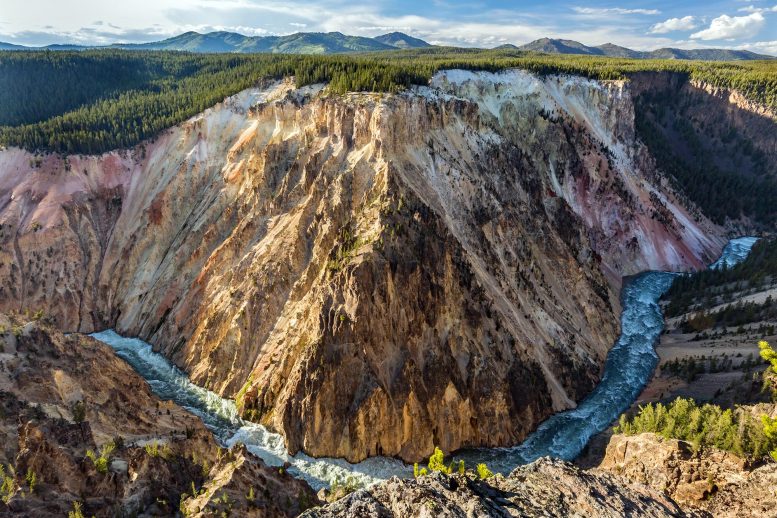
Over millions of years, Earth’s summits and valleys have moved and shifted, resulting in the dramatic landscapes of peaks and shadows we know today. Mountains often form when pressure under Earth’s surface pushes upward, yet many factors impact their ultimate height, including the erosion of the areas between mountains, known as channels.
Scientists have long assumed that as land is pushed faster upward to form a mountain, its height increases in a continuous and predictable way. But new research shows that these predictions may stop working for the steepest mountains and therefore limit their height – and this may hold true for ranges on the entire planet.
“People have argued for a long time that as channels get steeper and steeper, the erosion rate keeps increasing,” said George Hilley, a professor of geological sciences at Stanford University’s School of Earth, Energy & Environmental Sciences (Stanford Earth) and lead author of a study published in Nature Geoscience on September 16, 2019. “We find that the theory works really well until a certain point and then it breaks down empirically – it seems as though something else kicks in that we don’t completely understand.”
The researchers analyzed samples from a broad range of mountain landscapes across the tropics, including Venezuela, Brazil, Guatemala, Costa Rica, and Taiwan, controlling for rock type and climate conditions to assess parallel comparisons. They found that after mountains reach a certain elevation, channels between mountains suddenly become extremely sensitive to subtle changes in their inclines, thereby limiting the height of the mountains above. They added data from hundreds of mountain ranges worldwide and found they followed a similar pattern: the height, or relief, of the landscape is capped after crossing a threshold driven by channel steepness.
“Areas of land above channels are likely being controlled by how quickly a river can cut down – this is the framework by which we understand how the height of mountains varies as a function of climate and the collision of continents,” Hilley said. “The anomaly we observed is kind of a mystery and is not necessarily what conventional theory might predict.”
Research impacts
By bringing evidence of this mysterious factor influencing mountain height, the research could impact other work, such as studies on the relationship between mountain erosion rates and climate – important elements for understanding ancient climate and forecasting future patterns.
“Our work adds an interesting depth to some of these studies, because the way in which Earth’s topography changes as climates become more or less erosive may also change as the threshold is approached,” Hilley said.
The work also has implications for the geophysical links of mountain formation, which scientists are interested in exploring to understand the hidden activity of tectonic movements below our feet.
“People like me have always hoped that you could actually use the topography in order to say something about how quickly faults might be slipping,” Hilley said. “What our results say is that you can still do that in landscapes that are moderately steep, but it might become increasingly difficult as landscapes become steeper.”
Global patterns
The scientists took a fundamentally different approach to the research by searching the globe for conditions that reveal changes in mountain height rather than focusing on just one location. That search led them to focus on ranges in the tropics, but the conclusions were consistent across all regions of the globe and may also be applied to understand ancient topography.
“The Himalayas are being uplifted pretty rapidly and they expose pretty hard rocks, and indeed, when you measure them out, they are pretty close to this threshold,” he said. “You might be able to take this threshold with just the modern configuration of the landscape and actually place some upper bound on what the topography of the ancient Himalayas looked like.”
Hilley said the results of the study were surprising, as well as the fact that they remained consistent when compared with global data.
“In retrospect, it makes sense when you look at it from the overall context of what our planet actually looks like,” Hilley said. “It really speaks to the fact that there might be lots of fertile ground to explore why this might happen. It also points to the fact that there might be something about the way in which rivers incise that we just don’t understand yet.”
###
Co-author Stephen Porder, now with Brown University, collected samples for the study while a postdoctoral researcher at Stanford. Stanford co-authors include graduate students Curtis Baden, Robert Sare and Aaron Steelquist. Samuel Johnstone, Frances Liu and Holly Young conducted research for the study while graduate students at Stanford. A researcher from Universidad Católica de Chile was also a co-author on the study.
The research was supported by the National Science Foundation (NSF) and Fondo Nacional de Desarrollo Científico y Tecnológico (National Fund for Scientific and Technological Development, Chile).
Reference: “Earth’s topographic relief potentially limited by an upper bound on channel steepness” by George E. Hilley, Stephen Porder, Felipe Aron, Curtis W. Baden, Samuel A. Johnstone, Frances Liu, Robert Sare, Aaron Steelquist and Holly H. Young, 16 September 2019, Nature Geoscience.
DOI: 10.1038/s41561-019-0442-3
Never miss a breakthrough: Join the SciTechDaily newsletter.
Follow us on Google and Google News.
2 Comments
I think that “mystery” might just be something civil engineers refer to as angle of repose. Which only applies to granular materials and not solid rock.
The article is confusingly written and I’m not sure if that is the sole fault of the author given how poor the initial research appears to be.
Previous comment is a useful suggestion to explore, related to change in “channel” configuration. However, second para commenting on the article’s construction is gratuitous and not helpful.