

A familiar diabetes pill could hold the power to slow the biological forces that leave the body increasingly vulnerable to disease as it ages.
What if a drug already prescribed to millions of people could do more than control blood sugar? For years, researchers have wondered whether metformin, one of the world’s most widely used diabetes medications, might also influence some of the biological processes that drive aging.
A new review published in the journal Aging examines the evidence behind that possibility. In their paper, the authors explore whether the drug could act on aging biology itself rather than simply treating one of its common metabolic consequences.
The review was authored by Jarra Manneh, May Alasmar, and Nady El Hajj of the College of Health and Life Sciences at Hamad Bin Khalifa University, Qatar Foundation, Doha, Qatar. Corresponding author Nady El Hajj is also affiliated with the university’s College of Science and Engineering.
Why Metformin Attracts Longevity Researchers
Metformin has been used for decades as a first-line treatment for type 2 diabetes, where it lowers blood glucose, improves insulin sensitivity, and reduces glucose production in the liver. But its appeal to longevity researchers comes from a broader possibility: the drug appears to interact with cellular pathways involved not only in metabolism, but also in energy sensing, inflammation, mitochondrial function, and other processes that change with age.
Instead of viewing cancer, cardiovascular disease, frailty, and metabolic disorders as entirely separate problems, geroscience looks for underlying mechanisms that contribute to many of them. The review draws on cell experiments, animal models, observational studies, and clinical trials to evaluate how metformin interacts with several of these mechanisms.
A major focus is AMP-activated protein kinase (AMPK), an energy sensor that helps cells respond when fuel is scarce. Metformin inhibits mitochondrial complex I, shifting the cell’s energy balance and activating AMPK. This response can suppress mechanistic target of rapamycin (mTOR) signaling, a pathway that encourages growth when nutrients are abundant.
Activating AMPK may also promote autophagy, the cellular recycling process that removes damaged components, while supporting the production of new mitochondria and reducing oxidative stress. These effects connect metformin’s familiar role in blood sugar control with nutrient sensing and cellular maintenance systems that often become less effective with age.
Multiple Hallmarks of Aging
The authors found particularly strong evidence linking metformin with deregulated nutrient sensing, mitochondrial dysfunction, impaired macroautophagy, cellular senescence, and epigenetic alterations. Research also points to possible effects on chronic inflammation and dysbiosis, while connections to telomere shortening and stem cell exhaustion remain less certain.
Senescent cells stop dividing but do not always disappear. As they accumulate, they can release inflammatory signals that disturb nearby tissues. Metformin may influence this process and the chronic, low-grade inflammation that commonly accompanies aging, although the extent of these effects in humans is not yet clear.
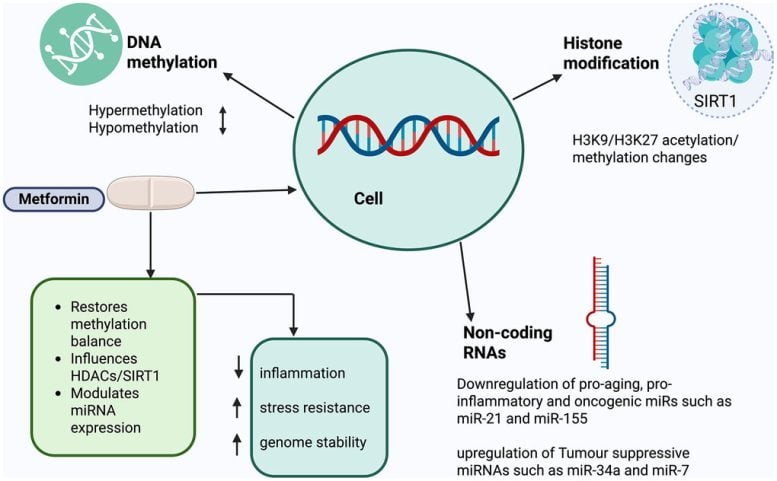
Epigenetics offers another possible route. Epigenetic mechanisms regulate whether genes become more or less active without altering the DNA sequence itself. Studies suggest that metformin can affect DNA methylation, histone modifications, and noncoding RNAs through AMPK, SIRT1, and other regulatory proteins.
Some human studies have associated metformin use with less epigenetic age acceleration. However, a favorable change in a molecular aging clock does not necessarily mean that a person will remain healthier longer. The authors caution that biomarker changes alone cannot establish that metformin slows aging or extends human healthspan.
The Gut Microbiome Connection
Metformin may also work partly through the gut. Oral doses reach high concentrations in the gastrointestinal tract, where the drug can reshape microbial communities and alter their production of short-chain fatty acids.
These microbial metabolites can affect the intestinal barrier, inflammation, insulin sensitivity, AMPK activity, and epigenetic regulation. The microbiome may therefore help carry metformin’s effects beyond the digestive tract, linking intestinal bacteria with metabolism throughout the body.
This complex relationship helps explain why metformin cannot be tied to a single mechanism. Its effects on energy sensing, mitochondria, cellular recycling, inflammation, gene regulation, and gut microbes are closely connected, making it difficult to identify which pathways matter most for healthy aging.
Longer Life in Animals, Uncertainty in Humans
Experiments summarized in the review have found that metformin can extend lifespan in Caenorhabditis elegans and several mouse models. Research involving male cynomolgus monkeys also reported reductions in markers of biological age across multiple tissues.
Human observational studies have linked metformin use with improved survival and other favorable aging-related outcomes. Some highly publicized findings, however, have not been reproduced in later research, which weakens the case for drawing firm conclusions.
Most human evidence also comes from people who already have diabetes or another health condition. Metformin might improve their survival by controlling blood sugar or reducing complications of disease without broadly slowing the aging process.
Comparisons across studies are further complicated by inconsistent endpoints. Researchers have measured mortality, cancer, cardiovascular disease, frailty, and biological age markers, but success in one category does not guarantee benefits in the others.
Clinical Trials Put the Idea to the Test
The Targeting Aging with Metformin (TAME) initiative was designed to investigate whether metformin can delay several age-related diseases in older adults without diabetes. Rather than treating aging as a disease, the project focuses on whether targeting its underlying biology can postpone multiple chronic conditions.
Results from the randomized MeMeMe trial provided a more mixed picture. Among more than 1,400 adults ages 50 to 79 with metabolic syndrome, metformin reduced the development of type 2 diabetes. It did not, however, prevent cancer, cardiovascular disease, or death.
That outcome reinforces an important distinction: a drug can deliver meaningful metabolic benefits without functioning as a general longevity treatment. Larger and longer trials will be needed to determine whether metformin affects the pace of aging or primarily lowers selected disease risks.
Long-term safety must also be considered if otherwise healthy people are expected to take the drug for years. Metformin is generally well tolerated, but prolonged use can contribute to vitamin B12 deficiency. Metformin-associated lactic acidosis is rare but serious, especially among people with impaired kidney function or other predisposing conditions.
Promising Biology Is Not Proof of Longevity
“By merging data from clinical, molecular, and population levels, metformin could be the wonder drug that redefines the limits of healthy aging,” the authors state.
Despite that optimistic assessment, essential questions remain unanswered. Researchers have not established the best dose, ideal treatment length, or most effective age to begin therapy for possible protection against aging. Benefits could also vary according to diabetes status, sex, body composition, and age.
Adequately powered randomized trials involving people without diabetes must demonstrate meaningful reductions in age-related disease, disability, or death. Until that evidence arrives, metformin remains a promising geroscience candidate rather than a proven treatment for slowing human aging.
Reference: “Metformin at the convergence of aging and longevity” by Jarra Manneh, May Alasmar and Nady El Hajj, 10 August 2026, Aging.
DOI: 10.18632/aging.206407
Never miss a breakthrough: Join the SciTechDaily newsletter.
Follow us on Google and Google News.