

Stanford researchers have created SandAI, an AI tool that reveals the ancient history of quartz sand grains, identifying how wind, rivers, waves, or glaciers shaped them. By using machine learning, SandAI enhances the accuracy and objectivity of microtextural analysis, making it valuable for geological studies and forensic investigations, like tracking illegal sand mining.
Stanford researchers have created an AI-powered tool called SandAI, capable of uncovering the history of quartz sand grains spanning hundreds of millions of years. SandAI allows scientists to accurately determine whether wind, rivers, waves, or glacial movements shaped and deposited the grains of sand.
The tool gives researchers a unique window into the past for geological and archeological studies, especially for eras and environments where few other clues, such as fossils, are preserved through time. SandAI’s approach, called microtextural analysis, can also help with modern-day forensic investigations into illegal sand mining and related issues.
“Working on sedimentary deposits that haven’t been disturbed or deformed feels about as close as you can get to being in a time machine – you’re seeing exactly what was on the surface of Earth, even hundreds of millions of years ago. SandAI adds another layer of detail to the information we can pull from them,” said Michael Hasson, a PhD candidate with Mathieu Lapôtre, an assistant professor of Earth and planetary sciences at the Stanford Doerr School of Sustainability. Hasson is the lead author of a new study demonstrating the tool, published this week in Proceedings of the National Academy of Sciences.
Telltale signatures
Historically, microtextural analysis has been done by hand and eye, using magnifying glasses and microscopes to attempt to draw inferences about sand grains’ histories. Modern science has validated the approach, showing that transport mechanisms do indeed impart telltale signatures – for example, grains that traveled farther often appear more rounded because they’ve had their sharp corners dulled; waves and wind also leave distinctive abrasion patterns.
However, traditional microtextural analysis is highly subjective, time-consuming, and scattershot across different studies. Thanks to the new tool, which leverages the power of machine learning to deeply scrutinize microscopic images of sand grains, microtextural analysis can now be far more quantitative, objective, and potentially useful across a wide range of applications. It also analyzes individual sand grains instead of lumping multiple grains into a single category, offering a more complete evaluation.
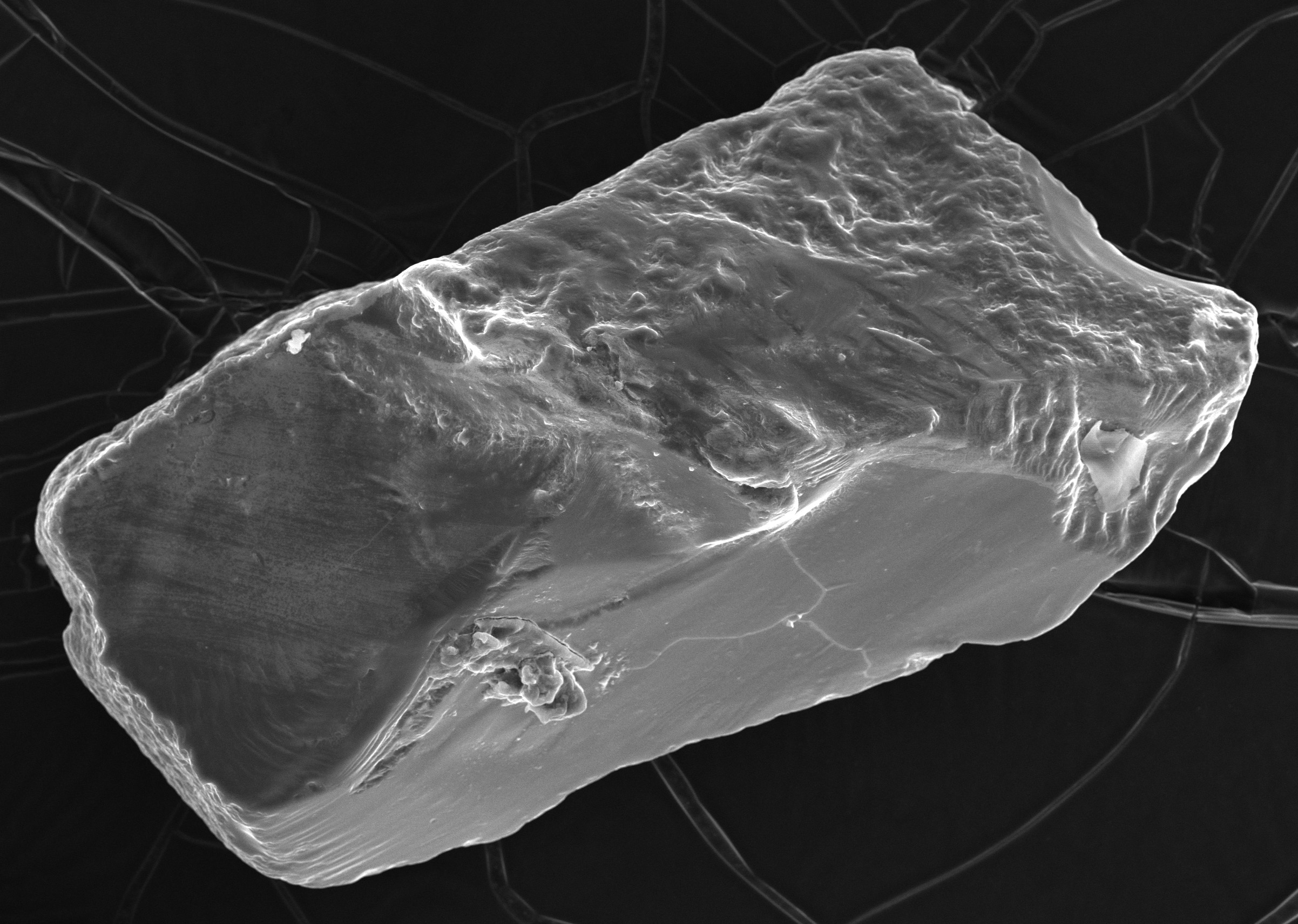
“Instead of a human going through and deciding what one texture is versus another for sand grains, we are using machine learning to make microtextural analysis more objective and rigorous,” said Lapôtre, who is senior author of the paper. “Our tool is opening doors for microtextural analysis applications that were not available before.”
Worldwide, sand is the most used resource, after water, and is critical in the construction industry. Materials such as concrete, mortar, and some plasters require angular sand for proper adhesion and stability. Gauging the origins of sand, however, to ensure ethical and legal sourcing is challenging, so the researchers hope SandAI can bolster traceability. For example, SandAI could help forensics investigators crack down on illegal sand mining and dredging.
Training the tool
To build SandAI, the researchers employed a neural network that “learns” in a manner akin to the human brain, where correct answers strengthen connections between artificial neurons, or nodes, in the program, enabling the computer to learn from its mistakes.
With help from collaborators around the world, Hasson assembled hundreds of scanning electron microscope images of sand grains, representing material from the most common terrestrial environments: fluvial (rivers and streams), eolian (windblown sediments, such as sand dunes), glacial, and beach.
“We wanted this method to work across geological time, but also across all of the geography that we have on Earth,” said Hasson. “So, for example, the windblown dunes class was designed to include examples that are wet and dry, large and small. We needed the classes to be as diverse as they possibly could be.”
SandAI analyzed this set of images to train itself to predict the sand grains’ histories based on features that human researchers might not ever discern. The tool naturally made errors and would then iteratively improve. Once SandAI reached a robust 90% prediction accuracy, the researchers introduced new samples the model had not previously seen.
With images of sandstones from well-characterized environments ranging from the current day back to roughly 200 million years into the Jurassic era, SandAI performed well, correctly elucidating the grains’ transport histories.
Novel science and applications
Next, the researchers challenged the tool with images of sand grains collected from Norway that date back more than 600 million years to the Cryogenian period. Better known as the time of “Snowball Earth,” this was when ice sheets are thought to have covered the whole planet before plants and animals had evolved. The origin of the sample in question, called the Bråvika Member, has been contested, with various research groups coming to different conclusions.
“With this Cryogenian sample, we were seeing how far we can push SandAI and really using it to do new science rather than just verifying that the tool worked,” Hasson said.
Intriguingly, SandAI surmised that the ancient sand grains had been shaped and deposited as part of a windblown sand dune – in agreement with some manual microtextural studies. Moreover, because the tool analyzes individual sand grains, versus lumping multiple grains into a single category, other details emerged. While the dominant signature indeed indicated wind transport, a secondary signature that manual techniques would likely miss pointed to glacial sand. Together, those signals paint a portrait of sand dunes running somewhere near a glacier, as might well be expected during the Snowball Earth period.
To evaluate those findings further, Hasson and colleagues looked for a potential modern analog of this Cryogenian geological scene. The researchers ran windblown sand grains from Antarctica through SandAI and, sure enough, arrived at the same result. “These findings from SandAI suggest that Antarctica really is a good modern analog to the environment represented by the Bråvika Member,” Hasson said. “They are a really strong piece of evidence that the signal we got from the Cryogenian deposits isn’t just a fluke.”
The researchers have made SandAI available online for anyone to use. They plan to continue developing it based on user feedback and look forward to seeing the tool applied in a range of contexts.
“The fact that we can now offer detailed conclusions about geological deposits that weren’t knowable before I find kind of mind-blowing,” said Hasson. “We’re looking forward to seeing what else SandAI can do.”
Reference: “Automated determination of transport and depositional environments in sand and sandstones” by Michael Hasson, M. Colin Marvin and Mathieu G. A. Lapôtre, 16 September 2024, Proceedings of the National Academy of Sciences.
DOI: 10.1073/pnas.2407655121
Never miss a breakthrough: Join the SciTechDaily newsletter.
Follow us on Google and Google News.
3 Comments
Very interesting, I like it!
“…, the researchers employed a neural network that ‘learns’ in a manner akin to the human brain, where correct answers strengthen connections between artificial neurons, or nodes, in the program, enabling the computer to learn from its mistakes.”
Whether the Neural Net made the correct decision or not is determined by those responsible for training it. It is those very same researchers who have built up the database that is described in the article, thusly: “traditional microtextural analysis is highly subjective, time-consuming, and scattershot across different studies.” That is, there is an element of human subjectivity that is not being acknowledged. The end result is a tool that classifies sand the way that humans do, whether right or not. As paradigms shift, what is an accepted interpretation today, may not be acceptable in the future.
“…, Hasson assembled hundreds of scanning electron microscope images of sand grains, representing material from the most common terrestrial environments: …”
One possible risk to this automated approach is that the samples are biased. Sampling is an important research task that is often given little thought. Samples are likely to be taken where they are accessible easily, from outcrops that appear anomalous and catch the field geologist’s eye, or are otherwise novel such as color or resistance to erosion. Also, with older sediments, diagenesis and percolating ground water can selectively dissolve some mineral particles, or even be the nucleus for precipitation or complete metamorphism, particularly for metaquartzites. Sampling is critical for the correct classification of sources. However, the laboratory techniques can also be important because SEM photos of the surface will generally fail to reveal the post-deposition history, and require polarized-light microscopy to discern epitaxial deposition.
One advantage of this approach is that instead of a researcher, with time limitations, reporting only the dominant sand class, it can provide percentages of the various potential sources, which provides insight on changing sources or re-working of sands. However, it appears that it will work best with unconsolidated sands or those cemented by calcite, which can be etched by acid.
However, overall, I see a risk of depending too much on this tool and having researchers unquestionably use what the tool says, without establishing the essential Multiple Working Hypotheses. This is interesting work, but I’m not sure that it is ready for ‘prime time.’
Manufactured? Assembled? Formed from existing elements?
No new dirt was created. Arrogance arises when we claim to “create” because nothing new is made from nothing.