
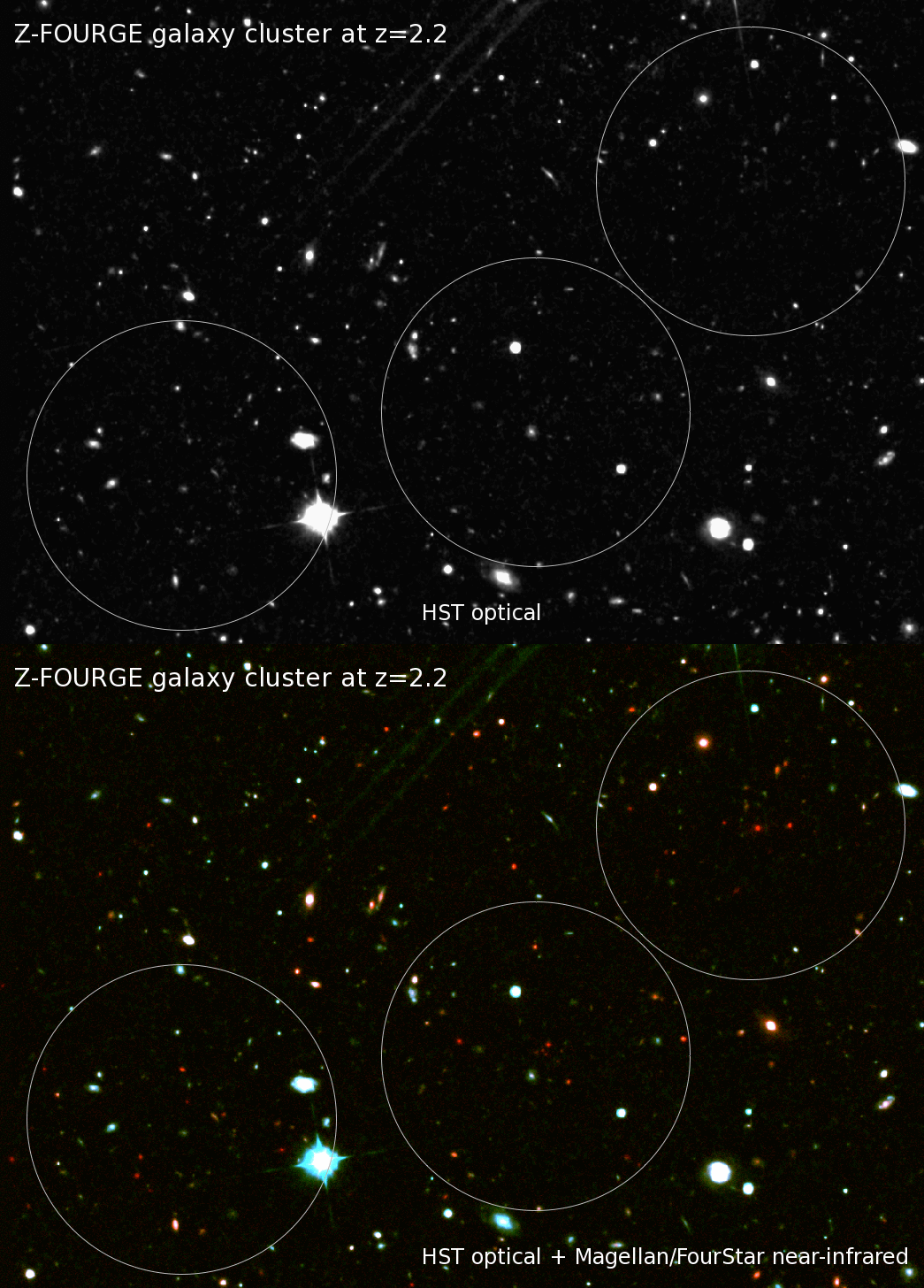
Missed by previous surveys, astronomers using FourStar found 30 red galaxies, which form the earliest known “galaxy city” in the universe, located 10.5 billion light-years away in the direction of the constellation Leo.
A team of astronomers has discovered the most distant cluster of red galaxies ever observed using FourStar, a new and powerful near-infrared camera on the 6.5-meter Magellan Baade Telescope. The galaxy cluster is located 10.5 billion light-years away in the direction of the constellation Leo. It is made up of 30 galaxies packed closely together, forming the earliest known “galaxy city” in the universe. The findings will be published in the Astrophysical Journal Letters.
Remarkably, the cluster was completely missed by previous surveys, which searched this region of the sky for thousands of hours and were conducted by all the major ground- and space-based observing facilities, including the Hubble Space Telescope. Despite these intense observations, accurate distances for such faint and distant galaxies were missing until the advent of FourStar.
Eric Persson of the Carnegie Observatories* led the development of the new camera that enabled these observations. Persson and his team—which includes Carnegie’s David Murphy, Andy Monson, Dan Kelson, Pat McCarthy, and Ryan Quadri—equipped FourStar with five special filters to collect images that are sensitive to narrow slices of the near-infrared spectrum. This powerful approach allows them to measure accurate distances between Earth and thousands of distant galaxies at one time, providing a 3-D map of the early universe.
The 3-D map revealed the conspicuous concentration of galaxies that existed when the universe was only three billion years old.
“This means the galaxy cluster is still young and should continue to grow into an extremely dense structure possibly containing thousands of galaxies,” explained lead author Lee Spitler of Australia’s Swinburne University of Technology.
Studying this system will help astronomers understand how galaxies are influenced by their environment, evolve, and assemble into larger structures.
The finding is part of a larger survey, the FourStar Galaxy Evolution Survey (“Z-FOURGE”), led by Dr. Ivo Labbé, a former Carnegie postdoctoral fellow, now at Leiden Observatory in the Netherlands. The focus of the survey is to address a classical problem in observational astronomy: determining distances. Only then do you know if a point of light is a star in our Milky Way, a small nearby galaxy, or a large one very far away.
The Z-FOURGE observations are being conducted using the Magellan 6.5-meter (21.3-foot) telescope at Carnegie’s Las Campanas Observatory in Chile. From the first six months of the survey, the team obtained accurate distances for faint galaxies over a region roughly one-fifth the apparent size of the Moon. Though the area is relatively small, they found about a thousand galaxies at even greater distances than the new cluster.
“The excellent image quality and sensitivity of Magellan and FourStar really make the difference,” Labbé said. “We look forward to many more exciting and unexpected discoveries!”
Reference: “First Results From Z −fourge*: Discovery of a Candidate Cluster at Z = 2.2 in Cosmos” by Lee R. Spitler, Ivo Labbé, Karl Glazebrook, S. Eric Persson, Andy Monson, Casey Papovich, Kim-Vy H. Tran, Gregory B. Poole, Ryan Quadri, Pieter van Dokkum, Daniel D. Kelson, Glenn G. Kacprzak, Patrick J. McCarthy, David Murphy, Caroline M. S. Straatman and Vithal Tilvi, 12 March 2012, The Astrophysical Journal Letters.
DOI: 10.1088/2041-8205/748/2/L21
*The full list of the research team is: Karl Glazebrook, Glenn G. Kacprzak, Ivo Labbé (PI), Daniel D. Kelson, Patrick J. McCarthy, Andy Monson, David Murphy, Casey Papovich, S. Eric Persson, Ryan Quadri, Lee R. Spitler, Caroline M. S. Straatman, Vithal Tilvi, Kim-Vy H. Tran, and Pieter van Dokkum.
Never miss a breakthrough: Join the SciTechDaily newsletter.
Follow us on Google and Google News.