
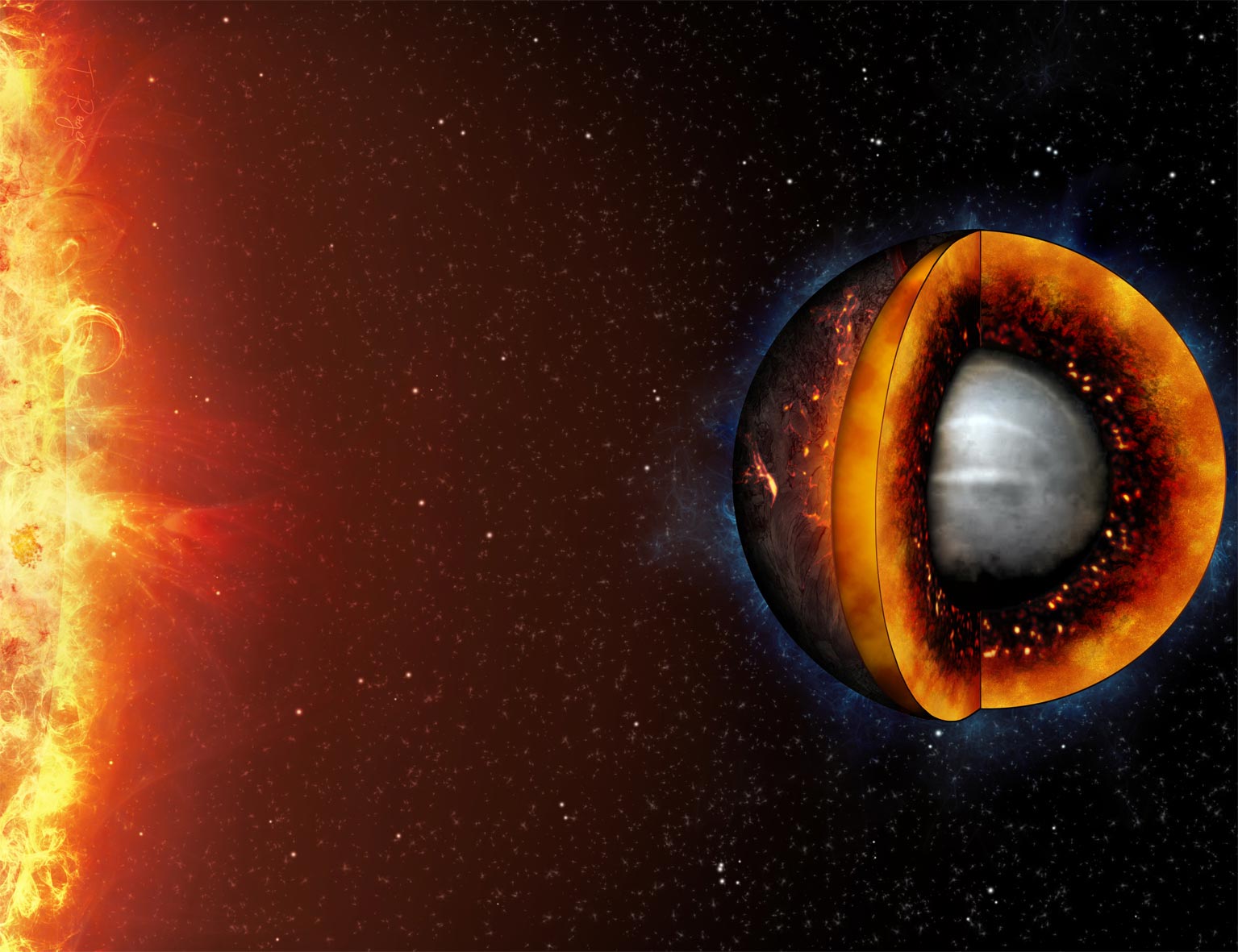
A hot, molten Earth would be around 5% larger than its solid counterpart. This is the result of a study led by researchers at the University of Bern. The difference between molten and solid rocky planets is important for the search of Earth-like worlds beyond our Solar System and the understanding of Earth itself.
Rocky exoplanets that are around Earth size are comparatively small, which makes them incredibly difficult to detect and characterize using telescopes. What are the optimal conditions to find such small planets that linger in the darkness? “A rocky planet that is hot, molten, and possibly harboring large outgassed atmosphere ticks all the boxes,” says Dan Bower, an astrophysicist at the Center for Space and Habitability (CSH) of the University of Bern. Such a planet could be more easily seen by telescopes due to strong outgoing radiation than its solid counterpart. The SNSF Ambizione and CSH Fellow continues: “Granted, you wouldn’t want to vacation on one of these planets, but they are important to study since many if not all rocky planets begin their life as molten blobs, yet eventually some may become habitable like Earth.
“Thinking about Earth in the context of exoplanets, and vice-versa, offers new opportunities for understanding planets both within and beyond the Solar System.” — Dan Bower

Rocky planets are built from the leftovers of the leftovers. “Everything that doesn’t make its way into the central star or a giant planet has the potential to end up forming a much smaller terrestrial planet,” says Bower: “We have reason to believe that processes occurring during the baby years of a planet’s life are fundamental in determining its life path.” Therefore, Bower and a team of post-docs — dominantly from within the PlanetS network — were intrigued to uncover the observable nature of such a planet. Their study is now published in the journal Astronomy & Astrophysics. It shows that a molten Earth would actually be around 5% larger in radius than a solid Earth, and this is due to the difference in the behavior of molten versus solid materials at the extreme conditions of a planetary interior. “In essence, a molten silicate occupies more volume than its equivalent solid, and this increases the size of the planet,” Bower explains.
A difference that CHEOPS can detect
In the characterization of exoplanets outside our solar system and the search for potentially habitable worlds, researchers at the University of Bern are among the world leaders. Although detection of a rocky planet around a bright Sun-like star will remain beyond reach at least until the launch of the PLATO space mission in 2026, Earth-size planets around cooler and smaller stars such as the red dwarf Trappist-1 or Proxima b are now set to take center stage. Interestingly, a 5% difference in planetary radii can be measured with current and future observational facilities, notably the space telescope CHEOPS which was developed and assembled in Bern and will launch later this year. Indeed, the latest exoplanet data already provides an inkling that low-mass molten planets, sustained by intense starlight, are present in the exoplanet catalog. Some exoplanets could therefore be Earth-like in terms of similar building blocks, yet have different amounts of solid and molten rock to explain observed variations in planet size. “They do not necessarily need to be made of exotic light materials to explain the data,” says Bower.
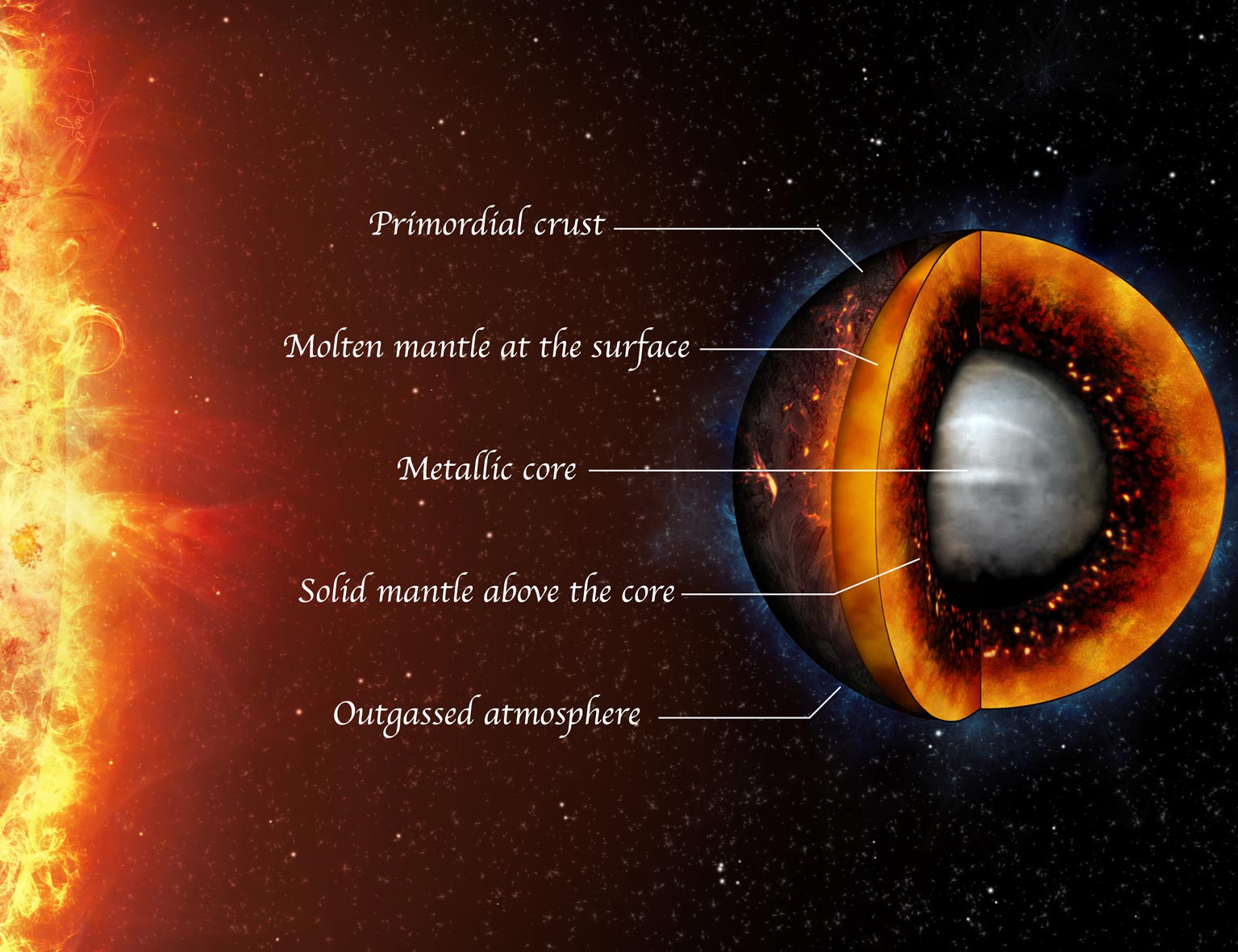
However, even a totally molten planet may not be able to explain the observation of the most extreme low-density planets. But on this the research team also has a proposition: Molten planets early in their history can outgas large atmospheres of volatile species that were originally trapped inside the magma in the interior of the planet. This could explain an additional decrease in the observed planetary density. The James Webb Space Telescope (JWST) should be able to distinguish such an outgassed atmosphere on a planet around a cool red dwarf if it is dominated by either water or carbon dioxide.
In addition to the consequences of observations, Bower, with his roots as an Earth Scientist, sees his study in a broader context: “Clearly, we can never observe our own Earth in its history when it was also hot and molten. But interestingly, exoplanetary science is opening the door for observations of early Earth and early Venus analogs that could greatly impact our understanding of Earth and the Solar System planets. Thinking about Earth in the context of exoplanets, and vice-versa, offers new opportunities for understanding planets both within and beyond the Solar System.”
Reference: “Linking the evolution of terrestrial interiors and an early outgassed atmosphere to astrophysical observations” by Dan J. Bower, Daniel Kitzmann, Aaron S. Wolf, Patrick Sanan, Caroline Dorn and Apurva V. Oza, Astronomy & Astrophysics.
DOI: 10.1051/0004-6361/201935710
Never miss a breakthrough: Join the SciTechDaily newsletter.
Follow us on Google and Google News.
1 Comment
No matter what you’ve got in your https://dltutuapp.com/tutuapp-download/
closet, there are tons of cool looks you can create to showcase your style.