
Close Menu
    Facebook X (Twitter) Instagram
    SciTechDaily
    • Biology
    • Chemistry
    • Earth
    • Health
    • Physics
    • Science
    • Space
    • Technology
    Facebook X (Twitter) Pinterest YouTube RSS
    SciTechDaily
    Home»Biology»Scientists Discover the Origin of Brain Mapping Diversity for Eye Dominance [Video]
    Biology

    Scientists Discover the Origin of Brain Mapping Diversity for Eye Dominance [Video]

    By State University of New York College of OptometryNovember 12, 20191 Comment3 Mins Read
    Facebook Twitter Pinterest Telegram LinkedIn WhatsApp Email Reddit
    Share
    Facebook Twitter LinkedIn Pinterest Telegram Email Reddit
    Brain Anatomy Eye
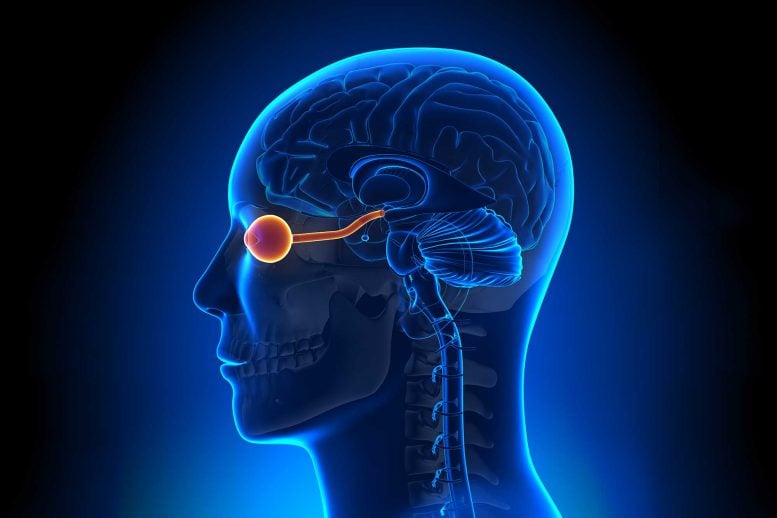
    SUNY Optometry researchers demonstrate that cortical maps for eye dominance are very diverse because the amount of cortex available to represent each binocular point varies greatly across species. Their findings were originally published in The Journal of Neuroscience. The work was done by Sohrab Najafian in the laboratory of Jose Manuel Alonso at the State University of New York College of Optometry.

    The human visual brain devotes most of its neuronal resources to process the part of the visual scene that we see with both eyes. To achieve this goal, afferents from the two eyes representing the same binocular point in visual space become close neighbors in the primary visual cortex, the first cortical recipient of visual input. In turn, the primary visual cortex carefully allocates its neuronal resources to represent stimuli within each binocular point as efficiently as possible.

    The primary visual cortex of different species achieves this goal using different strategies. In humans and macaques, the cortex splits the map of visual space in intercalated pairs of stripes for the left and right eyes forming a Zebra pattern. In carnivores, the cortex splits the map in blobs forming a Dalmatian pattern. In rodents and lagomorphs, the afferents from the two eyes mix and do not form any specific pattern. For decades, the origin of these diverse ocular cortical patterns remained a controversial puzzle.

    In a recent study that will be published in the Journal of Neuroscience on November 14, 2019, researchers found evidence that ocular dominance patterns are diverse because the amount of cortex available to represent each binocular point varies greatly across species and individual animals of the same species.

    In humans, the primary visual cortex devotes large cortical rectangles to represent each binocular point, allowing the afferents from the two eyes to form stripes running parallel along the shortest axis of the rectangle. However, in cats, the cortex devotes smaller cortical squares to represent each binocular point and the afferents are constrained to form blob patterns. Finally, in mice, the cortex is too small and the few afferents representing the same binocular point mix and form no specific pattern.

    The researchers also found that, when cortical resources decrease to represent points that are increasingly farther from the point of visual fixation, the half eye that is closest to the nose (nasal retina) dominates and gains access to more cortical space than the other half eye (temporal retina). Therefore, just as the right hand dominates motor processing in right-handed humans, the nasal retina dominates visual processing and this dominance increases with the distance from the point of fixation.

    Taken together, these results support the notion that the primary visual cortex optimizes its neuronal resources to encode as efficiently as possible the different stimulus combinations available at each binocular point of visual space. The work was done by Sohrab Najafian in the laboratory of Jose Manuel Alonso at the State University of New York College of Optometry.

    Never miss a breakthrough: Join the SciTechDaily newsletter.
    Follow us on Google and Google News.

    Eyes Neuroscience Ophthalmology Optics SUNY
    Share. Facebook Twitter Pinterest LinkedIn Email Reddit

    Related Articles

    UCLA Research Reveals “Dormant” Cones in Retinal Degeneration May Preserve Visual Function

    Human, Bird and Reptile Tears Aren’t So Different – Critical to Healthy Eyesight Across Species

    Cutting-Edge 3D Imaging Reveals How the Nose Detects Odor Combinations

    To See the Invisible – Scientific Astonishment and Two-Photon Vision

    CRISPR-Based Treatment Restores Retinal Function in Mice

    New Layer of the Human Cornea Discovered

    Females Distinguish Colors Better While Men Excel At Tracking Fast Moving Objects

    Stem Cell Biologists Grow Optic Cups From Human ESCs

    Scientists Restore Basic Elements of Vision in Live Mice

    1 Comment

    1. Dennis Schwartz on November 12, 2019 4:47 pm

      Please take me off your notification list. You should have an icon where one can un-list oneself.

      Reply
    Leave A Reply Cancel Reply

    • Facebook
    • Twitter
    • Pinterest
    • YouTube

    Don't Miss a Discovery

    Subscribe for the Latest in Science & Tech!

    Trending News

    Scientists Discover Stem Cells That Could Regrow Teeth and Bone

    Early Cannabis Use May Stall Key Brain Skills in Teens

    Popular Vitamin D Supplement Has “Previously Unknown” Negative Effect, Study Finds

    Study Reveals Malaria’s Hidden Role in Human Evolution

    The Hidden Risk of Taking Breaks From Weight-Loss Drugs Like Ozempic

    Scientists Warn That This Common Pet Fish Can Wreck Entire Ecosystems

    Scientists Make Breakthrough in Turning Plastic Trash Into Clean Fuel Using Sunlight

    This Popular Supplement May Interfere With Cancer Treatment, Scientists Warn

    Follow SciTechDaily
    • Facebook
    • Twitter
    • YouTube
    • Pinterest
    • Newsletter
    • RSS
    SciTech News
    • Biology News
    • Chemistry News
    • Earth News
    • Health News
    • Physics News
    • Science News
    • Space News
    • Technology News
    Recent Posts
    • Cancer-Like Mutations Found in the Brain May Be Driving Alzheimer’s Disease
    • A Simple Molecule Could Unlock Safer, Easier Weight Loss
    • Stretching Diamonds Unlocks Powerful New Quantum Sensing Abilities
    • This Robot Could Explore Mars 3x Faster Than Today’s Rovers
    • Scientists Just Built a Quantum Battery That Charges Almost Instantly
    Copyright © 1998 - 2026 SciTechDaily. All Rights Reserved.
    • Science News
    • About
    • Contact
    • Editorial Board
    • Privacy Policy
    • Terms of Use

    Type above and press Enter to search. Press Esc to cancel.