

Lightweight wireless network enables precise mapping of bats’ social networks.
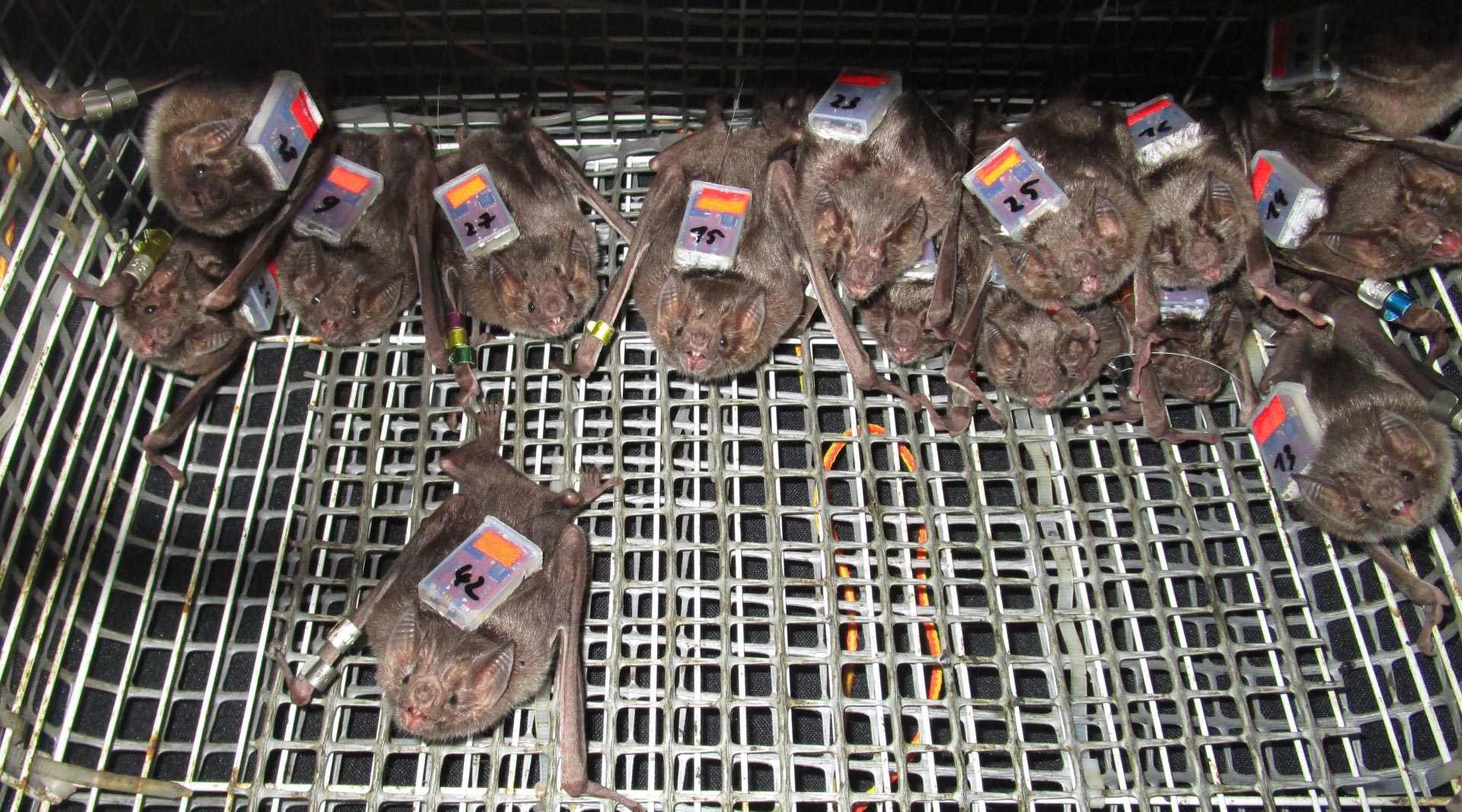
To truly understand an animal species is to observe its behavior and social networks in the wild. With new technology described in PLOS Biology on April 2, 2020, researchers are able to track tiny animals that divide their time between flying around in the sky and huddling together in caves and hollow trees – by attaching little backpacks to them with glue.
These high-tech backpacks, which can communicate with each other and ground-based receivers, provided data for the popular study published on Halloween in 2019 showing that vampire bats developed social bonds in captivity that they maintained in the wild.
The wireless network developed by a team of engineers, computer scientists and biologists contains functions similar to what we find in our smartphones – such as motion detection and Bluetooth-style connectivity – at a fraction of the weight and energy consumption.
Keeping the system automated and lightweight was critical to the success of the network to track adult vampire bats, which weigh between 1 and 1.5 ounces (28 and 43 grams) and grow to 3½ inches (9 centimeters) in length. Using devices that can track larger animals, such as those incorporated into harnesses or necklaces, wouldn’t work for bats or other small species.
“Using backpacks on bats saves weight and it also makes sure the sensors fall off easily,” said Simon Ripperger, lead author of the paper and a postdoctoral scholar in evolution, ecology, and organismal biology at The Ohio State University. “We don’t really want the bats to have that burden of additional weight for extended time periods.”
The sensors often get scratched off in the bats’ roost within about two weeks. The researchers retrieve them if they can to recycle the backpacks and recharge and reuse the batteries.
Though the study describes the complexity of constructing the network and testing its effectiveness on bats, the system would work for other animals, such as birds, rodents, reptiles, and amphibians, Ripperger said. Hence the team’s name for the network: Broadly Applicable Tracking System, or BATS.
When Ripperger was pursuing his Ph.D. a decade ago, he used a much more primitive system to study bats. He relied on radio-telemetry, sometimes running after the animals, tracking their flight path with an antenna in hand. At best, he might be able to calculate where they were every two minutes over a 30-meter area.
“It was a time-consuming, exhausting, and inaccurate method,” he said.
With funding from the German equivalent of the National Science Foundation, the grant’s principal investigators at the Museum of Natural History in Berlin and a number of German universities assembled an interdisciplinary team and set out to make a better system. Ripperger was a postdoc at the time at the natural history museum, and is still a visiting scientist there.
The work took about seven years, with computer scientists writing code from scratch to come up with the highest-performance network possible using ultra-low levels of energy. The capacity of each battery that powers the network amounts to about 5 percent of a AAA battery’s capacity.
The network consists of the tiny computers – accelerometers producing data when the bats are moving and proximity sensors to show when they are close to each other – all encased in each 3D-printed plastic backpack that weighs less than a penny. A series of base stations on the ground pick up signals and record data on bats’ social activities and flight trajectories. The components are asleep most of the time, waking up when they receive a signal from another bat and then broadcasting every two seconds.
“One key advantage of our system is these wake-up receivers. They are in energy-saving mode and only wake up when they receive a signal from another bat, and then they are shouting, ‘I’m here, I’m here!’ and there’s another receiver that comes into full consciousness and exchanges data,” Ripperger said. “That’s one way we conserve power consumption.”
Despite the low power, the network produced robust results in various studies of different species of bats. A two-week test in which 50 vampire bats were tagged produced data on almost 400,000 individual meetings. Researchers can download all the data from the system onto their phones in the field.
Ripperger described BATS and GPS, the most commonly used method for tracking animals on a grander scale, as highly complementary systems, with BATS able to collect signals in places where GPS cannot.
“If you want to study social behavior, once a bat enters a cave or tree trunk, a GPS logger doesn’t give us information because the signal from the satellite gets interrupted. But inside the roost is where all the social behavior is happening,” he said. “These are really two different approaches to studying animal behavior.”
There is a definite novelty to learning about how vampire bats interact, but the research also has shown remarkable similarities between their social behavior and certain aspects of human relationships. Using this system to tag vampire bats and the cattle they feed on can also help scientists better understand the spread of rabies, Ripperger said. He and colleagues are currently designing a conservation study to tag protected sand lizards living near railway lines in Germany to determine how track maintenance affects their movement.
Reference: “Thinking small: Next-generation sensor networks close the size gap in vertebrate biologging” by Simon P. Ripperger, Gerald G. Carter, Rachel A. Page, Niklas Duda, Alexander Koelpin, Robert Weigel, Markus Hartmann, Thorsten Nowak, Jörn Thielecke, Michael Schadhauser, Jörg Robert, Sebastian Herbst, Klaus Meyer-Wegener, Peter Wägemann, Wolfgang Schröder-Preikschat, Björn Cassens, Rüdiger Kapitza, Falko Dressler and Frieder Mayer, 2 April 2020, PLOS Biology.
DOI: 10.1371/journal.pbio.3000655
This work was supported by the German Research Foundation, a Smithsonian Institution Scholarly Studies Grant and a National Geographic Society Research Grant.
Gerald Carter of Ohio State co-authored the study. Additional co-authors were from the Smithsonian Tropical Research Institute in Panama and the Museum of Natural History, Friedrich-Alexander University Erlangen–Nürnberg, Brandenburg University of Technology, Technische Universität Braunschweig, Paderborn University and the Berlin-Brandenburg Institute of Advanced Biodiversity Research in Germany.
Never miss a breakthrough: Join the SciTechDaily newsletter.
Follow us on Google and Google News.