
Close Menu
    Facebook X (Twitter) Instagram
    SciTechDaily
    • Biology
    • Chemistry
    • Earth
    • Health
    • Physics
    • Science
    • Space
    • Technology
    Facebook X (Twitter) Pinterest YouTube RSS
    SciTechDaily
    Home»Space»Hubble Captures Image of NGC 891 in the Constellation of Andromeda
    Space

    Hubble Captures Image of NGC 891 in the Constellation of Andromeda

    By NASAMay 21, 2012No Comments2 Mins Read
    Facebook Twitter Pinterest Telegram LinkedIn WhatsApp Email Reddit
    Share
    Facebook Twitter LinkedIn Pinterest Telegram Email Reddit
    close-up of NGC 891
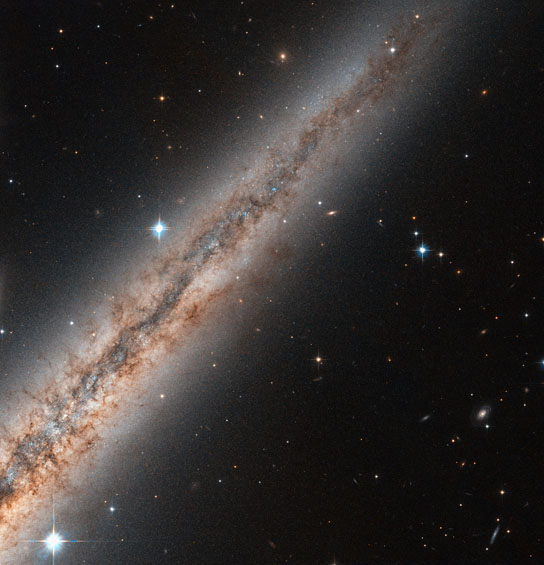
    Spiral galaxy NGC 891 is located about 30 million light-years away in the constellation of Andromeda. close-up of NGC 891 Credit: ESA/Hubble & NASA

    The Hubble Space Telescope captured this image of galaxy NGC 891, which is part of a small group of galaxies bound together by gravity in the constellation of Andromeda.

    Visible in the constellation of Andromeda, NGC 891 is located approximately 30 million light-years away from Earth. The NASA/ESA Hubble Space Telescope turned its powerful wide field Advanced Camera for Surveys towards this spiral galaxy and took this close-up of its northern half. The galaxy’s central bulge is just out of the image on the bottom left.

    The galaxy, spanning some 100,000 light-years, is seen exactly edge-on, and reveals its thick plane of dust and interstellar gas. While initially thought to look like our own Milky Way if seen from the side, more detailed surveys revealed the existence of filaments of dust and gas escaping the plane of the galaxy into the halo over hundreds of light-years. They can be clearly seen here against the bright background of the galaxy halo, expanding into space from the disk of the galaxy.

    Astronomers believe these filaments to be the result of the ejection of material due to supernovae or intense stellar formation activity. By lighting up when they are born, or exploding when they die, stars cause powerful winds that can blow dust and gas over hundreds of light-years in space.

    A few foreground stars from the Milky Way shine brightly in the image, while distant elliptical galaxies can be seen in the lower right of the image.

    NGC 891 is part of a small group of galaxies bound together by gravity.

    A version of this image was entered into the Hubble’s Hidden Treasures Image Processing Competition by contestant Nick Rose. Hidden Treasures is an initiative to invite astronomy enthusiasts to search the Hubble archive for stunning images that have never been seen by the general public.

    Never miss a breakthrough: Join the SciTechDaily newsletter.
    Follow us on Google and Google News.

    European Space Agency Galaxy Hubble Space Telescope NASA
    Share. Facebook Twitter Pinterest LinkedIn Email Reddit

    Related Articles

    Hubble Snaps Spiral Galaxy’s Profile – From Hydra Constellation, 80 Million Light-Years Away

    Hubble Tracks a Galaxy Moving Toward Us at Over 543,000 Miles Per Hour

    Astronomers Have Seen Signs of “Life” at the Center of Messier 110

    Hubble Image of Peculiar Galaxy Pair Arp 116

    Hubble Helps Solve the Mystery of Why Ultra-Faint Dwarf Galaxies Contain Few Stars

    Hubble Captures Image of Compact Blue Dwarf Galaxy UGC 5497

    A Spiral Within a Spiral, Galaxy ESO 498-G5

    Hubble Captures New Image of Messier 9

    Researchers Discover First Intermediate-Mass Black Hole

    Leave A Reply Cancel Reply

    • Facebook
    • Twitter
    • Pinterest
    • YouTube

    Don't Miss a Discovery

    Subscribe for the Latest in Science & Tech!

    Trending News

    Doctors May Need To Rethink Calcium and Vitamin D Recommendations After Major Review

    Scientists Discover a Hidden Cause of Cellular Aging That Can Be Reversed

    Archaeologists Have Found Something Unexpected Inside a 1,600-Year-Old Egyptian Mummy

    Scientists May Have Found a Completely New Way To Treat Depression

    New 7-Dimensional Theory May Finally Solve the Black Hole Information Paradox

    Scientists Made Older Mice Biologically Younger Using Gut Microbes

    Scientists Finally Uncover Why Ozempic Stops Working for Some People

    Wasp Colonies Explode Into Violence After Losing Their Queen

    Follow SciTechDaily
    • Facebook
    • Twitter
    • YouTube
    • Pinterest
    • Newsletter
    • RSS
    SciTech News
    • Biology News
    • Chemistry News
    • Earth News
    • Health News
    • Physics News
    • Science News
    • Space News
    • Technology News
    Recent Posts
    • Researchers Measured Alien Planet Spins and Discovered a Surprising Pattern
    • NASA’s Roman Telescope Will Search 100 Million Stars for New Worlds
    • A Cannibal Star Finally Solves One of Astronomy’s Biggest Mysteries
    • Researchers Solve the Mystery Behind a Billion-Dollar Dental Implant Disease
    • Scientists Finally Uncover How a “Forever Chemical” Causes Birth Defects
    Copyright © 1998 - 2026 SciTechDaily. All Rights Reserved.
    • Science News
    • About
    • Contact
    • Editorial Board
    • Privacy Policy
    • Terms of Use

    Type above and press Enter to search. Press Esc to cancel.