
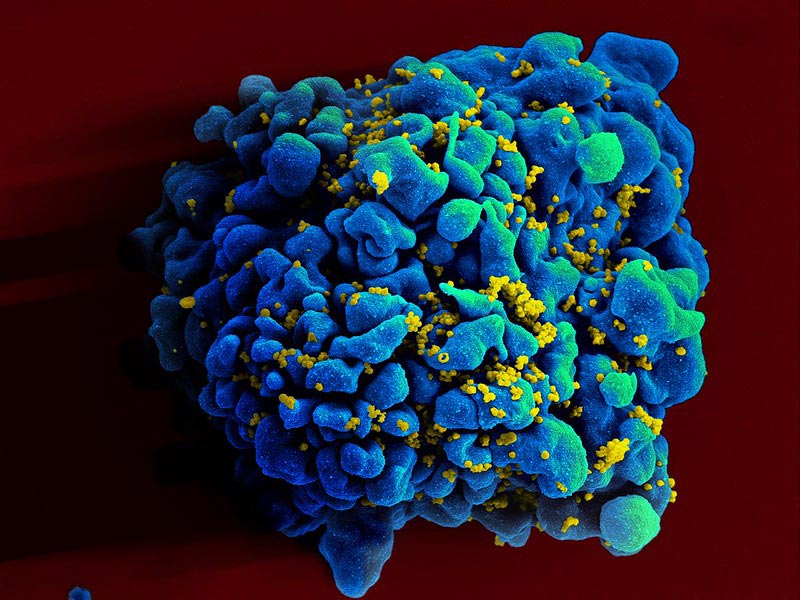
While studying 27 patients with acute HIV infection, researchers at the University of North Carolina School of Medicine found that early treatment reduced the production of latently infected cells and that there are two types of latently infected cells, one short-lived and the other a “deep” latent infection.
While current therapies are effective at controlling HIV, some virus remains hidden in certain CD4+ T cells, specialized immune system cells that the virus uses to replicate. This latent infection remains a significant challenge to curing HIV.
A team of researchers led by the University of North Carolina School of Medicine has demonstrated that latency develops soon after infection and slows when antiretroviral therapy is given.
The results were published today online in the early edition of Proceedings of the National Academy of Sciences.
The team studied 27 patients with acute HIV infection (AHI). AHI occurs soon after exposure, when virus is found in blood plasma but antibodies are not yet detectible. All but one of the patients studied had been infected in the last 45 days. The study team developed a mathematical model to predict how often latent cells were infected based on when ART was started. They found that early treatment reduced the production of latently infected cells.
In addition, the researchers found that there are two types of latently infected cells, one short-lived, but another extremely durable, what the authors refer to as a “deep” latent infection. “We found that latent infection decayed in some patients, but that all had a few deeply latent infected cells,” said David Margolis, MD, professor of medicine, microbiology and immunology, and epidemiology at UNC and senior author on the study. “These are the cells that we must eliminate to cure infection.”
The team made other hopeful observations. “The immune response of some patients appear to play a role in limiting the size of the latent reservoir,” said Nancie Archin, PhD, the study’s lead author and a research scientist at the medical school. “Efforts to improve the immune response to prevent HIV infection may also teach us to eradicate it.”
Reference: “Immediate antiviral therapy appears to restrict resting CD4+ cell HIV-1 infection without accelerating the decay of latent infection” by Nancie M. Archin, Naveen K. Vaidya, JoAnn D. Kuruc, Abigail L. Liberty, Ann Wiegand, Mary F. Kearney, Myron S. Cohen, John M. Coffin, Ronald J. Bosch, Cynthia L. Gay, Joseph J. Eron, David M. Margolis and Alan S. Perelson, 29 May 2012, Proceedings of the National Academy of Sciences.
DOI: 10.1073/pnas.1120248109
The research was conducted through the Center for HIV/AIDS Vaccine Immunology and as part of a UNC-led consortium, the Collaboratory of AIDS Researchers for Eradication (CARE), funded by the National Institute of Allergy and Infectious Diseases. The consortium is administered by the North Carolina Translational and Clinical Sciences (NC TraCS) Institute at UNC, one of 60 medical research institutions in the US working to improve biomedical research through the NIH Clinical and Translational Science Awards (CTSA) program.
Other UNC authors on the paper include Nancie Archin, PhD, Joann Kuruc, MSN, Abigail Liberty, Myron Cohen, MD, Cynthia L. Gay, MD, and Joseph Eron, MD, all of the medical school.
Funding for this research was provided by the Center for HIV/AIDS Vaccine Immunology, the National Institutes of Health, and the James B. Pendleton Charitable Trust.
Never miss a breakthrough: Join the SciTechDaily newsletter.
Follow us on Google and Google News.